This article explores the investment comparison between Hashflow (HFT) and The Graph (GRT), essential players in high-frequency trading and graph-based recommendations in modern finance. It delves into price history, technological infrastructure, market liquidity, and regulatory environments, providing insights into which asset might be a better buy now. It also covers investment strategies and potential risks, suitable for both conservative and aggressive investors. Key themes include HFT's innovative DeFi solutions and GRT's established blockchain data infrastructure. For real-time pricing, visit Gate.
Introduction: HFT vs GRT Investment Comparison
In the cryptocurrency market, the comparison between Hashflow (HFT) vs The Graph (GRT) has been an unavoidable topic for investors. The two not only show significant differences in market cap ranking, application scenarios, and price performance, but also represent different cryptocurrency asset positioning.
Hashflow (HFT): Since its launch in 2022, it has gained market recognition for its universal zk-settlement layer and RFQ liquidity provision in DeFi.
The Graph (GRT): Introduced in 2020, it has been hailed as the "Google of blockchains," serving as one of the most important indexing protocols for querying data across multiple blockchain networks.
This article will provide a comprehensive analysis of the investment value comparison between HFT and GRT, focusing on historical price trends, supply mechanisms, institutional adoption, technological ecosystems, and future predictions, attempting to answer the question investors are most concerned about:
"Which is the better buy right now?"
I. Price History Comparison and Current Market Status
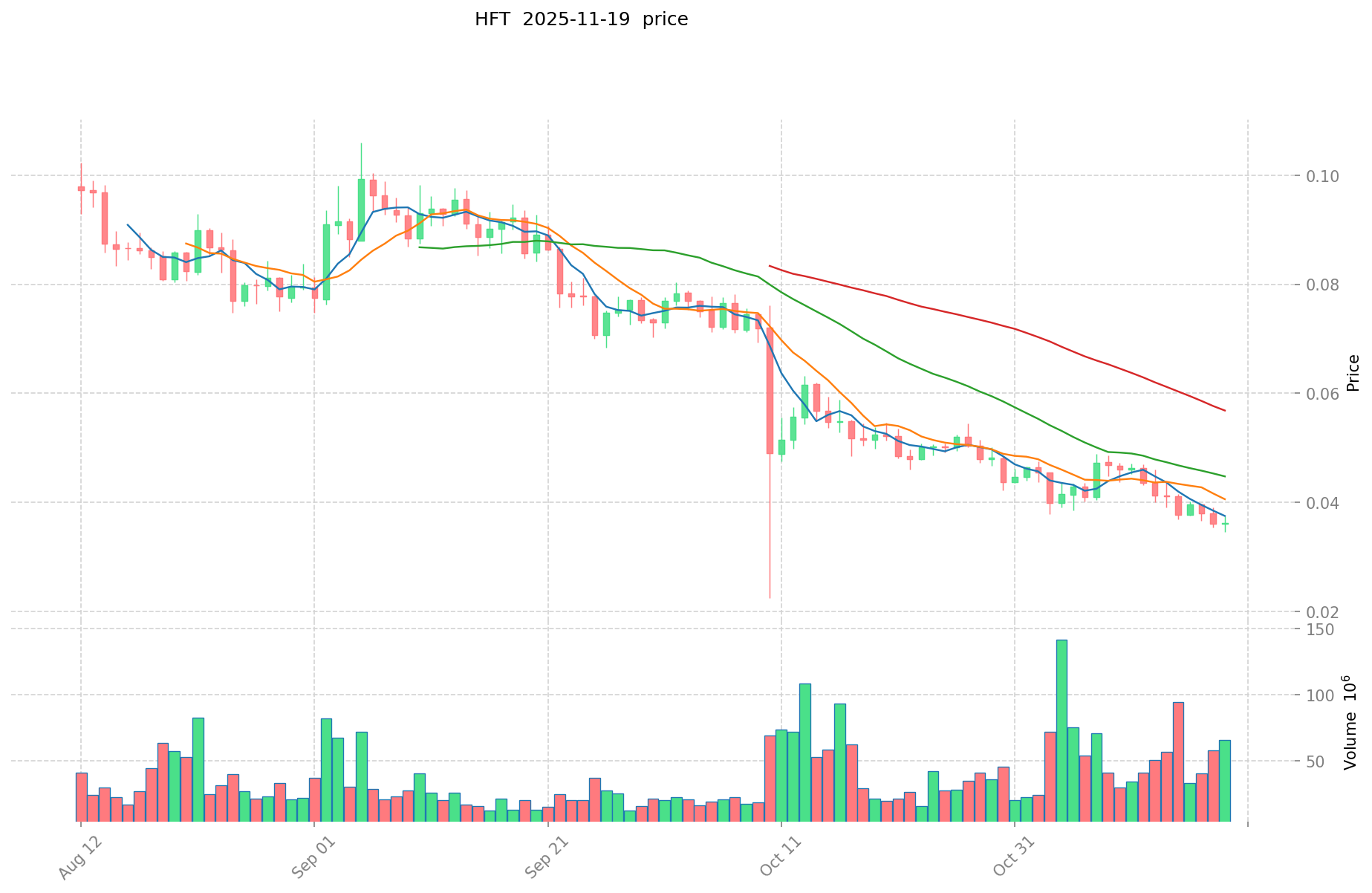
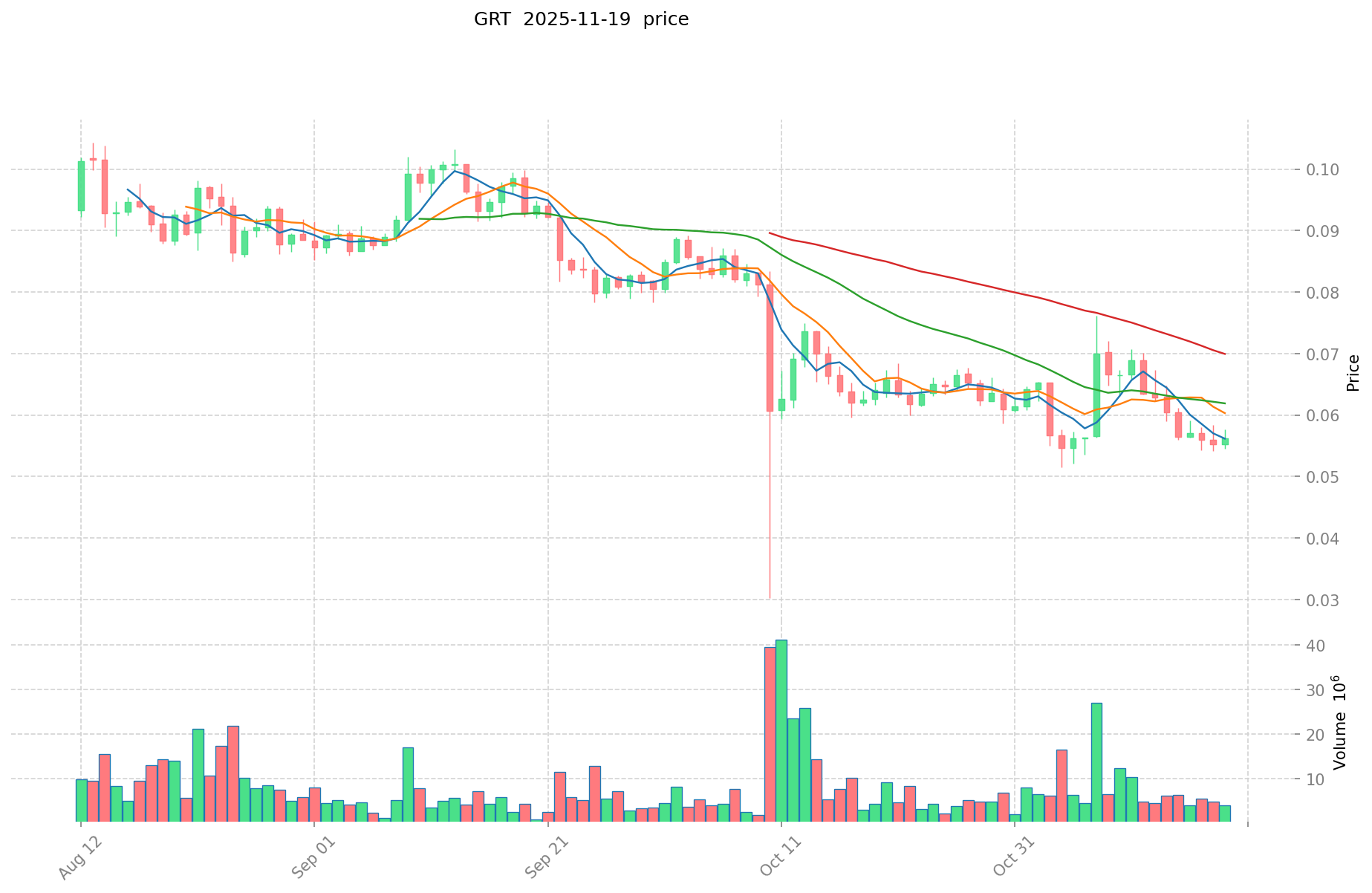
HFT and GRT Historical Price Trends
- 2022: HFT reached its all-time high of $3.61 on November 7, 2022.
- 2021: GRT peaked at $2.84 on February 12, 2021, driven by increased adoption of The Graph protocol.
- Comparative analysis: During the recent market cycle, HFT dropped from $3.61 to a low of $0.02468737, while GRT declined from $2.84 to $0.04626017.
Current Market Situation (2025-11-19)
- HFT current price: $0.03546
- GRT current price: $0.055
- 24-hour trading volume: $2,222,221 (HFT) vs $137,102 (GRT)
- Market Sentiment Index (Fear & Greed Index): 15 (Extreme Fear)
Click to view real-time prices:
- View HFT current price Market Price
- View GRT current price Market Price
Key Factors Influencing HFT and DeFi Investment Value
Technology Infrastructure Requirements
- HFT: Requires ultra-low latency systems capable of executing trades in microseconds (250μs tick-to-trade by 2009), with continuous hardware upgrades outpacing Moore's Law
- DeFi: Built on blockchain architecture with emphasis on decentralization and smart contract functionality rather than pure speed
Market Liquidity & Execution
- HFT: Depends on queue positioning in order books with first-in-first-out execution principles
- DeFi: Relies on liquidity pools and decentralized exchanges with different market structure dynamics
- 📌 Historical pattern: Higher market liquidity correlates with improved execution efficiency in both systems
- HFT: Measures performance by latency (microseconds), order execution rates, and cancellation rates
- DeFi: Focuses on transaction throughput, gas efficiency, and smart contract reliability
- Technical improvement roadmaps impact long-term viability of both technologies
Regulatory Environment
- HFT: Operates within established financial market regulations with specific speed and volatility controls
- DeFi: Faces evolving regulatory frameworks with significant jurisdictional differences
- Regulatory clarity is crucial for institutional adoption in both sectors
Data Management & Processing
- HFT: Requires sophisticated time-series databases and real-time data processing capabilities
- DeFi: Benefits from on-chain data transparency but faces challenges in scaling and processing speed
- Both require robust caching strategies and data architecture to maintain system performance
III. 2025-2030 Price Predictions: HFT vs GRT
Short-term Forecast (2025)
- HFT: Conservative $0.0294 - $0.0355 | Optimistic $0.0355 - $0.0493
- GRT: Conservative $0.0511 - $0.0550 | Optimistic $0.0550 - $0.0655
Mid-term Forecast (2027)
- HFT may enter a growth phase, with prices expected in the range of $0.0334 - $0.0628
- GRT may enter a steady growth phase, with prices expected in the range of $0.0481 - $0.0785
- Key drivers: Institutional capital inflow, ETFs, ecosystem development
Long-term Forecast (2030)
- HFT: Base scenario $0.0636 - $0.0723 | Optimistic scenario $0.0723 - $0.0846
- GRT: Base scenario $0.0670 - $0.0906 | Optimistic scenario $0.0906 - $0.1323
View detailed price predictions for HFT and GRT
Disclaimer
HFT:
| 年份 |
预测最高价 |
预测平均价格 |
预测最低价 |
涨跌幅 |
| 2025 |
0.0493172 |
0.03548 |
0.0294484 |
0 |
| 2026 |
0.045366502 |
0.0423986 |
0.038582726 |
19 |
| 2027 |
0.06275204793 |
0.043882551 |
0.03335073876 |
23 |
| 2028 |
0.07517739224565 |
0.053317299465 |
0.0437201855613 |
50 |
| 2029 |
0.080309182319156 |
0.064247345855325 |
0.0494704563086 |
81 |
| 2030 |
0.084565568982071 |
0.07227826408724 |
0.063604872396771 |
103 |
GRT:
| 年份 |
预测最高价 |
预测平均价格 |
预测最低价 |
涨跌幅 |
| 2025 |
0.06545 |
0.055 |
0.05115 |
0 |
| 2026 |
0.07166775 |
0.060225 |
0.0397485 |
9 |
| 2027 |
0.07847618625 |
0.065946375 |
0.04814085375 |
19 |
| 2028 |
0.07509973185 |
0.072211280625 |
0.04693733240625 |
31 |
| 2029 |
0.10753703910675 |
0.0736555062375 |
0.06039751511475 |
33 |
| 2030 |
0.132270558101302 |
0.090596272672125 |
0.067041241777372 |
64 |
IV. Investment Strategy Comparison: HFT vs GRT
Long-term vs Short-term Investment Strategies
- HFT: Suitable for investors focused on DeFi innovation and liquidity provision
- GRT: Suitable for investors interested in blockchain data infrastructure and long-term ecosystem growth
Risk Management and Asset Allocation
- Conservative investors: HFT: 30% vs GRT: 70%
- Aggressive investors: HFT: 60% vs GRT: 40%
- Hedging tools: Stablecoin allocation, options, cross-currency portfolio
V. Potential Risk Comparison
Market Risk
- HFT: Higher volatility due to newer market status and lower liquidity
- GRT: Susceptible to overall blockchain industry trends and adoption rates
Technical Risk
- HFT: Scalability, network stability, and smart contract vulnerabilities
- GRT: Data indexing efficiency, potential centralization of indexers
Regulatory Risk
- Global regulatory policies may impact both differently, with DeFi protocols like HFT potentially facing more scrutiny
VI. Conclusion: Which Is the Better Buy?
📌 Investment Value Summary:
- HFT advantages: Innovative DeFi solution, potential for high growth in emerging markets
- GRT advantages: Established ecosystem, critical infrastructure for blockchain data queries
✅ Investment Advice:
- Novice investors: Consider a balanced approach with a slight tilt towards GRT for its more established position
- Experienced investors: Explore a dynamic allocation strategy, adjusting based on market conditions and project developments
- Institutional investors: Consider both for diversified exposure to DeFi and blockchain infrastructure sectors
⚠️ Risk Warning: Cryptocurrency markets are highly volatile. This article does not constitute investment advice.
None
VII. FAQ
Q1: What are the main differences between HFT and GRT in terms of their technological focus?
A: HFT focuses on providing a universal zk-settlement layer and RFQ liquidity in DeFi, while GRT serves as an indexing protocol for querying data across multiple blockchain networks, often referred to as the "Google of blockchains."
Q2: How do the current market prices of HFT and GRT compare?
A: As of 2025-11-19, HFT's current price is $0.03546, while GRT's current price is $0.055.
Q3: What are the key factors influencing the investment value of HFT and GRT?
A: Key factors include technology infrastructure requirements, market liquidity and execution, technical performance metrics, regulatory environment, and data management capabilities.
Q4: What are the long-term price predictions for HFT and GRT by 2030?
A: For HFT, the base scenario predicts $0.0636 - $0.0723, with an optimistic scenario of $0.0723 - $0.0846. For GRT, the base scenario predicts $0.0670 - $0.0906, with an optimistic scenario of $0.0906 - $0.1323.
Q5: How do the investment strategies for HFT and GRT differ?
A: HFT is suitable for investors focused on DeFi innovation and liquidity provision, while GRT is suitable for those interested in blockchain data infrastructure and long-term ecosystem growth. Conservative investors might allocate 30% to HFT and 70% to GRT, while aggressive investors might allocate 60% to HFT and 40% to GRT.
Q6: What are the potential risks associated with investing in HFT and GRT?
A: Both face market risks, technical risks, and regulatory risks. HFT may have higher volatility due to its newer market status, while GRT is more susceptible to overall blockchain industry trends. Technical risks include scalability and smart contract vulnerabilities for HFT, and data indexing efficiency for GRT.
* The information is not intended to be and does not constitute financial advice or any other recommendation of any sort offered or endorsed by Gate.













