The article compares two contrasting cryptocurrency investments, HIBS and SAND, examining their market cap rankings, price performances, and application scenarios. It aims to answer which is the better buy for investors by analyzing historical price trends, supply mechanisms, institutional adoption, technology development, and macroeconomic factors. Targeted at both new and seasoned investors, the piece provides insights into investment strategies and risk management while offering price predictions up to 2030. It emphasizes market risks, technological challenges, and regulatory implications for both tokens, optimizing decision-making with strategic allocation guidance.
Introduction: HIBS vs SAND Investment Comparison
In the cryptocurrency market, the comparison between HIBS vs SAND has been an unavoidable topic for investors. The two not only show significant differences in market cap ranking, application scenarios, and price performance, but also represent different positioning in the crypto asset landscape.
Hiblocks (HIBS): Since its launch, it has gained market recognition for its role as a social media planning platform.
Sandbox (SAND): Introduced in 2020, it has been hailed as a virtual game world, becoming one of the most traded and highest market cap cryptocurrencies globally.
This article will comprehensively analyze the investment value comparison between HIBS vs SAND, focusing on historical price trends, supply mechanisms, institutional adoption, technological ecosystems, and future predictions, attempting to answer the question investors are most concerned about:
"Which is the better buy right now?"
I. Price History Comparison and Current Market Status
HIBS (Coin A) and SAND (Coin B) Historical Price Trends
- 2021: SAND experienced significant growth, reaching its all-time high of $8.4 on November 25, 2021.
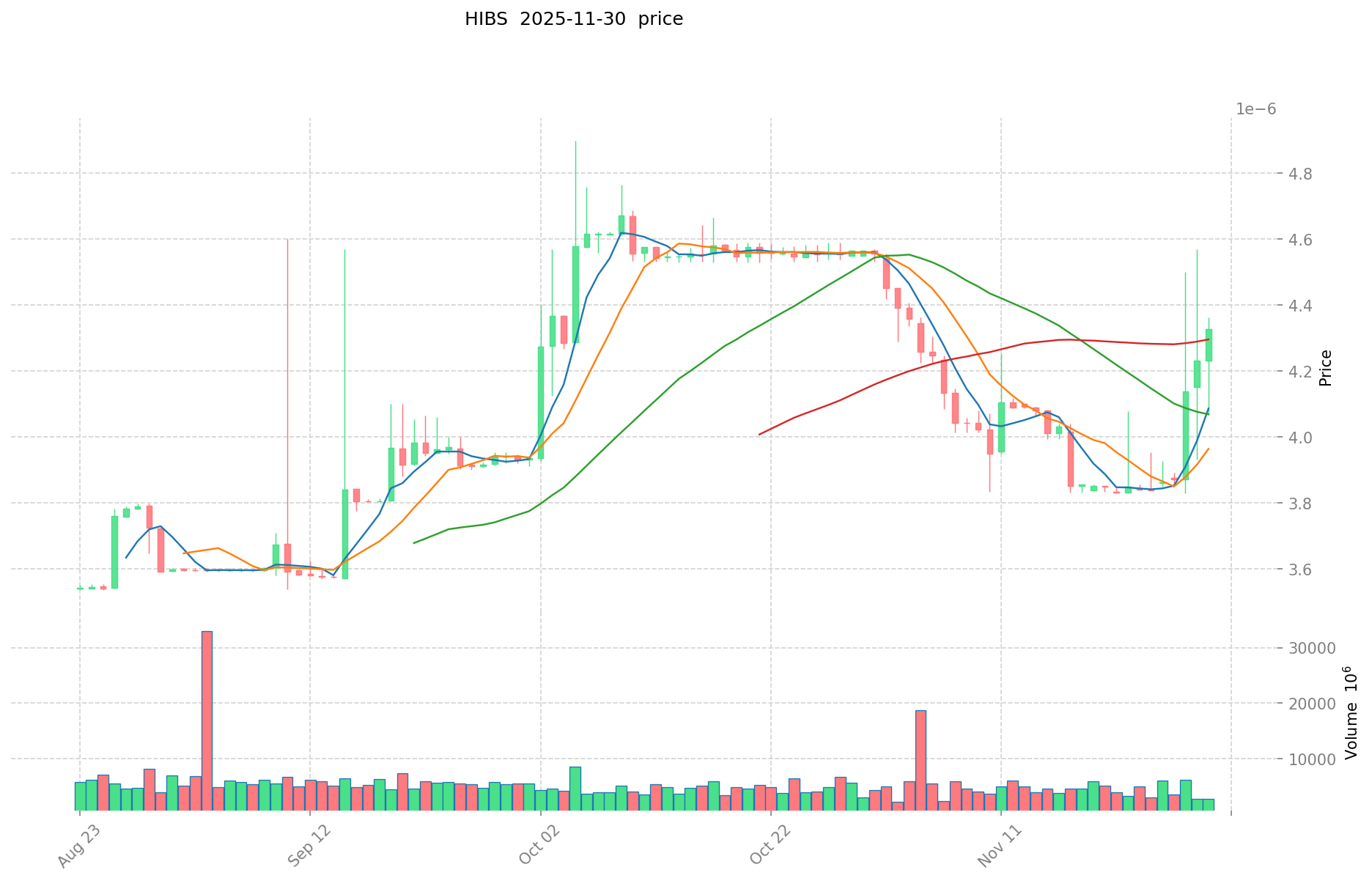
- 2025: HIBS hit its all-time low of $0.00000227 on July 29, 2025.
- Comparative Analysis: In the recent market cycle, HIBS dropped from its all-time high of $0.02503452 to its current price of $0.000004328, while SAND declined from its peak of $8.4 to the current $0.1541.
Current Market Situation (2025-11-30)
- HIBS current price: $0.000004328
- SAND current price: $0.1541
- 24-hour trading volume: HIBS $11,990.10 vs SAND $44,867.05
- Market Sentiment Index (Fear & Greed Index): 28 (Fear)
Click to view real-time prices:
- View HIBS current price Market Price
- View SAND current price Market Price

II. Core Factors Affecting the Investment Value of HIBS vs SAND
Supply Mechanism Comparison (Tokenomics)
- HIBS: Limited total supply of 1 billion tokens, with specific allocations for various ecosystem components, such as reserves, team members, and advisors.
- SAND: Maximum supply capped at 3 billion tokens, with progressive distribution through staking rewards and ecosystem growth initiatives.
- 📌 Historical pattern: Deflationary or capped supply models like these tend to create scarcity value over time, especially during periods of increased ecosystem adoption and user growth.
Institutional Adoption and Market Applications
- Institutional holdings: SAND has attracted more institutional interest through partnerships with major brands and entertainment companies developing virtual experiences on The Sandbox platform.
- Enterprise adoption: SAND is utilized for virtual land purchases, digital asset transactions, and gameplay within The Sandbox metaverse, while HIBS serves as the utility token for the Hiblocks ecosystem.
- National policies: Both tokens face varying regulatory approaches across jurisdictions, with metaverse tokens generally receiving more regulatory clarity than newer ecosystem tokens.
Technology Development and Ecosystem Building
- HIBS technology: Powers the Hiblocks ecosystem, focusing on content creator monetization and social media engagement.
- SAND technology development: Underpins The Sandbox metaverse platform, enabling virtual land ownership, asset creation, and gameplay experiences.
- Ecosystem comparison: SAND has established a more comprehensive ecosystem with virtual real estate, NFT marketplaces, and game development tools, while HIBS focuses on content creation and social media engagement tools.
Macroeconomic Factors and Market Cycles
- Performance in inflationary environments: Metaverse tokens like SAND have historically shown mixed correlation with inflation, depending more on technology adoption cycles.
- Macroeconomic monetary policy: Both tokens show sensitivity to broader crypto market trends, which are influenced by interest rates and dollar strength.
- Geopolitical factors: Growth in digital entertainment and virtual social spaces may benefit both tokens during periods of increased demand for digital experiences.
III. 2025-2030 Price Prediction: HIBS vs SAND
Short-term Prediction (2025)
- HIBS: Conservative $0.00000358145 - $0.000004315 | Optimistic $0.000004315 - $0.000005178
- SAND: Conservative $0.126198 - $0.1539 | Optimistic $0.1539 - $0.172368
Mid-term Prediction (2027)
- HIBS may enter a growth phase, with estimated price range $0.0000048642132 - $0.0000081649293
- SAND may enter a stable phase, with estimated price range $0.1027499499 - $0.1928814849
- Key drivers: Institutional capital inflow, ETFs, ecosystem development
Long-term Prediction (2030)
- HIBS: Base scenario $0.000005395188107 - $0.000008991980178 | Optimistic scenario $0.000008991980178 - $0.000011509734628
- SAND: Base scenario $0.151096678326547 - $0.23608855988523 | Optimistic scenario $0.23608855988523 - $0.292749814257685
View detailed price predictions for HIBS and SAND
Disclaimer: This analysis is based on historical data and projections. Cryptocurrency markets are highly volatile and unpredictable. This information should not be construed as financial advice. Always conduct your own research before making investment decisions.
HIBS:
| 年份 |
预测最高价 |
预测平均价格 |
预测最低价 |
涨跌幅 |
| 2025 |
0.000005178 |
0.000004315 |
0.00000358145 |
0 |
| 2026 |
0.00000683496 |
0.0000047465 |
0.0000028479 |
9 |
| 2027 |
0.0000081649293 |
0.00000579073 |
0.0000048642132 |
33 |
| 2028 |
0.000007884947504 |
0.00000697782965 |
0.00000418669779 |
61 |
| 2029 |
0.000010552571779 |
0.000007431388577 |
0.000006019424747 |
71 |
| 2030 |
0.000011509734628 |
0.000008991980178 |
0.000005395188107 |
107 |
SAND:
| 年份 |
预测最高价 |
预测平均价格 |
预测最低价 |
涨跌幅 |
| 2025 |
0.172368 |
0.1539 |
0.126198 |
0 |
| 2026 |
0.19739214 |
0.163134 |
0.08809236 |
5 |
| 2027 |
0.1928814849 |
0.18026307 |
0.1027499499 |
16 |
| 2028 |
0.227618178489 |
0.18657227745 |
0.1548549902835 |
21 |
| 2029 |
0.26508189180096 |
0.2070952279695 |
0.184314752892855 |
34 |
| 2030 |
0.292749814257685 |
0.23608855988523 |
0.151096678326547 |
53 |
IV. Investment Strategy Comparison: HIBS vs SAND
Long-term vs Short-term Investment Strategies
- HIBS: Suitable for investors focused on social media monetization potential and ecosystem growth
- SAND: Suitable for investors interested in metaverse development and virtual asset ownership
Risk Management and Asset Allocation
- Conservative investors: HIBS: 20% vs SAND: 80%
- Aggressive investors: HIBS: 40% vs SAND: 60%
- Hedging tools: Stablecoin allocation, options, cross-currency portfolios
V. Potential Risk Comparison
Market Risks
- HIBS: Higher volatility due to lower market cap and trading volume
- SAND: Susceptibility to overall crypto market trends and metaverse sector performance
Technical Risks
- HIBS: Scalability, network stability
- SAND: Smart contract vulnerabilities, platform adoption challenges
Regulatory Risks
- Global regulatory policies may impact SAND more due to its higher profile and metaverse focus
VI. Conclusion: Which Is the Better Buy?
📌 Investment Value Summary:
- HIBS advantages: Potential for growth in social media monetization, lower entry price
- SAND advantages: Established metaverse platform, brand partnerships, higher liquidity
✅ Investment Advice:
- New investors: Consider a small allocation to SAND as part of a diversified crypto portfolio
- Experienced investors: Explore both HIBS and SAND, with a higher weight on SAND
- Institutional investors: Focus on SAND due to its more established ecosystem and liquidity
⚠️ Risk Warning: Cryptocurrency markets are highly volatile. This article does not constitute investment advice.
None
VII. FAQ
Q1: What are the main differences between HIBS and SAND?
A: HIBS is a social media planning platform token, while SAND is a metaverse gaming token. SAND has a larger market cap, higher trading volume, and more established ecosystem compared to HIBS.
Q2: Which token has performed better historically?
A: SAND has shown stronger historical performance, reaching an all-time high of $8.4 in November 2021. HIBS, on the other hand, hit its all-time low of $0.00000227 in July 2025.
Q3: How do the supply mechanisms of HIBS and SAND differ?
A: HIBS has a limited total supply of 1 billion tokens, while SAND has a maximum supply capped at 3 billion tokens. Both use deflationary or capped supply models to create scarcity value over time.
Q4: Which token has attracted more institutional interest?
A: SAND has attracted more institutional interest through partnerships with major brands and entertainment companies developing virtual experiences on The Sandbox platform.
Q5: What are the key factors affecting the investment value of HIBS and SAND?
A: Key factors include supply mechanisms, institutional adoption, technology development, ecosystem building, and macroeconomic factors such as inflation and monetary policy.
Q6: What are the predicted price ranges for HIBS and SAND in 2030?
A: For HIBS, the base scenario predicts $0.000005395188107 - $0.000008991980178, with an optimistic scenario of $0.000008991980178 - $0.000011509734628. For SAND, the base scenario predicts $0.151096678326547 - $0.23608855988523, with an optimistic scenario of $0.23608855988523 - $0.292749814257685.
Q7: How should investors allocate their portfolio between HIBS and SAND?
A: Conservative investors might consider allocating 20% to HIBS and 80% to SAND, while aggressive investors might opt for 40% HIBS and 60% SAND. However, individual allocations should be based on personal risk tolerance and investment goals.
Q8: What are the potential risks associated with investing in HIBS and SAND?
A: Risks include market volatility, technical challenges such as scalability and smart contract vulnerabilities, and regulatory uncertainties. HIBS may face higher volatility due to its lower market cap, while SAND may be more susceptible to overall crypto market trends and metaverse sector performance.
* The information is not intended to be and does not constitute financial advice or any other recommendation of any sort offered or endorsed by Gate.














