This comprehensive guide compares KAITO and GRT, two distinct blockchain solutions dominating the data infrastructure landscape. KAITO, launched in 2025, operates as an AI-powered InfoFi network rewarding community engagement, currently trading at $0.54 with $6.17M daily volume. GRT (The Graph), established since 2020, provides decentralized data indexing services across Web3 ecosystems at $0.04 with established infrastructure integration. The article analyzes historical price performance, tokenomics mechanisms, institutional adoption, technical ecosystem development, and 2026-2031 price projections to determine investment suitability. Through strategic asset allocation frameworks and detailed risk assessments, this analysis addresses critical investment decisions for novice, experienced, and institutional investors navigating between early-stage community-driven projects versus proven infrastructure protocols on Gate.
Introduction: Investment Comparison Between KAITO and GRT
In the cryptocurrency market, the comparison between KAITO vs GRT has become a topic of interest for investors. Both projects exhibit distinct differences in market cap ranking, application scenarios, and price performance, representing different positioning within the crypto asset landscape.
KAITO: Launched in 2025, this project has attracted market attention by positioning itself as an AI-powered InfoFi network designed to redistribute attention and capital more efficiently while rewarding participants.
GRT (The Graph): Since its launch in 2020, The Graph has established itself as a decentralized protocol for indexing and querying blockchain data, primarily serving the Ethereum ecosystem and making data queries more accessible.
This article will provide a comprehensive analysis of KAITO vs GRT investment value comparison through historical price trends, supply mechanisms, institutional adoption, technical ecosystem, and future outlook, attempting to address investors' most pressing question:
"Which is the better buy right now?"
I. Historical Price Comparison and Current Market Status
KAITO (Coin A) and GRT (Coin B) Historical Price Trends
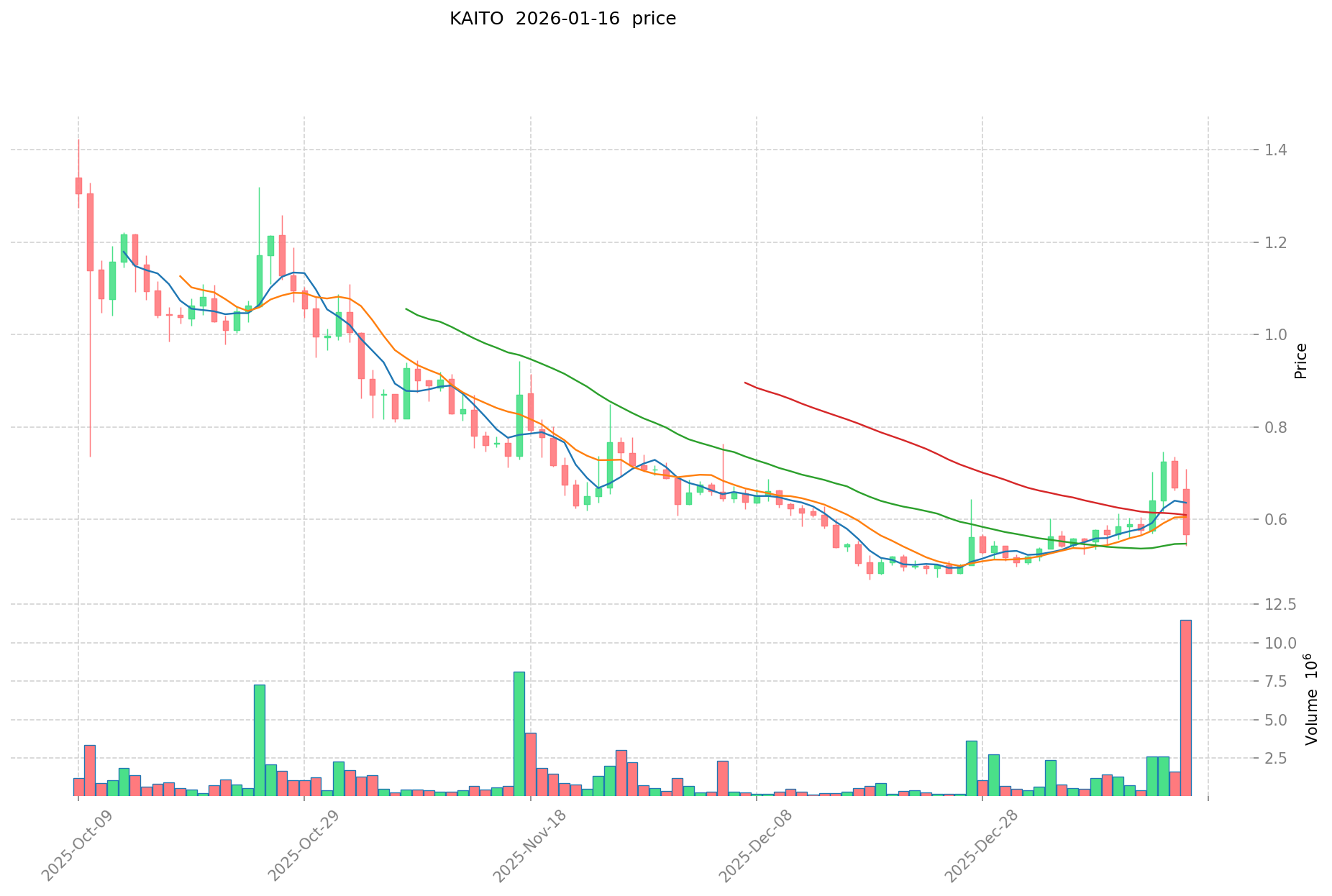
- 2025: KAITO experienced notable price volatility following its launch in February 2025, with the token reaching a peak of $2.92 during late February before declining substantially.
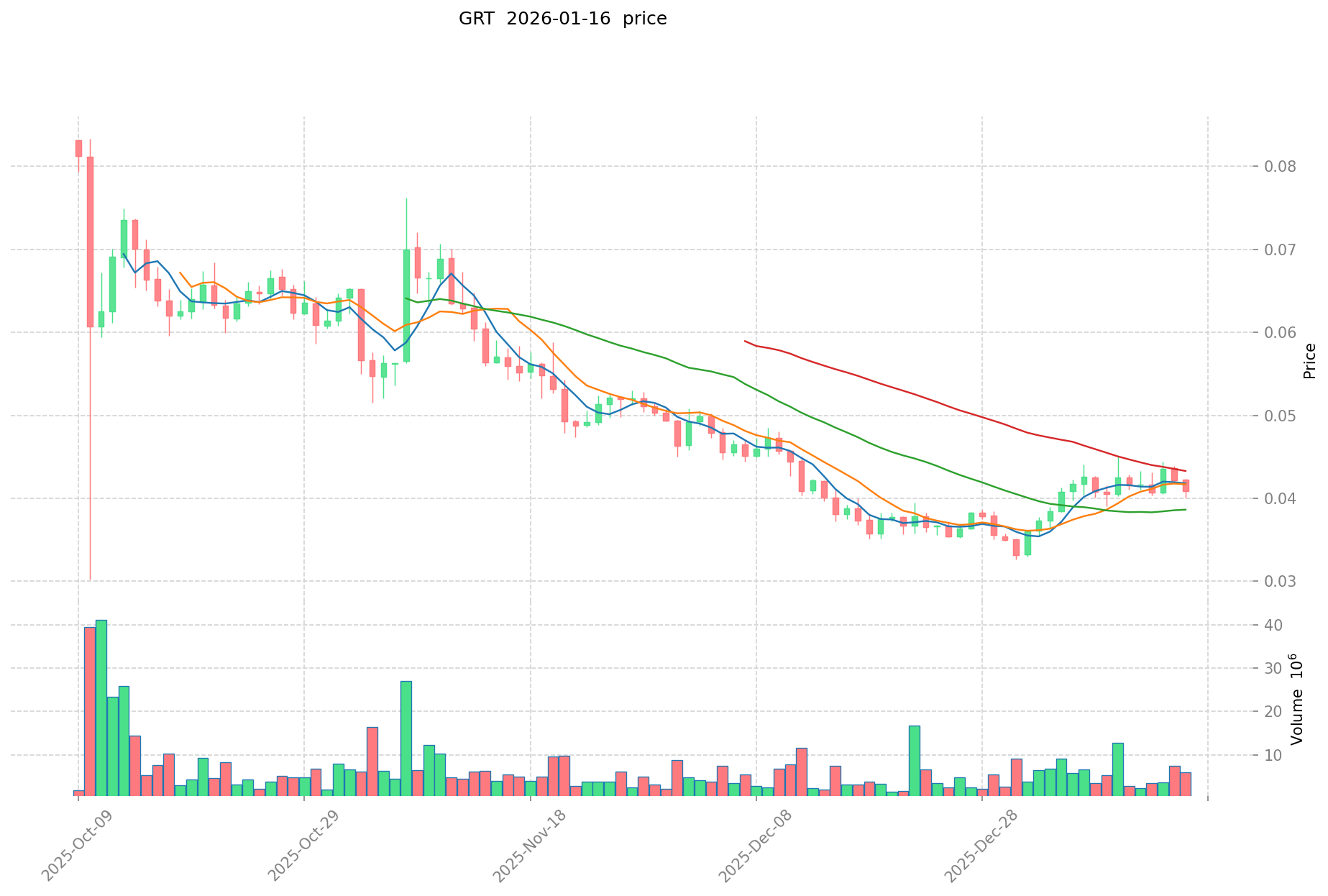
- 2021-2025: GRT demonstrated significant price fluctuations, reaching its historical high of $2.84 in February 2021, followed by a prolonged downward trend through subsequent years.
- Comparative Analysis: During the recent market cycle, KAITO declined from its peak of $2.92 to approximately $0.54, representing a substantial correction. In contrast, GRT has experienced a more extended decline from its 2021 peak of $2.84 to around $0.04, reflecting different market dynamics and adoption trajectories.
Current Market Status (2026-01-17)
- KAITO current price: $0.54
- GRT current price: $0.04
- 24-hour trading volume: KAITO $6.17M vs GRT $0.24M
- Market Sentiment Index (Fear & Greed Index): 49 (Neutral)
View real-time prices:
II. Core Factors Influencing KAITO vs GRT Investment Value
Tokenomics Comparison
-
KAITO: The token's design philosophy centers on rewarding community participation, moving beyond capital as the sole measurement standard to recognize and incentivize members who are most relevant, loyal, and influential to the project. The value proposition is closely tied to community engagement metrics rather than traditional supply constraints.
-
GRT: According to reference materials, GRT maintains a circulating supply representing approximately 91% of total supply, indicating a high degree of value release. The token operates within The Graph's decentralized indexing protocol, with supply dynamics influenced by network query demand and staking mechanisms.
-
📌 Historical Pattern: Supply mechanisms interact with adoption cycles to drive price movements, though both tokens exhibit significant volatility influenced by broader market conditions.
Institutional Adoption and Market Applications
-
Institutional Holdings: Reference materials do not provide specific comparative data on institutional preference between KAITO and GRT.
-
Enterprise Adoption: GRT demonstrates practical application in blockchain data indexing services, with query volume reportedly increasing substantially year-over-year. The Graph has integrated with Chainlink CCIP (as of May 2024), enabling cross-chain asset flow across Ethereum and Polygon networks. This integration has been recognized as enhancing GRT's utility in DeFi and Web3 ecosystems, potentially supporting asset management and settlement scenarios.
-
Regulatory Environment: Both tokens are subject to varying government policies on cryptocurrency, which directly affect market acceptance and valuation. Regulatory developments remain a key influence factor, though specific jurisdictional stances are not detailed in available materials.
Technical Development and Ecosystem Building
-
KAITO Technical Development: Available materials emphasize the project's focus on community-centric value attribution rather than specific technical infrastructure upgrades.
-
GRT Technical Evolution: The Graph has pursued several technical initiatives, including integration with Chainlink CCIP for enhanced cross-chain security and flexibility, introduction of GRC-20 standards, and deployment of Token API Beta. These developments aim to strengthen The Graph's infrastructure capabilities and expand its technical ecosystem.
-
Ecosystem Comparison: GRT positions itself as a "data engine" for Web3, with established applications in multi-chain indexing and mainstream DeFi protocol integration. The project supports blockchain data indexing needs across DeFi, AI, and big data sectors. KAITO's ecosystem focus appears oriented toward social engagement and community influence measurement.
Macroeconomic Factors and Market Cycles
-
Performance in Inflationary Environments: Reference materials do not provide comparative analysis of inflation-hedging properties for either token.
-
Monetary Policy Impact: Interest rates, dollar index movements, and broader macroeconomic conditions influence both assets, though specific sensitivity comparisons are not available in provided materials. Market sentiment, investor confidence, and technological progress are noted as significant value drivers for both tokens.
-
Geopolitical Considerations: Cross-border transaction demand and international developments may affect cryptocurrency adoption broadly, though token-specific impacts are not detailed in available references.
III. 2026-2031 Price Prediction: KAITO vs GRT
Short-term Forecast (2026)
- KAITO: Conservative $0.34-$0.55 | Optimistic $0.55-$0.77
- GRT: Conservative $0.035-$0.040 | Optimistic $0.040-$0.058
Mid-term Forecast (2028-2029)
- KAITO may enter a consolidation phase with projected price range of $0.47-$1.03 in 2028, potentially reaching $0.69-$0.95 in 2029
- GRT may experience gradual growth with estimated price range of $0.035-$0.077 in 2028, advancing to $0.062-$0.090 in 2029
- Key drivers: institutional capital inflows, ETF developments, ecosystem expansion
Long-term Forecast (2030-2031)
- KAITO: Baseline scenario $0.63-$0.93 | Optimistic scenario $0.93-$1.27
- GRT: Baseline scenario $0.063-$0.086 | Optimistic scenario $0.086-$0.124
View detailed price predictions for KAITO and GRT
Disclaimer: Price predictions are based on historical data analysis and market modeling. Cryptocurrency markets are highly volatile and subject to various risk factors. These projections should not be considered as investment advice. Always conduct thorough research and consult with financial professionals before making investment decisions.
KAITO:
| Year |
Predicted High Price |
Predicted Average Price |
Predicted Low Price |
Price Change |
| 2026 |
0.77112 |
0.5508 |
0.341496 |
1 |
| 2027 |
0.9451728 |
0.66096 |
0.5816448 |
21 |
| 2028 |
1.027924992 |
0.8030664 |
0.465778512 |
48 |
| 2029 |
0.95211552384 |
0.915495696 |
0.686621772 |
68 |
| 2030 |
1.073876451408 |
0.93380560992 |
0.6256497586464 |
72 |
| 2031 |
1.27487810894328 |
1.003841030664 |
0.53203574625192 |
85 |
GRT:
| Year |
Predicted High Price |
Predicted Average Price |
Predicted Low Price |
Price Change |
| 2026 |
0.0582248 |
0.03988 |
0.0354932 |
0 |
| 2027 |
0.068182836 |
0.0490524 |
0.027959868 |
23 |
| 2028 |
0.07737525576 |
0.058617618 |
0.0351705708 |
47 |
| 2029 |
0.0897552966816 |
0.06799643688 |
0.0618767575608 |
71 |
| 2030 |
0.093862281469152 |
0.0788758667808 |
0.069410762767104 |
98 |
| 2031 |
0.124371466739965 |
0.086369074124976 |
0.063049424111232 |
117 |
IV. Investment Strategy Comparison: KAITO vs GRT
Long-term vs Short-term Investment Strategies
-
KAITO: May suit investors focused on community-driven projects and social engagement metrics, particularly those interested in emerging AI-powered information networks with higher risk tolerance for early-stage assets.
-
GRT: May appeal to investors seeking exposure to blockchain infrastructure with established use cases in data indexing, particularly those interested in Web3 ecosystem development and cross-chain integration capabilities.
Risk Management and Asset Allocation
-
Conservative Investors: KAITO 20-30% vs GRT 70-80% - Higher allocation to GRT reflects its longer operational history and established infrastructure role, though both assets carry significant volatility.
-
Aggressive Investors: KAITO 50-60% vs GRT 40-50% - Balanced exposure recognizing KAITO's early-stage potential while maintaining GRT's infrastructure positioning.
-
Hedging Tools: Stablecoin allocation for liquidity management, options strategies for downside protection, cross-asset diversification to mitigate single-token concentration risk.
V. Potential Risk Comparison
Market Risks
-
KAITO: Recent launch in 2025 presents limited historical performance data, substantial price volatility observed from peak of $2.92 to current levels around $0.54, relatively lower trading volume at $6.17M may impact liquidity during market stress.
-
GRT: Extended price decline from 2021 peak of $2.84 to current levels around $0.04 reflects changing market dynamics, lower 24-hour trading volume of $0.24M compared to KAITO indicates reduced market activity, high circulating supply ratio of approximately 91% may influence price appreciation potential.
Technical Risks
-
KAITO: Limited technical infrastructure details in available materials, early-stage project faces execution risks in delivering community engagement mechanisms, scalability considerations remain unclear given recent launch.
-
GRT: Network dependency on accurate blockchain data indexing, technical integration complexity with multiple chains presents operational challenges, competition from alternative indexing solutions may impact market share.
Regulatory Risks
- Both tokens remain subject to evolving cryptocurrency regulatory frameworks across different jurisdictions, classification uncertainties may affect trading availability and institutional adoption, compliance requirements vary significantly by region and may impact accessibility for different investor categories.
VI. Conclusion: Which Is the Better Buy?
📌 Investment Value Summary:
-
KAITO Strengths: Early-stage positioning in AI-powered information networks, community-centric value model emphasizing engagement metrics, current price of $0.54 reflects significant discount from February 2025 peak.
-
GRT Strengths: Established blockchain data indexing infrastructure with operational history since 2020, technical integrations including Chainlink CCIP enhance cross-chain capabilities, practical applications in Web3 ecosystem with year-over-year query volume growth.
✅ Investment Recommendations:
-
Novice Investors: Consider starting with smaller allocations to both assets, prioritize understanding fundamental differences between community-driven models and infrastructure protocols, maintain significant stablecoin reserves for risk management.
-
Experienced Investors: Evaluate portfolio diversification benefits of combining early-stage community projects with established infrastructure assets, consider technical development trajectories and ecosystem adoption metrics, implement position sizing based on individual risk tolerance and market cycle assessment.
-
Institutional Investors: Conduct comprehensive due diligence on regulatory compliance across operating jurisdictions, assess liquidity requirements against current trading volumes, evaluate alignment with broader portfolio strategy regarding infrastructure exposure versus emerging technology positioning.
⚠️ Risk Warning: The cryptocurrency market exhibits high volatility. This article does not constitute investment advice. Investors should conduct independent research and consult financial professionals before making investment decisions.
VII. FAQ
Q1: What are the key differences between KAITO and GRT in terms of core functionality?
KAITO is an AI-powered InfoFi network launched in 2025 that focuses on redistributing attention and capital while rewarding community engagement and influence, whereas GRT (The Graph) is an established decentralized protocol since 2020 that specializes in indexing and querying blockchain data across multiple chains. The fundamental distinction lies in KAITO's community-centric value attribution model versus GRT's infrastructure-focused data indexing services for Web3 ecosystems.
Q2: How do the current trading volumes compare between KAITO and GRT, and what does this indicate?
As of January 2026, KAITO demonstrates a 24-hour trading volume of $6.17M compared to GRT's $0.24M, representing approximately 25 times higher liquidity. This volume differential suggests stronger current market activity and potentially better liquidity conditions for KAITO, though both tokens experience relatively modest trading volumes compared to major cryptocurrencies. The lower volume for GRT may reflect reduced market interest following its extended price decline from 2021 peaks.
Q3: What is the price volatility comparison between KAITO and GRT since their respective launches?
KAITO has experienced substantial short-term volatility, declining from its February 2025 peak of $2.92 to approximately $0.54 (representing an 82% correction). GRT demonstrates more extended volatility over a longer timeframe, declining from its February 2021 historical high of $2.84 to current levels around $0.04 (representing a 98% decline). While KAITO shows intense short-term price movements, GRT reflects prolonged downward pressure over multiple years.
Q4: How do the tokenomics models differ between KAITO and GRT?
KAITO's tokenomics emphasize rewarding community participation based on relevance, loyalty, and influence rather than capital alone, creating a value proposition tied directly to engagement metrics. GRT operates with approximately 91% of total supply already in circulation, functioning within a decentralized indexing protocol where token dynamics are influenced by network query demand and staking mechanisms. KAITO focuses on community incentivization while GRT's model reflects traditional network utility and service provision.
Q5: What technical developments distinguish GRT's ecosystem advancement?
GRT has implemented several significant technical integrations including Chainlink CCIP integration (May 2024) enabling cross-chain asset flows across Ethereum and Polygon, introduction of GRC-20 standards, and deployment of Token API Beta. These developments position The Graph as blockchain data infrastructure supporting DeFi, AI, and big data indexing needs. In contrast, available materials for KAITO emphasize community engagement mechanisms rather than specific technical infrastructure upgrades.
Q6: What are the projected price ranges for KAITO and GRT through 2031?
For 2026, KAITO projects a conservative range of $0.34-$0.55 and optimistic range of $0.55-$0.77, while GRT estimates conservative $0.035-$0.040 and optimistic $0.040-$0.058. By 2031, KAITO's baseline scenario projects $0.63-$0.93 with optimistic potential reaching $0.93-$1.27, whereas GRT's baseline scenario estimates $0.063-$0.086 with optimistic range of $0.086-$0.124. These projections reflect KAITO's higher absolute price levels but both tokens show potential for growth under favorable market conditions.
Q7: Which asset allocation strategy is recommended for conservative versus aggressive investors?
Conservative investors may consider allocating 20-30% to KAITO and 70-80% to GRT, reflecting higher exposure to GRT's established infrastructure role and longer operational history. Aggressive investors might adopt a more balanced 50-60% KAITO and 40-50% GRT allocation, recognizing KAITO's early-stage growth potential while maintaining GRT's infrastructure positioning. Both strategies should incorporate stablecoin reserves for liquidity management and employ hedging tools to mitigate concentration risk.
Q8: What are the primary regulatory and market risks affecting both tokens?
Both KAITO and GRT face evolving cryptocurrency regulatory frameworks across different jurisdictions, with classification uncertainties potentially affecting trading availability and institutional adoption. Market-specific risks include KAITO's limited historical performance data and substantial volatility from its 2025 peak, while GRT faces extended price decline challenges and lower trading volumes. Technical risks involve KAITO's early-stage execution challenges and GRT's network dependency on accurate data indexing amid competition from alternative solutions.
* The information is not intended to be and does not constitute financial advice or any other recommendation of any sort offered or endorsed by Gate.