The article "METAL vs ZIL: The Battle of Blockchain Titans in the Gaming Industry" compares the investment value of METAL and ZIL, focusing on price trends, supply mechanisms, institutional adoption, and technological ecosystems. Targeting investors, it analyzes which asset might be the better buy currently. It covers historical data, market cycles, and offers predictions, while addressing risk management and asset allocation strategies. The article is structured to provide clear insights into the economic and technological factors affecting these two blockchain assets, aiding in investment decision-making. For real-time price updates, visit Gate.
In the cryptocurrency market, the comparison between METAL and ZIL has always been a topic that investors cannot avoid. The two not only have significant differences in market cap ranking, application scenarios, and price performance, but also represent different crypto asset positioning.
METAL (METAL): Since its launch, it has gained market recognition as an extensible zero layer blockchain.
ZIL (ZIL): Since its inception, it has been hailed as a high-throughput public blockchain platform, aiming to solve transaction speed and scalability issues.
This article will comprehensively analyze the investment value comparison between METAL and ZIL, focusing on historical price trends, supply mechanisms, institutional adoption, technological ecosystems, and future predictions, and attempt to answer the question that investors care most about:
"Which is the better buy right now?"
Here is the report based on the provided template and information:
I. Price History Comparison and Current Market Status
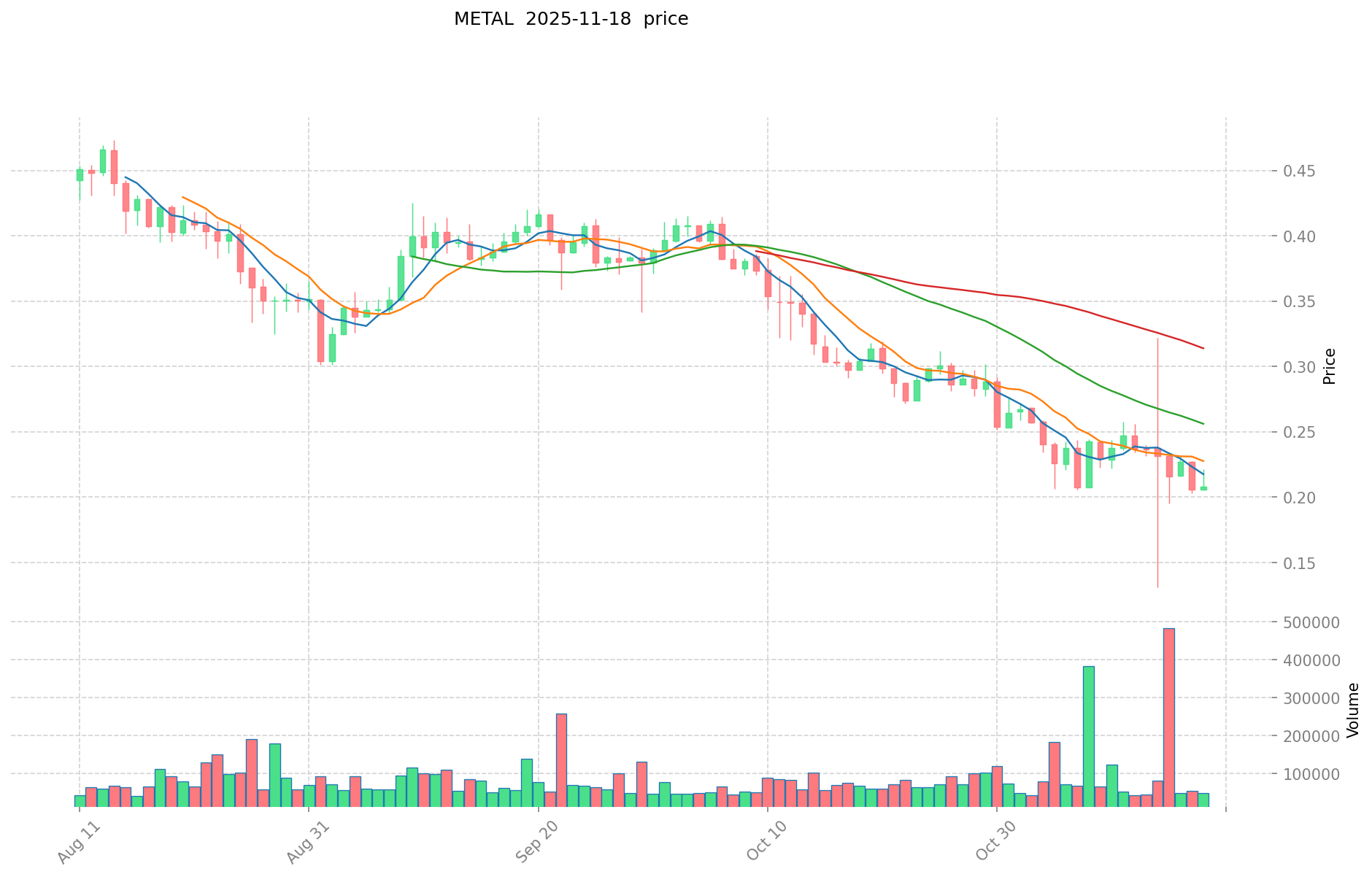
- 2022: METAL reached its all-time high of $1.6464 due to significant market interest.
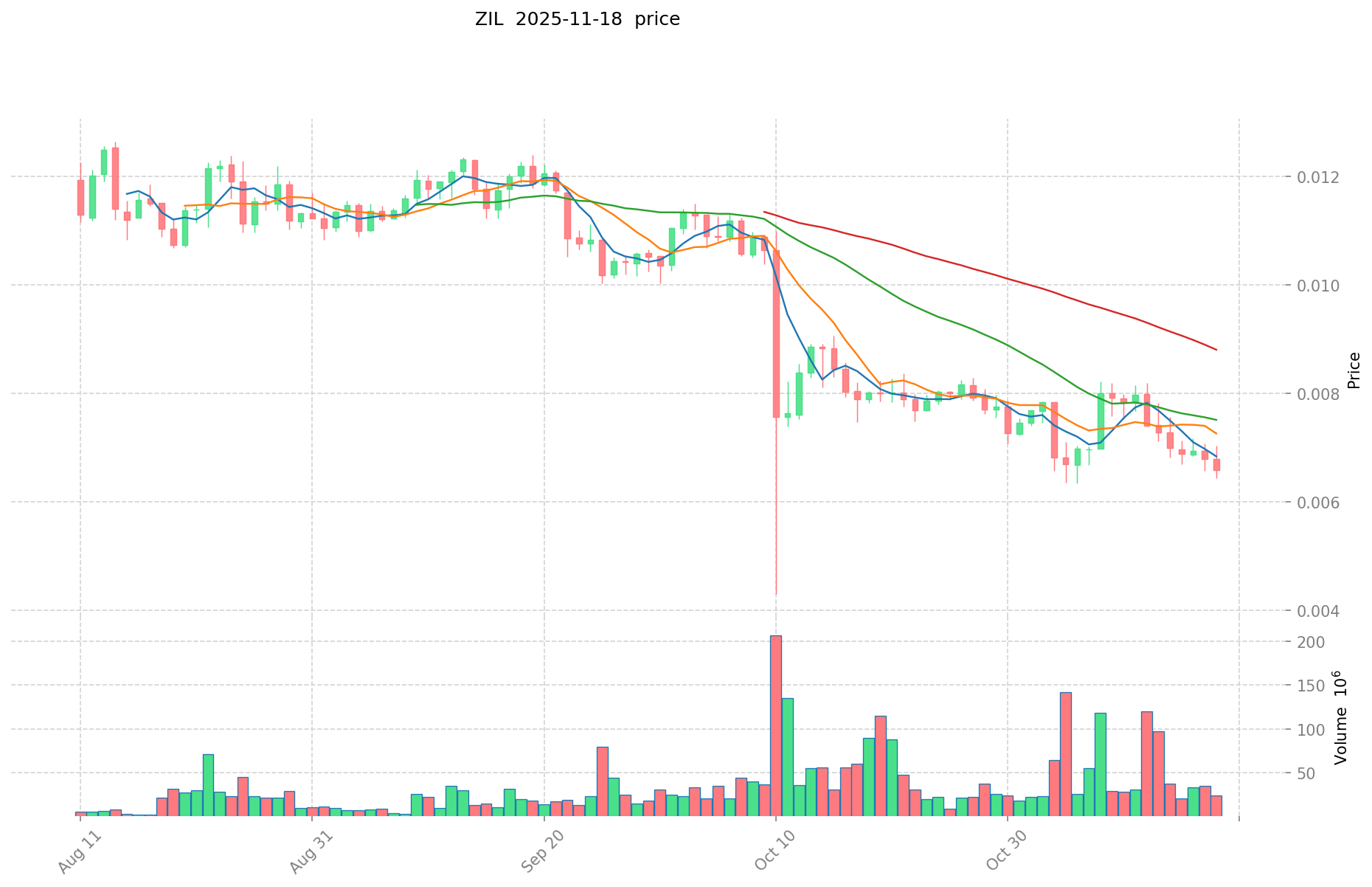
- 2021: ZIL experienced a major price surge, reaching its all-time high of $0.255376 during the bull market.
- Comparative analysis: During the recent market cycle, METAL dropped from its high of $1.6464 to a low of $0.03527, while ZIL declined from $0.255376 to $0.00239616, showing similar volatility patterns.
Current Market Situation (2025-11-18)
- METAL current price: $0.20495
- ZIL current price: $0.006606
- 24-hour trading volume: METAL $9,939.10 vs ZIL $100,007.52
- Market Sentiment Index (Fear & Greed Index): 11 (Extreme Fear)
Click to view real-time prices:
- Check METAL current price Market Price
- Check ZIL current price Market Price
Supply Mechanism Comparison (Tokenomics)
- METAL: Supply is closely tied to mining production; domestic tungsten prices have risen due to tight supply at the mining end, with previously available inventories being consumed
- ZIL: Value is primarily influenced by technological advancements and market adoption patterns
- 📌 Historical pattern: Supply constraints in METAL create cyclical price movements driven by industrial demand fluctuations
Institutional Adoption and Market Applications
- Institutional holdings: Metal assets like gold show correlation with real interest rates, affecting opportunity costs when holding such assets
- Enterprise adoption: Metal investments are driven by supply-demand dynamics in industrial applications, while ZIL adoption depends on technological integration
- Regulatory attitudes: Environmental inspections and mining safety production regulations significantly impact METAL supply and pricing
Technology Development and Ecosystem Building
- METAL innovation: Kazakhstan's Baku mine represents potential supply growth that could affect future market dynamics
- ZIL technological development: Value closely linked to ongoing technological advancements and adoption rates
- Ecosystem comparison: METAL primarily valued for industrial applications, while ZIL's ecosystem depends on technological integration
Macroeconomic Factors and Market Cycles
- Performance in inflationary environments: Gold-like metal assets can maintain real value during inflation
- Macroeconomic monetary policy: Real yields show relatively close correlation with prices of metal assets
- Geopolitical factors: Safety production concerns and environmental regulations create supply constraints that impact pricing
Short-term Prediction (2025)
- METAL: Conservative $0.16396 - $0.20495 | Optimistic $0.20495 - $0.262336
- ZIL: Conservative $0.00402173 - $0.006593 | Optimistic $0.006593 - $0.00698858
Mid-term Prediction (2027)
- METAL may enter a growth phase, with an estimated price range of $0.1667977377 - $0.3646933587
- ZIL may enter a moderate growth phase, with an estimated price range of $0.004056817946 - $0.010211990002
- Key drivers: Institutional capital inflow, ETF developments, ecosystem growth
Long-term Prediction (2030)
- METAL: Base scenario $0.45997868667135 - $0.653169735073317 | Optimistic scenario up to $0.653169735073317
- ZIL: Base scenario $0.011912922838079 - $0.016797221201692 | Optimistic scenario up to $0.016797221201692
View detailed price predictions for METAL and ZIL
Disclaimer: These predictions are based on historical data and current market trends. Cryptocurrency markets are highly volatile and subject to rapid changes. This information should not be considered as financial advice. Always conduct your own research before making investment decisions.
METAL:
| 年份 |
预测最高价 |
预测平均价格 |
预测最低价 |
涨跌幅 |
| 2025 |
0.262336 |
0.20495 |
0.16396 |
0 |
| 2026 |
0.33177306 |
0.233643 |
0.21728799 |
14 |
| 2027 |
0.3646933587 |
0.28270803 |
0.1667977377 |
37 |
| 2028 |
0.4693660068075 |
0.32370069435 |
0.2880936179715 |
57 |
| 2029 |
0.52342402276395 |
0.39653335057875 |
0.2537813443704 |
93 |
| 2030 |
0.653169735073317 |
0.45997868667135 |
0.441579539204496 |
124 |
ZIL:
| 年份 |
预测最高价 |
预测平均价格 |
预测最低价 |
涨跌幅 |
| 2025 |
0.00698858 |
0.006593 |
0.00402173 |
0 |
| 2026 |
0.0071982374 |
0.00679079 |
0.0064512505 |
2 |
| 2027 |
0.010211990002 |
0.0069945137 |
0.004056817946 |
5 |
| 2028 |
0.01092612985077 |
0.008603251851 |
0.00490385355507 |
30 |
| 2029 |
0.014061154825274 |
0.009764690850885 |
0.009374103216849 |
47 |
| 2030 |
0.016797221201692 |
0.011912922838079 |
0.009411209042082 |
80 |
Long-term vs Short-term Investment Strategies
- METAL: Suitable for investors focused on industrial applications and cyclical demand
- ZIL: Suitable for investors interested in blockchain technology development and ecosystem growth
Risk Management and Asset Allocation
- Conservative investors: METAL: 60% vs ZIL: 40%
- Aggressive investors: METAL: 40% vs ZIL: 60%
- Hedging tools: Stablecoin allocation, options, cross-currency portfolios
V. Potential Risk Comparison
Market Risks
- METAL: Volatility due to industrial demand fluctuations and supply constraints
- ZIL: Susceptibility to overall cryptocurrency market sentiment and technological adoption rates
Technical Risks
- METAL: Supply chain disruptions, mining safety issues
- ZIL: Scalability challenges, network stability
Regulatory Risks
- Global regulatory policies may have different impacts on industrial metals and blockchain technologies
VI. Conclusion: Which Is the Better Buy?
📌 Investment Value Summary:
- METAL advantages: Strong correlation with industrial demand, potential hedge against inflation
- ZIL advantages: Blockchain technology potential, ecosystem growth opportunities
✅ Investment Advice:
- New investors: Consider a balanced approach with exposure to both assets
- Experienced investors: Allocate based on risk tolerance and market cycle analysis
- Institutional investors: Evaluate METAL for portfolio diversification and ZIL for long-term blockchain potential
⚠️ Risk Warning: Cryptocurrency markets are highly volatile. This article does not constitute investment advice.
None
VII. FAQ
Q1: What are the key differences between METAL and ZIL in terms of investment potential?
A: METAL is closely tied to industrial demand and supply constraints, making it cyclical in nature. It can potentially serve as a hedge against inflation. ZIL, on the other hand, is more focused on blockchain technology development and ecosystem growth, with its value largely dependent on technological adoption and advancements.
Q2: How do the supply mechanisms of METAL and ZIL compare?
A: METAL's supply is primarily influenced by mining production and industrial demand, with factors like environmental regulations and safety concerns affecting availability. ZIL's supply is more technology-driven, with its value influenced by technological advancements and market adoption patterns.
Q3: What are the short-term price predictions for METAL and ZIL in 2025?
A: For METAL, the conservative estimate ranges from $0.16396 to $0.20495, while the optimistic range is $0.20495 to $0.262336. For ZIL, the conservative estimate is between $0.00402173 and $0.006593, with an optimistic range of $0.006593 to $0.00698858.
Q4: How do institutional adoption and market applications differ between METAL and ZIL?
A: METAL's institutional adoption is largely driven by industrial applications and supply-demand dynamics. ZIL's adoption depends more on technological integration and blockchain ecosystem development. Regulatory attitudes, particularly environmental and safety regulations, significantly impact METAL's supply and pricing.
Q5: What are the main risk factors for investing in METAL and ZIL?
A: METAL faces risks related to industrial demand fluctuations, supply chain disruptions, and mining safety issues. ZIL is more susceptible to overall cryptocurrency market sentiment, technological adoption rates, and potential scalability challenges. Both are subject to regulatory risks, though these may impact them differently.
Q6: How should investors approach asset allocation between METAL and ZIL?
A: For conservative investors, a suggested allocation might be 60% METAL and 40% ZIL. More aggressive investors might consider 40% METAL and 60% ZIL. It's important to also consider stablecoin allocation, options, and cross-currency portfolios for risk management.
Q7: Which asset might be more suitable for long-term vs. short-term investment strategies?
A: METAL may be more suitable for investors focused on long-term industrial applications and cyclical demand patterns. ZIL might appeal more to investors interested in the long-term potential of blockchain technology development and ecosystem growth. Short-term strategies for both would need to consider current market trends and volatility.
* The information is not intended to be and does not constitute financial advice or any other recommendation of any sort offered or endorsed by Gate.














