Exploring Knit Finance (KFT), the article delves into its impact on DeFi through cross-chain asset management and blockchain interoperability. It addresses challenges in decentralization, secure transactions, and market performance, offering insights for investors and developers. The structured contents highlight Knit Finance’s origins, functionality, market dynamics, ecosystem applications, community sentiment, and avenues for participation. Optimized for quick reading, it underscores KFT’s pivotal role in shaping future decentralized finance with safety and transparency. Buy KFT and engage in its governance on Gate.
Knit Finance's Positioning and Significance
In 2021, Knit Finance (KFT) was launched to address the challenges of cross-chain asset integration and DeFi accessibility. As a pioneering packaging protocol, Knit Finance plays a crucial role in creating cross-chain wrappers for multiple types of assets across various blockchain networks.
As of 2025, Knit Finance has become a notable project in the DeFi space, offering solutions for cross-chain asset management and reducing Ethereum network congestion. It has opened up new possibilities for the next trillion-dollar asset class in DeFi while minimizing risks for both individual and institutional users.
Origins and Development History
Birth Background
Knit Finance was created in 2021 with the goal of solving the limitations of single-chain asset deployment and the inefficiencies in cross-chain DeFi operations. It emerged during the DeFi boom and the growing need for interoperability between blockchain networks. Knit Finance aimed to revolutionize asset management across multiple chains by providing a secure and efficient wrapping protocol.
Important Milestones
- 2021: Mainnet launch, introducing cross-chain asset wrapping capabilities.
- 2021: The project's token, KFT, reached its all-time high of $3.33 on September 2.
- 2025: Continued development and expansion of the protocol, with a focus on enhancing DeFi accessibility across multiple chains.
With support from its community and development team, Knit Finance continues to optimize its technology, security, and real-world applications in the cross-chain DeFi space.
How Does Knit Finance Work?
Decentralized Control
Knit Finance operates on a decentralized network of computers (nodes) spread across the globe, free from the control of traditional financial institutions or governments. These nodes collaborate to validate transactions, ensuring system transparency and resilience while empowering users with greater autonomy.
Blockchain Core
Knit Finance utilizes blockchain technology to create a public, immutable digital ledger that records every transaction. Transactions are grouped into blocks and linked through cryptographic hashes, forming a secure chain. Anyone can view the records, establishing trust without intermediaries. Knit Finance's unique approach involves creating cross-chain wrappers, allowing assets to be used across different blockchain networks.
Ensuring Fairness
Knit Finance likely employs a consensus mechanism to validate transactions and prevent fraudulent activities such as double-spending. Participants in the network maintain its security through activities like staking or running nodes, potentially earning KFT rewards. The innovation lies in its ability to facilitate cross-chain asset management and DeFi operations.
Secure Transactions
Knit Finance uses public-private key encryption to protect transactions:
- Private keys (like secret passwords) are used to sign transactions
- Public keys (like account numbers) are used to verify ownership
This mechanism ensures fund security, with transactions maintaining a level of pseudonymity. Additional security features may include multi-signature capabilities or advanced encryption methods to safeguard cross-chain asset transfers.
Circulation Overview
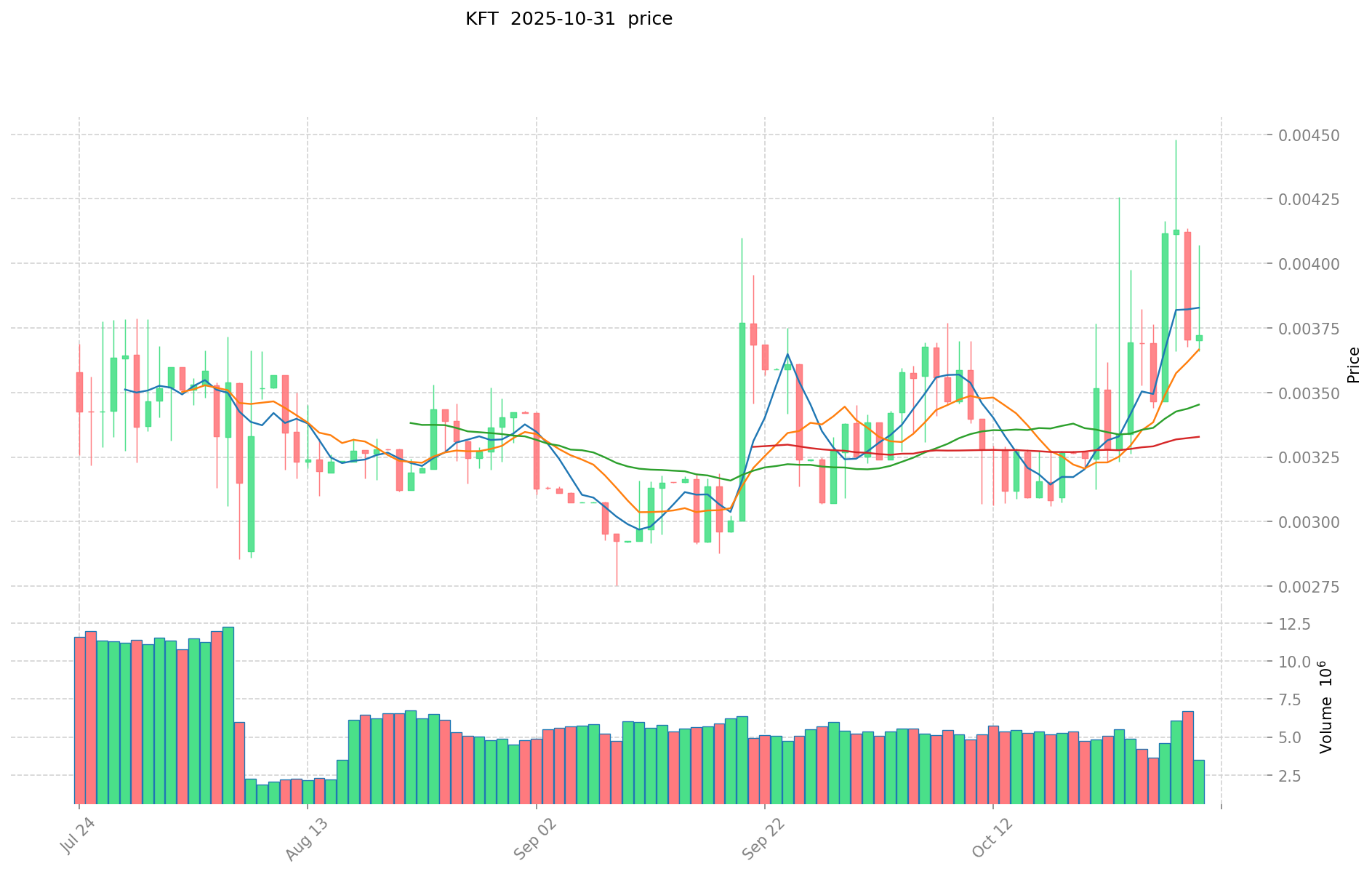
As of November 1, 2025, KFT has a circulating supply of 50,932,953.95431276 tokens, with a total supply of 100,000,000 tokens.
Price Fluctuations
KFT reached its all-time high of $3.33 on September 2, 2021, driven by market enthusiasm for cross-chain solutions.
Its lowest price was $0.0018445, occurring on November 23, 2024, likely due to broader market downturns.
These fluctuations reflect market sentiment, adoption trends, and external factors affecting the DeFi and cross-chain sectors.
Click to view the current KFT market price
On-Chain Metrics
- Daily Trading Volume: $10,391.63 (indicating network activity)
- Active Addresses: 788 (reflecting user engagement)
KFT Ecosystem Applications and Partnerships
Core Use Cases
KFT's ecosystem supports various applications:
- Cross-chain Wrapping: Knit Finance protocol, providing cross-chain wrappers for multiple types of assets.
- DeFi Integration: Facilitating DeFi expansion across multiple chains.
Strategic Collaborations
KFT has established partnerships to enhance its technical capabilities and market influence.
These partnerships provide a solid foundation for KFT's ecosystem expansion.
Controversies and Challenges
KFT faces the following challenges:
- Technical Hurdles: Potential scalability issues across multiple chains
- Regulatory Risks: Uncertainty in cross-chain asset regulations
- Competitive Pressure: Emergence of other cross-chain solutions
These issues drive ongoing discussions in the community and market, pushing KFT towards continuous innovation.
Fan Enthusiasm
KFT's community shows vigor, with growing interest in cross-chain asset wrapping.
On X platform, related posts and hashtags (such as #KnitFinance) gain traction.
New feature releases and cross-chain capabilities ignite community enthusiasm.
Sentiment on X presents a mix of opinions:
- Supporters praise KFT's cross-chain functionality and DeFi expansion potential, viewing it as a "bridge for multi-chain assets".
- Critics focus on potential risks in cross-chain operations and smart contract security.
Recent trends show growing interest in cross-chain DeFi solutions.
Hot Topics
X users actively discuss KFT's cross-chain asset wrapping, DeFi integration, and multi-chain strategy,
showcasing its transformative potential and the challenges in achieving widespread adoption.
- Official Website: Visit Knit Finance official website for features, use cases, and latest updates.
- X Updates: On X platform, Knit Finance uses @knitfinance, as of November 1, 2025 having followers,
with posts covering technical updates, community events, and partnership news.
KFT Future Roadmap
- Ecosystem Goal: Expand support for more chains and asset types
- Long-term Vision: Become a standard for cross-chain asset wrapping and DeFi integration
How to Participate in KFT?
- Purchase Channels: Buy KFT on Gate.com
- Storage Solutions: Use secure wallets for KFT storage
- Engage in Governance: Participate in community decisions through governance mechanisms
- Build the Ecosystem: Visit developer documentation to contribute to the Knit Finance ecosystem
Summary
KFT, through Knit Finance, is redefining cross-chain asset management, offering transparency, security, and efficient cross-chain transfers.
Its active community, rich resources, and strong market performance make it stand out in the cryptocurrency field.
Despite facing regulatory and technical challenges, KFT's innovative spirit and clear roadmap secure its important position in the future of decentralized technology.
Whether you're a newcomer or an experienced player, KFT is worth watching and participating in.
FAQ
What is the normal range for KFT?
KFT typically fluctuates between $0.50 and $2.00, with occasional spikes to $5.00 during high market activity periods.
What is KFT used for?
KFT is used to evaluate kidney function and overall health by measuring waste products in the blood.
What tests are done for KFT?
KFT typically includes urine and blood tests. Urine tests check for protein and waste products, while blood tests measure creatinine and urea levels to assess kidney function.
What does KFT do?
KFT analyzes blood and urine to assess kidney function, measuring waste filtration efficiency. It helps detect potential kidney issues or diseases.
* The information is not intended to be and does not constitute financial advice or any other recommendation of any sort offered or endorsed by Gate.













