# MeterStable (MTR): A Comprehensive Guide to Understanding Low-Volatility Blockchain Tokens
## Introduction
MeterStable (MTR) is a unique utility token generated through SHA256 mining within the Meter blockchain ecosystem, designed to facilitate transactions and gas payments. This comprehensive guide explores MTR's innovative energy-based economics, mining mechanisms, and market performance for investors, developers, and network participants seeking to understand alternative blockchain infrastructure tokens. Unlike traditional stablecoins, MTR grounds its value in measurable computational costs—approximately 10 kilowatt-hours of electricity per token. Whether you're interested in mining operations, smart contract execution, or governance participation through conversion to MTRG tokens, this guide provides essential insights into MTR's technical architecture, economic sustainability, and current market positioning on trading platforms like Gate. Discover how MTR bridges Bitcoin mining infrastructure with pr
MeterStable (MTR) Research Report
MeterStable's Positioning and Significance
MeterStable (MTR) is a low-volatility token generated through SHA256 mining within the Meter system. Designed to facilitate transactions and gas payments on the Meter blockchain, MTR serves as a critical infrastructure token that bridges the gap between mining economics and blockchain utility.
As of January 3, 2026, MTR operates within the Meter ecosystem, which employs a unique mining mechanism tied to Bitcoin's mainstream mining infrastructure. The token enables efficient transaction processing while maintaining economic sustainability through its direct correlation with computational costs—specifically, an average of 10 kilowatt-hours of electricity generates one MTR token.
This report provides a comprehensive analysis of MTR's technical architecture, economic model, market performance, and operational mechanisms.
Origin and Development History
Genesis and Background
MTR was created as part of the Meter system to solve the challenge of creating a stable, economically sound token that reflects real-world computational costs. Unlike traditional stablecoins pegged to fiat currency, MTR's value is grounded in the energy consumption required for its generation via SHA256 mining.
The Meter system operates with no pre-mining, ensuring a fair distribution mechanism where miners produce MTR tokens only when it remains profitable relative to Bitcoin mining. This approach aligns token supply with genuine economic utility and network security costs.
Key Characteristics
- No Pre-mining: Meter maintains complete fairness by not allocating tokens to founders or early investors before launch.
- Unlimited Supply: Unlike capped token models, MTR's total supply is unlimited (∞), allowing supply to scale with network demand and mining profitability.
- Energy-Based Economics: Each MTR token represents approximately 10 kilowatt-hours of computational work, creating intrinsic value based on real energy expenditure.
- Governance Bridge: MTR can be exchanged for MTRG (Meter's governance token) through on-chain competitive bidding, enabling token holders to participate in ecosystem governance.
How MeterStable (MTR) Operates
Decentralized Mining Architecture
MTR operates through a distributed network of miners using Bitcoin's standard mining hardware. This approach eliminates central control and ensures that token creation remains economically rational—miners only produce MTR when it generates profit compared to Bitcoin mining alternatives.
The mining process leverages proven, widely-available SHA256 ASIC hardware, reducing barriers to entry and promoting network decentralization.
Blockchain Foundation
MTR transactions are recorded on the Meter blockchain, a transparent, immutable distributed ledger. Each transaction is cryptographically verified and grouped into blocks, forming an unbreakable chain secured through advanced cryptographic hashing.
The network's transparency allows any participant to audit transaction history while maintaining the ability to transact without intermediaries.
Economic Sustainability
Unlike inflationary models that depend on fixed schedules, MTR's supply dynamically adjusts based on mining profitability. When electricity and hardware costs make MTR mining profitable relative to Bitcoin, miners increase production. When conditions become unfavorable, supply naturally contracts—creating a self-regulating economic system aligned with real-world resource constraints.
Fee and Gas Mechanism
Within the Meter system, MTR serves dual purposes:
- Transaction Fees: MTR pays all on-chain transaction costs
- Gas Payments: MTR covers computational costs for contract execution and network operations
This unified fee structure simplifies user experience and ensures transparent cost calculations tied to actual network resource consumption.
Cryptographic Security
MTR transactions employ public-key cryptography:
- Private Keys: Secure transaction signing, known only to the account holder
- Public Keys: Enable transaction verification and fund receipt without revealing private information
This mechanism ensures transaction authenticity while protecting user funds through proven cryptographic standards.
Current Market Status (As of January 3, 2026)
| Metric |
Value |
| Current Price |
$0.335 USD |
| Market Capitalization |
$131,226.54 USD |
| Circulating Supply |
391,721 MTR |
| 24-Hour Volume |
$11,848.86 USD |
| Market Dominance |
0.000004% |
| Timeframe |
Change |
| 1 Hour |
+0.58% |
| 24 Hours |
+1.00% |
| 7 Days |
+12.68% |
| 30 Days |
-49.58% |
| 1 Year |
-46.41% |
Historical Price Levels
- All-Time High: $32.69 (April 11, 2021)
- All-Time Low: $0.181504 (February 3, 2025)
- 24-Hour Range: $0.3291 - $0.335 USD
Trading and Accessibility
MTR is available for trading on Gate.com, providing users with a secure platform to buy, sell, or exchange the token. The 24-hour trading volume of approximately $11,848.86 indicates active market participation and liquidity availability.
For detailed instructions on acquiring MTR, users can reference Gate.com's comprehensive trading guides.
Technical Specifications
Conclusion
MeterStable (MTR) represents an innovative approach to blockchain token economics by grounding value in measurable, real-world resource consumption. Its energy-based mining model, unlimited supply mechanism, and integration with the Meter ecosystem create a sustainable framework for blockchain transaction settlement and gas payments.
The token's recent short-term gains (+12.68% over 7 days) contrast with significant longer-term declines, reflecting broader cryptocurrency market dynamics and evolving investor sentiment. As the blockchain industry continues to mature, MTR's unique positioning within the Meter system and its governance bridge to MTRG tokens position it as a noteworthy component of the decentralized infrastructure landscape.
Circulating Supply Overview
As of January 3, 2026, MeterStable (MTR) has a circulating supply of 391,721 tokens, with a total supply of 391,721 tokens. The maximum supply is unlimited, following an inflationary model where new tokens are generated through SHA256 mining by the Meter system.
New MTR tokens enter the market through Proof-of-Work mining, where miners utilizing Bitcoin mainstream mining hardware consume approximately 10 kilowatts of electricity to produce one MTR token. This mechanism ensures that MTR token generation is economically viable only when profitable compared to Bitcoin mining. Meter features no pre-mining, maintaining a fair distribution model where token supply is directly tied to network security and economic incentives.
Price Volatility
MTR reached its all-time high price of $32.69 on April 11, 2021, driven by early market adoption and growing interest in the Meter ecosystem's unique proof-of-work stablecoin model.
The lowest price of $0.181504 was recorded on February 3, 2025, reflecting significant market corrections and shifts in sentiment toward the project. As of January 3, 2026, MTR is trading at $0.335, representing a recovery from recent lows but still down approximately 46.41% over the past year.
These fluctuations underscore the challenges faced by novel stablecoin mechanisms in volatile crypto markets and changing investor sentiment regarding alternative stability solutions.
Check current MTR market price
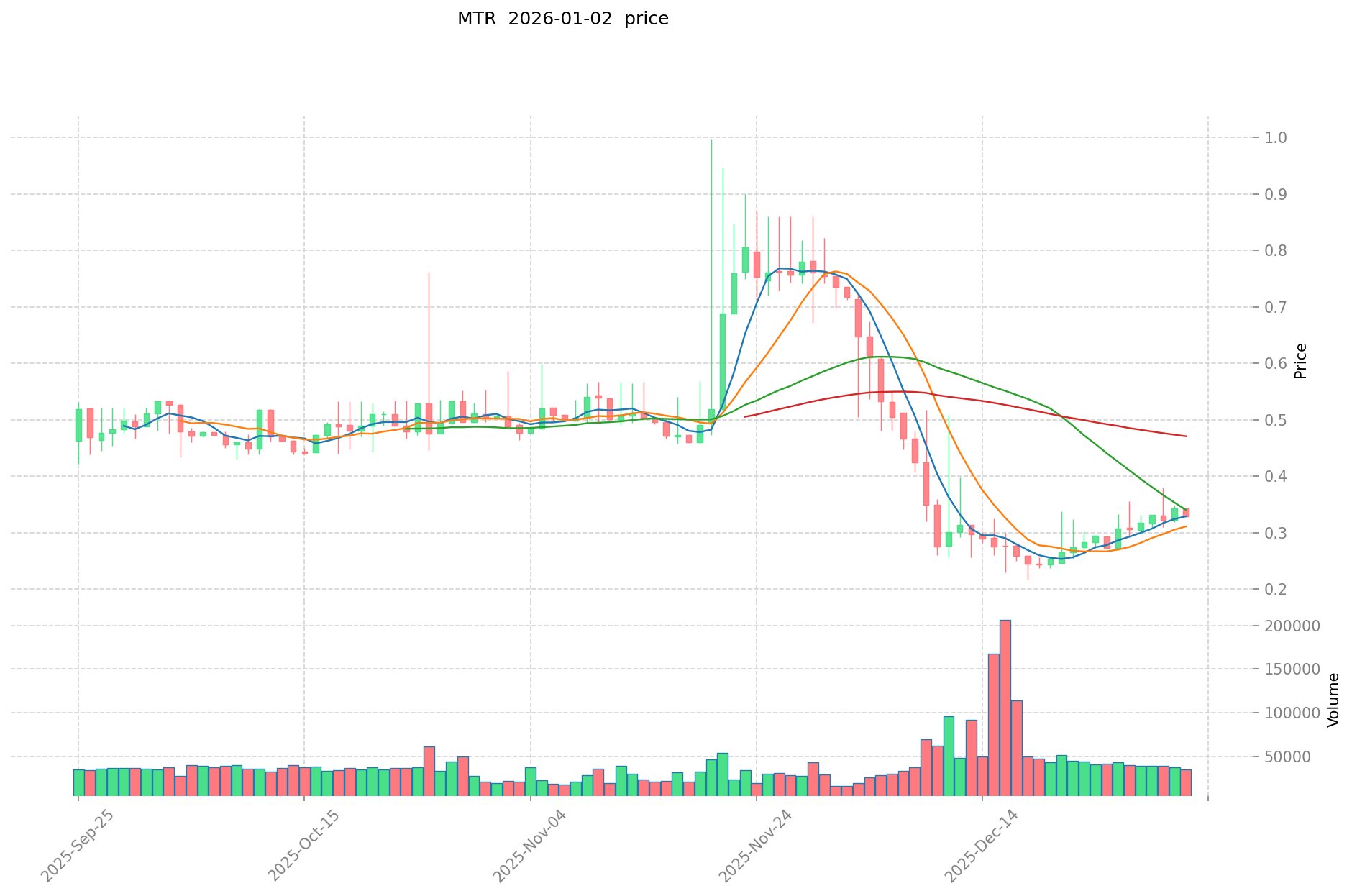
- 1 Hour: +0.58% (+$0.001932)
- 24 Hours: +1.00% (+$0.003317)
- 7 Days: +12.68% (+$0.037698)
- 30 Days: -49.58% (-$0.329419)
- 1 Year: -46.41% (-$0.290117)
Market Metrics
- Current Price: $0.335
- 24-Hour Trading Volume: $11,848.86
- Total Market Capitalization: $131,226.54
- Market Dominance: 0.000004%
- Market Ranking: #4,590
MeterStable (MTR) Research Report
Overview
MeterStable (MTR) is a low-volatility token generated through SHA256 mining within the Meter system. With a current price of $0.335 as of January 3, 2026, MTR serves as the utility token for transaction fees and gas payments on the Meter network. The token operates on a unique economic model where Bitcoin miners can profitably produce MTR tokens using standard mining equipment, consuming approximately 10 kilowatt-hours of electricity per token generated.
Key Metrics
- Current Price: $0.335
- Market Capitalization: $131,226.54
- Circulating Supply: 391,721 MTR
- All-Time High: $32.69 (April 11, 2021)
- All-Time Low: $0.181504 (February 3, 2025)
- 24-Hour Volume: $11,848.86
- Market Ranking: #4,590
Recent Price Trends
MTR exhibits mixed short-term momentum with varied performance across different timeframes:
- 1-Hour Change: +0.58% ($0.001932)
- 24-Hour Change: +1.00% ($0.003317)
- 7-Day Change: +12.68% ($0.037698)
- 30-Day Change: -49.58% ($-0.329419)
- 1-Year Change: -46.41% ($-0.290117)
Market Position
MTR maintains a modest market presence with a dominance of 0.0000040% in the broader cryptocurrency market. The token's circulating supply equals its total supply at 391,721 tokens, with no maximum supply cap, reflecting Meter's unlimited issuance model tied to profitable mining operations.
Token Economics & Mechanism
Mining-Based Emission
MTR operates on a distinctive economic model distinct from traditional blockchain tokens:
- Production Method: SHA256 mining, compatible with Bitcoin's standard mining infrastructure
- Energy Input: Approximately 10 kWh per token
- Profitability Trigger: Tokens are only produced when mining remains profitable relative to Bitcoin mining
- No Pre-mining: The Meter ecosystem contains no pre-mined tokens, ensuring fair distribution
Utility Functions
- Transaction Fees: MTR covers all network transaction costs
- Gas Payments: Smart contract execution costs are denominated in MTR
- Future Conversion: MTR can be converted through on-chain bidding to MTRG, Meter's governance token
How to Participate in MTR?
- Purchase Channels: Acquire MTR through Gate.com and other supported trading platforms
- Network Participation: Engage with the Meter ecosystem by utilizing MTR for transaction fees and smart contract interactions
- Mining Participation: Utilize existing Bitcoin mining equipment to participate in MTR production when mining economics are favorable
- Ecosystem Development: Explore opportunities within the Meter network for DApp development and protocol contributions
Summary
MeterStable (MTR) represents an innovative approach to blockchain tokenomics by leveraging existing Bitcoin mining infrastructure to create a low-volatility utility token. The token's value proposition centers on practical utility within the Meter ecosystem, where it facilitates all transaction costs and gas payments. With no pre-mining and unlimited supply tied to mining profitability, MTR operates on unique economic principles that differentiate it from conventional blockchain tokens.
The recent price recovery of 12.68% over the past seven days suggests renewed market interest, though the significant 49.58% decline over the past month reflects broader market volatility. As of January 3, 2026, MTR remains positioned as a utility-focused token within its ecosystem, valuable primarily to users and developers actively participating in the Meter network. Whether for transaction settlement, smart contract execution, or potential future conversion to governance tokens, MTR serves distinct functions within its specialized blockchain environment.
FAQ
What does MTR mean?
MTR is a cryptocurrency token native to the Meter blockchain ecosystem. It serves as the primary utility and governance token, enabling transactions, smart contract execution, and network participation within the Meter protocol infrastructure.
What are the main lines included in Hong Kong's MTR system?
Hong Kong MTR operates 17 lines including Island Line, Tsuen Wan Line, Kwun Tong Line, Central & Mid-Levels Escalator, Tung Chung Line, Airport Express, Tseung Kwan O Line, Disneyland Resort Line, South Island Line, West Island Line, Northern Line, and others serving the territory comprehensively.
How to purchase and use MTR tickets?
Purchase MTR tickets on the official website by selecting destination and ticket type, then choose your payment method to complete the transaction. After confirmation, redeem your ticket at designated locations using the QR code from your confirmation email.
What is MTR's operating time?
MTR (Mass Transit Railway) operated from October 1, 1979 to December 2, 2007, when it merged with Kowloon-Canton Railway to form the current MTR Corporation Limited, which continues operations today.
What are the advantages of MTR compared to other transportation methods?
MTR offers higher efficiency with greater capacity, avoiding surface congestion and saving urban space. It provides superior transportation capability compared to other public transit options, making it ideal for high-volume passenger movement.
What payment methods can be used on MTR?
MTR supports multiple payment options including credit cards (VISA, Mastercard), digital wallets (Apple Pay, WeChat Pay, Alipay), and contactless payment methods. Specific payment options may vary by region and transaction type.
* The information is not intended to be and does not constitute financial advice or any other recommendation of any sort offered or endorsed by Gate.