Résumé du règlement européen AML
En 2025, le Conseil de l’Union européenne a adopté le dernier règlement de lutte contre le blanchiment de capitaux (AML) — le règlement européen interdisant les paiements en espèces —, harmonisant ainsi l’interdiction des paiements en espèces supérieurs à 10 000 €. Tout commerçant, institution ou particulier effectuant une transaction en espèces au-delà de ce seuil devra passer par une banque ou un prestataire de paiement agréé. Par ailleurs, l’UE mettra en place une nouvelle autorité de supervision, l’Autorité européenne de lutte contre le blanchiment de capitaux (AMLA), qui sera pleinement opérationnelle en 2026 et assurera une surveillance unifiée des paiements transfrontaliers ainsi que des prestataires de services sur actifs numériques (VASP).
Cela marque un tournant vers un contrôle accru tant des transactions anonymes en espèces que de certains paiements cryptographiques anonymes.
Pourquoi restreindre les paiements en espèces ?
L’objectif de l’UE est de combattre le blanchiment d’argent, la fraude fiscale et le financement du terrorisme. L’argent liquide, difficilement traçable, reste depuis toujours un outil privilégié pour le blanchiment. Selon la Commission européenne, les transactions en espèces de grande valeur dissimulent souvent des fonds illicites, tandis que les paiements électroniques laissent une trace vérifiable.
Néanmoins, certains détracteurs estiment que cette politique encourage indirectement une “société sans argent liquide”. Des défenseurs de la vie privée avancent qu’elle obligera le public à dépendre des banques centralisées, au détriment de l’autonomie financière individuelle.
La frontière réglementaire entre crypto et espèces
À mesure que les limitations sur les espèces se durcissent, le marché se tourne de plus en plus vers les actifs numériques. D’un point de vue réglementaire, l’UE distingue deux grandes catégories :
- Actifs cryptographiques réglementés (par exemple, stablecoins, actifs présents sur des plateformes agréées)
- Privacy coins et transactions via des portefeuilles non enregistrés (comme Monero, Zcash, etc.)
Le nouveau dispositif AML impose formellement aux plateformes d’échange et prestataires de portefeuilles la mise en place de procédures KYC (Know Your Customer) et le signalement des transactions suspectes. Cette évolution relève nettement le niveau d’exigence pour les transferts anonymes.
Dans le même temps, la traçabilité des blockchains amène certains régulateurs à considérer que les transactions crypto conformes pourraient s’avérer plus sûres que les paiements en espèces.
Les stablecoins : une « alternative légitime » ?
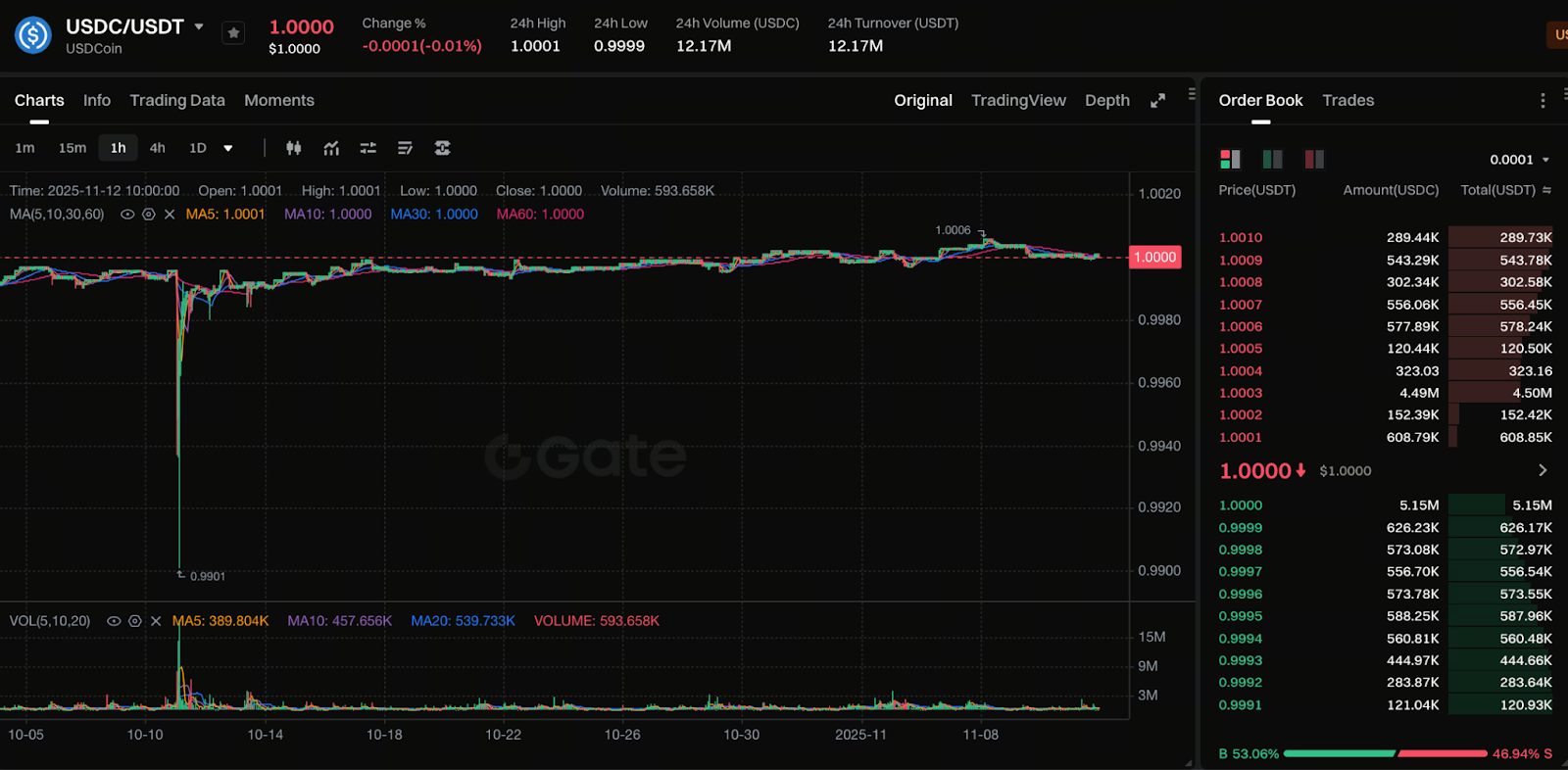
Figure : https://www.gate.com/trade/USDC_USDT
Avec les restrictions croissantes sur l’argent liquide, les stablecoins sont bien placés pour en bénéficier. Selon le cadre réglementaire MiCA (Markets in Crypto-Assets), les émetteurs de stablecoins disposant d’une licence pourront légalement assurer les paiements transfrontaliers et les règlements marchands.
À titre d’exemple :
- L’USDT / l’USDC pourraient obtenir une reconnaissance partielle en tant que moyen de paiement dans l’UE ;
- L’UE développe également des stablecoins indexés sur l’euro, tels que EUROe et Circle EURC.
Ainsi, les achats futurs en France ou en Allemagne pourraient s’effectuer via des portefeuilles Web3 conformes, remplaçant l’usage de l’espèce.
Impacts pour les investisseurs et les équipes projet
- Pour les investisseurs crypto : la montée en puissance des règles AML accroîtra les risques pour les privacy coins et plateformes sans KYC, tandis que les plateformes réglementées et les stablecoins bénéficieront d’une reconnaissance juridique renforcée.
- Pour les équipes projet Web3 : les initiatives de paiement décentralisé (passerelles DeFi, systèmes de règlement on-chain) validant leur conformité AML pourraient devenir l’ossature des paiements grand public.
- Pour les entreprises traditionnelles : les acteurs du e-commerce transfrontalier et des services devront proposer des solutions de paiement crypto conformes, sous peine d’être écartés du cadre réglementaire européen.
Conclusion
Le règlement européen interdisant les paiements en espèces ne se limite pas à restreindre l’argent liquide : il pose les bases d’un nouveau cadre pour les paiements numériques et l’écosystème crypto. Avec la baisse des transactions en espèces, particuliers et entreprises rechercheront des modes de paiement numériques plus pratiques et plus sécurisés. Cela ouvre la voie à de nouvelles opportunités réglementaires pour les stablecoins, les paiements on-chain et les infrastructures financières Web3, tout en relevant les exigences en matière de conformité pour les projets.
Dans les années à venir, l’UE s’imposera comme un terrain d’expérimentation pour la convergence entre la conformité crypto et la finance traditionnelle. Pour les investisseurs, comprendre les évolutions réglementaires et adopter un environnement blockchain plus transparent constituera la véritable “nouvelle opportunité de l’ère anti-blanchiment”.