Irys Launch Sparks Major Market Volatility — Can the New IRYS Token Hold Its Early Gains?

Beginner
Quick Reads
Last Updated 2026-03-27 08:53:23
Reading Time: 1m
Irys increased by nearly 100% immediately after launch, but subsequently declined by over 80% on its first day trading on the platform. This article breaks down the mechanisms driving IRYS and its price action, providing a clear overview of the potential opportunities and risks.

What Is Irys?


Source: https://irys.xyz/

Irys is a Layer-1 public blockchain designed as a programmable data-centric blockchain. Its core innovation lies in not only providing on-chain data storage but also enabling on-chain data access and smart contract execution through its integrated execution layer (IrysVM). This architecture targets data-intensive applications, offering a more efficient, cost-effective, and scalable foundation.

Unlike traditional solutions that combine blockchain with independent storage, Irys’s unified approach to data storage and execution dramatically reduces both storage and operational costs. This distinctive model is a key factor driving significant industry interest in the project.

IRYS Token Structure and Tokenomics

According to official tokenomics, IRYS has a total supply of 10 billion tokens, with 20% initially in circulation.

Token allocation is as follows: 30% to the ecosystem, 9.9% to the foundation, 8% for airdrops and future incentives, 8% to liquidity and launch partners, 18.8% to the team and advisors, and 25.3% to investors. Vesting schedules apply to team and investor allocations.

The network also distributes a 2% annual reward to validators (and miners, if applicable), halving every four years. Under the fee mechanism, a portion of execution fees and most storage fees are burned, creating ongoing deflationary pressure on the total supply.

This structure theoretically balances early ecosystem incentives with a long-term deflationary model, potentially supporting token value over time.

Post-Launch Price Action — Initial Surge, Then Decline

On November 25, 2025, just 24 hours after Mainnet launch, IRYS soared nearly 99% from its low. At its peak, the token traded around $0.047–$0.048.

A low initial market cap, intense market attention, and the launch event and airdrop mechanism drove rapid appreciation—all of which fueled strong buying pressure.

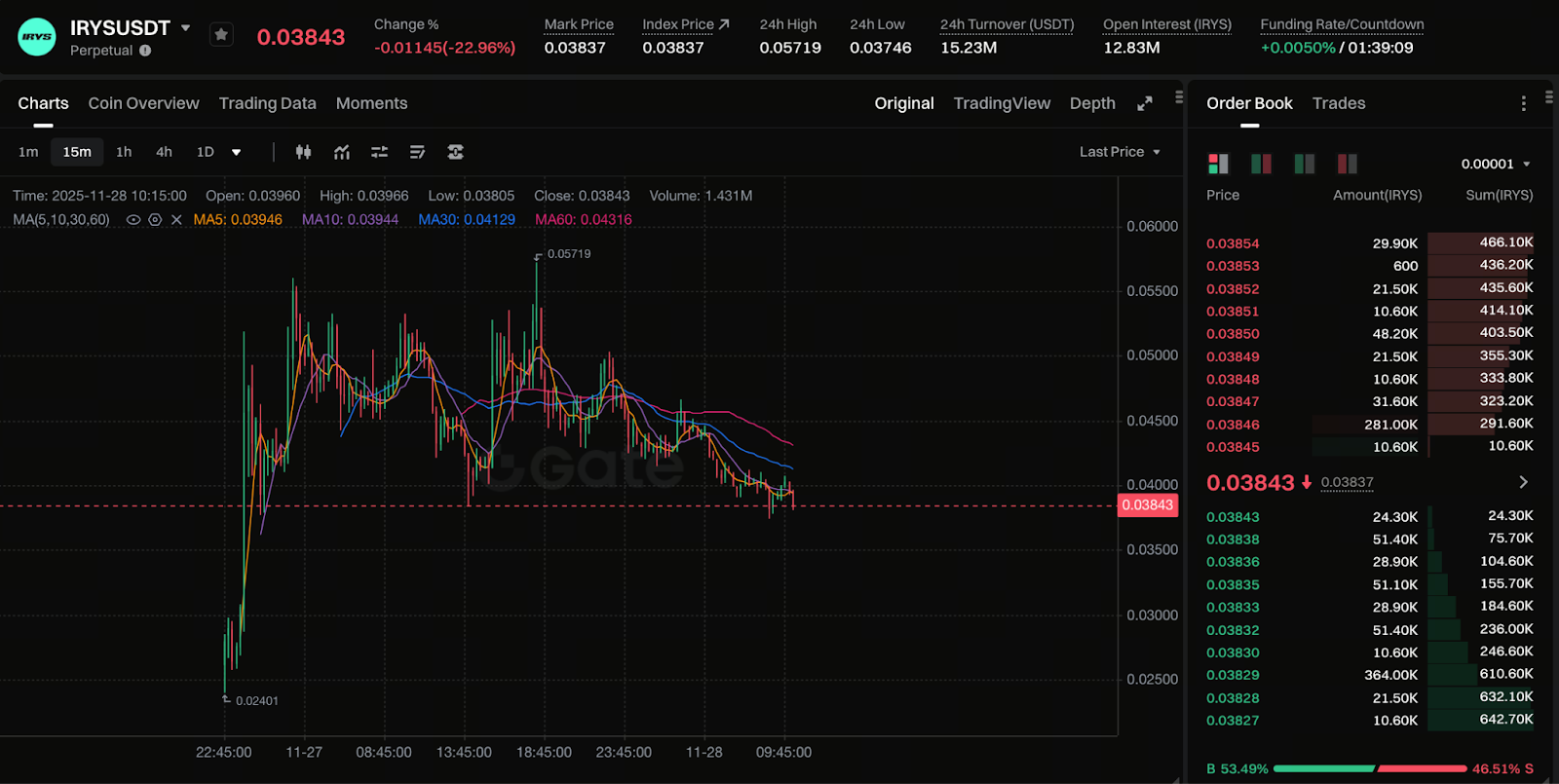
The rally, however, was short-lived. As IRYS began trading on Binance Alpha, reports indicated the token plunged roughly 85% on its first day, dropping from highs near $0.11 (according to some sources) to around $0.0135. For users who received 1,200 IRYS via airdrop, this meant potential gains of over $130 evaporated to just about $16—a textbook example of a high-risk, high-reward token launch.

Source: https://www.gate.com/futures/USDT/IRYS_USDT

As of November 28, 2025, the price stood at approximately $0.038.

Technical Analysis and Market Sentiment

Both on-chain and technical chart analysis reveal that IRYS’s early price action displayed the classic traits of a new token: high volatility and low liquidity. Professional assessments indicate that, while prices often spike post-launch, trading volume and capital flow metrics, such as On-Balance Volume (OBV), do not support sustained rallies. This suggests much of the buying lacks a solid foundation.

On the 1-hour chart, IRYS briefly traded above its Volume Weighted Average Price (VWAP), signaling that pullbacks led to increased buying activity. However, a divergence emerged between volume bars and OBV: while price lows rose, OBV made lower lows, indicating that committed capital and long-term holdings had not yet formed.

IRYS can regain upward momentum if two key conditions are met: sustained improvement in trading volume and capital inflows, and long-term market confidence in the Irys project—such as real developer adoption of its storage and execution architecture, and a vibrant ecosystem.

Investment Opportunities and Potential Risks

Potential opportunities:

  • With just 20% of tokens initially circulating and a high proportion locked, IRYS retains deflationary potential if the Mainnet and ecosystem develop steadily. If Irys becomes a foundational platform for data storage and execution, its value could go beyond short-term speculation.
  • After a significant price correction, long-term investors confident in the project’s fundamentals may find attractive upside potential at a relatively low entry cost.

Potential risks:

  • Extreme price swings highlight pronounced volatility and liquidity risks, making IRYS highly sensitive to short-term sentiment and market shocks.
  • Real-world adoption remains unproven—without developer or user uptake, the risk of unused or inactive tokens is considerable.
  • Future unlocks and release schedules could introduce additional selling pressure.

Conclusion

IRYS’s debut was a high-profile market event—its low market cap, distinctive programmable data-centric blockchain + IrysVM positioning, and unique issuance model drove rapid attention. The subsequent price crash, however, underscores the dual nature of new token launches: opportunity and risk are inseparable. For investors willing to accept high risk and closely track Irys’s technical and ecosystem progress, this asset may be worth considering. Investors seeking stability and low volatility should exercise caution and prudent judgment.

Author: Max
Disclaimer
* The information is not intended to be and does not constitute financial advice or any other recommendation of any sort offered or endorsed by Gate.
* This article may not be reproduced, transmitted or copied without referencing Gate. Contravention is an infringement of Copyright Act and may be subject to legal action.

Related Articles

What is Fartcoin? All You Need to Know About FARTCOIN
Intermediate

What is Fartcoin? All You Need to Know About FARTCOIN

Fartcoin (FARTCOIN) is a representative meme coin within the Solana ecosystem based on an AI-driven narrative. Its core concept originated from an experiment aimed at exploring the "boundaries between AI Agents and humor." More than just a digital asset with social attributes, the project deeply couples absurd humor culture with on-chain financial logic by integrating autonomous AI interaction models.
2026-04-04 22:01:19
Gold Price Forecast for the Next Five Years: 2026–2030 Trend Outlook and Investment Implications, Could It Reach $6,000?
Beginner

Gold Price Forecast for the Next Five Years: 2026–2030 Trend Outlook and Investment Implications, Could It Reach $6,000?

Analyze current gold price trends alongside authoritative five-year forecasts, integrating an evaluation of market risks and opportunities. This gives investors insight into the potential trajectory of gold prices and the main drivers expected to shape the market over the next five years.
2026-03-25 18:13:30
Aster vs Hyperliquid: Which Perp DEX Will Prevail?
Beginner

Aster vs Hyperliquid: Which Perp DEX Will Prevail?

Aster and Hyperliquid are the two representative protocols of the "purpose-built L1 path" within the current decentralized perpetual exchange (Perp DEX) sector. As a pioneer in the field, Hyperliquid has built a deep liquidity moat through its highly mature order book architecture and strong community consensus. Conversely, Aster, as a rising challenger, seeks to leapfrog the competition in high-performance trading through more aggressive multi-chain aggregation logic, private transaction modules, and an underlying execution environment optimized for 2026 market demands.
2026-03-24 11:58:33
AI-Native Settlement Layers: How United Stables Is Building the Next Financial Rail
Beginner

AI-Native Settlement Layers: How United Stables Is Building the Next Financial Rail

Stablecoins were originally designed as dollar substitutes within exchanges, primarily used for asset pricing and trade settlement. As on-chain financial ecosystems have matured, their role has expanded beyond simple payments to include collateral assets, cross-chain liquidity mediums, and unified settlement units. In particular, as AI systems and automated agents begin to participate directly in economic activity, demand has risen sharply for programmable value units capable of instant settlement. This shift is pushing stablecoins toward the role of foundational financial infrastructure.
2026-03-25 03:16:17
Aerodrome Tokenomics: How ve(3,3) Powers Base's Most Profitable DEX
Beginner

Aerodrome Tokenomics: How ve(3,3) Powers Base's Most Profitable DEX

AERO is the native token of Aerodrome Finance, a core decentralized exchange and liquidity protocol in the Base ecosystem. It is primarily used for liquidity incentives and ecosystem operations. veAERO is a governance NFT that users receive by locking AERO, representing both voting power and the right to share protocol revenue. Through a dual track structure of AERO as a utility token and veAERO as a governance credential, Aerodrome separates liquidity usage value from long term governance power, allowing participants to act as liquidity providers, governance decision makers, and revenue sharers within the same system.
2026-03-25 06:40:31
Hybrid Collateral Stablecoins: Inside United Stables' Stability and Yield Architecture
Beginner

Hybrid Collateral Stablecoins: Inside United Stables' Stability and Yield Architecture

In the early stages of the crypto market, traditional stablecoins mainly relied on single-reserve or single-collateral models. Their primary focus was price stability and payment convenience, which allowed them to become foundational tools for on-chain trading and capital flows. As the market has entered a more mature financial phase, however, this structure has begun to reveal limitations, including high concentration risk and the difficulty of balancing liquidity with yield. These constraints have driven the evolution toward multi-layer collateral and portfolio-based designs, such as the dual-layer hybrid collateral architecture proposed by United Stables, which seeks to redefine the underlying logic of stable assets.
2026-03-25 03:17:39





