As blockchain technology matures, the industry’s focus is shifting from native crypto assets toward the on-chain representation of real world assets, RWA. Traditional financial assets, such as bonds, funds, bills, and real estate income rights, can gain greater liquidity, lower settlement costs, and higher transparency by moving on-chain. For that reason, RWA has become an important direction in blockchain finance.
However, bringing RWA on-chain is not simply a matter of digitizing assets. It also requires the underlying network to provide financial grade performance, asset management capabilities, and a long term value support mechanism. Traditional general purpose public blockchains are open by design, but they still face limitations in throughput efficiency, business adaptability, and support for financial use cases.
Pharos (PROS) is positioned as a high performance Layer1 network focused on real finance, or RealFi, use cases. Its core goal is to provide underlying infrastructure support for bringing real world assets on-chain. Unlike public blockchains built for general applications, Pharos places greater emphasis on providing a high throughput, low latency, and scalable base environment for asset issuance, payment settlement, and institutional grade financial services, so it can meet the needs of real financial assets operating on-chain.
Why Does RWA Adoption Need Dedicated Infrastructure Support?
Bringing real world assets on-chain is fundamentally different from ordinary on-chain asset trading. RWA involves complex processes such as asset issuance, yield distribution, cross border transfers, and clearing, all of which place higher demands on network performance and stability. For example, when financial assets such as bonds or bills are issued and traded on-chain, transaction confirmation speed, settlement efficiency, and system scalability directly affect how efficiently those assets can circulate.
In addition, RWA adoption usually comes with institutional participation and long term capital flows. This means the underlying network must have a sustainable long term incentive mechanism, rather than relying only on short term traffic driven growth. While traditional general purpose public blockchains are suitable for open application deployment, they often struggle to provide stable enough performance for high frequency settlement and large scale financial operations. As a result, RWA development requires infrastructure networks specifically optimized for financial scenarios, and this is exactly where Pharos positions itself.
The foundation of Pharos’ support for RWA adoption lies in its high performance Layer1 architecture. Through a parallel execution mechanism, Pharos can process multiple transactions at the same time, significantly improving network throughput. This is especially important for RWA use cases because real asset transactions often involve large capital flows and frequent settlement. If network processing capacity is insufficient, asset liquidity efficiency will be affected.
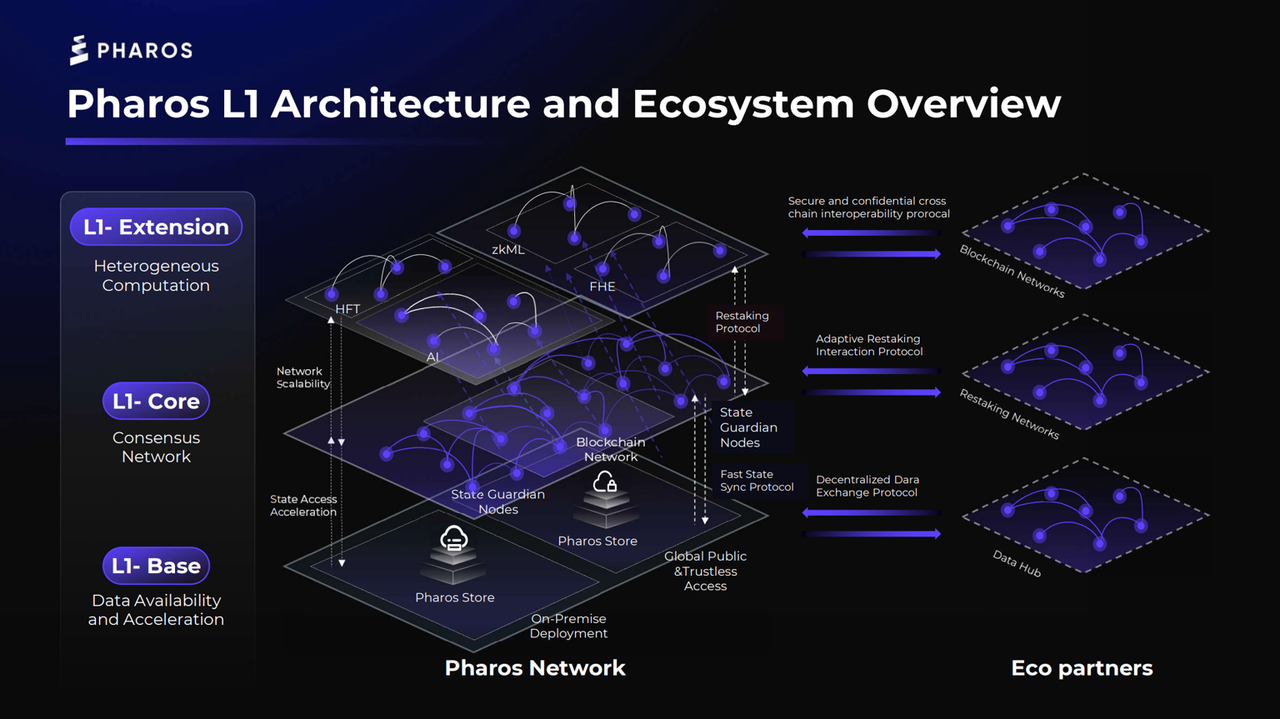
Overview of the Pharos L1 architecture and ecosystem. Source: Pharos
At the same time, Pharos’ modular architecture allows the network to flexibly support the needs of different financial scenarios. For example, asset issuance, payment settlement, and liquidity management can each be optimized through different functional modules without affecting the stability of the underlying network. This design improves the network’s ability to adapt to complex financial operations and provides more reliable infrastructure support for the issuance and circulation of real assets on-chain.
How Does RealFi Infrastructure Logic Connect Traditional Assets with on-chain Liquidity?
The logic behind Pharos’ RealFi infrastructure is, at its core, about using an on-chain network to provide a more efficient liquidity gateway for traditional financial assets. Traditional financial assets usually have limited liquidity and settlement efficiency, while blockchain can improve asset circulation through digitization and on-chain trading. By building an underlying network adapted to the circulation of financial assets, Pharos enables traditional assets to enter on-chain markets more easily and gain broader liquidity support.
This logic means Pharos is not only helping assets “go on-chain”; it is also providing infrastructure support for assets to “circulate.” Once real assets enter the blockchain environment, their trading, clearing, and value transfer all depend on the underlying network. Pharos’ high performance architecture and long term value model are built to serve this purpose, connecting traditional assets with on-chain liquidity and gradually supporting the formation of a RealFi ecosystem.
How Does PROS Capture Network Value During RWA Adoption?
Within Pharos’ RealFi system, PROS is an important medium for network value flow. When real assets are issued, traded, and cleared on the network, these activities generate demand for transaction fees, and PROS, as the native token, carries this value capture function. As more RWA projects connect to the network, growth in on-chain activity will drive demand for PROS usage in parallel.
Beyond that, PROS also participates in network operations through staking and ecosystem incentive mechanisms. Validator nodes maintain network security through staking, while ecosystem participants use incentive programs to encourage assets and applications to join the network. This mechanism allows network growth to feed back into token demand, forming a value cycle driven by real financial activity. This is also an important economic foundation for Pharos as it promotes RWA adoption.
What Are the Core Advantages of Pharos in Supporting RWA Adoption?
Pharos’ core advantage lies in combining a high performance technical architecture with a RealFi value model, providing complete infrastructure support for bringing RWA on-chain. Compared with platforms that only provide asset issuance functions, Pharos pays more attention to circulation efficiency and long term value support after assets enter the blockchain environment. This positioning makes it closer to an “on-chain operating network for real financial assets” than a simple asset mapping platform.
As the RWA market continues to expand, the importance of the underlying network will keep rising. The network that can provide stable, efficient, and sustainable infrastructure for real assets will have a stronger chance of becoming an important participant in the RWA sector. Through this infrastructure logic, Pharos is building the underlying support needed for RWA to enter on-chain financial markets at scale.
Conclusion
Pharos (PROS) provides underlying support for bringing real world assets, RWA, on-chain through its high performance Layer1 architecture and infrastructure logic designed for financial scenarios. By improving transaction efficiency through parallel execution, strengthening business adaptability through modular design, and combining these with the long term value model of PROS, Pharos aims to build a RealFi network that connects traditional assets with on-chain liquidity.
As RWA becomes an important growth direction in blockchain finance, market demand for financial grade infrastructure networks will also continue to increase. The value of Pharos lies in the fact that it does more than help assets move on-chain; it also supports asset circulation through high performance and value capture mechanisms. If its ecosystem continues to expand, Pharos may become one of the important infrastructure projects driving the development of RealFi.
FAQs
Pharos provides efficient underlying support for real asset issuance, trading, and settlement through its high performance Layer1 architecture and modular design, helping RWA connect more smoothly to the on-chain financial system.
Why Does RWA Need a Dedicated Infrastructure Network?
Because bringing real assets on-chain involves complex trading and settlement requirements, it places higher demands on throughput, stability, and long term value mechanisms. Traditional general purpose public blockchains may find it difficult to fully meet these needs.
What Is Pharos’ RealFi Infrastructure Logic?
Its core logic is to connect traditional financial assets with on-chain liquidity through a high performance underlying network, supporting the circulation and value exchange of real assets on-chain.
What Role Does PROS Play in RWA Adoption?
PROS is used to pay transaction fees, participate in staking, and support ecosystem incentives. It is an important part of Pharos’ network value capture and operating mechanism.







