Prediction Market Bets Surge: BlackRock Executive Could Become the Next Federal Reserve Chair Under a Trump Administration

Beginner
Quick Reads
Last Updated 2026-03-25 17:13:47
Reading Time: 1m
Prediction market data indicates a notable increase in the likelihood of BlackRock executive Rick Rieder emerging as a potential Federal Reserve chair nominee in a Trump administration, leading to short-term volatility in the dollar, U.S. Treasury bonds, and U.S. equities.

Prediction Markets Surge: BlackRock’s Rick Rieder Emerges as Top Fed Chair Contender

With the new US administration set to announce its core financial and economic leadership, prediction markets have shown significant shifts. Rick Rieder, Global Head of Fixed Income at BlackRock—one of the world’s largest asset managers—has seen his odds of being nominated as Federal Reserve Chair surge across multiple prediction platforms, making him a focal point for market participants.

This uptick in betting reflects not only changing political expectations but is also beginning to influence the dollar, US Treasury yields, and equity market risk appetite at the margins, positioning it as a key topic in current macro trading strategies.

Why Are Prediction Markets Rapidly Backing BlackRock Leadership?
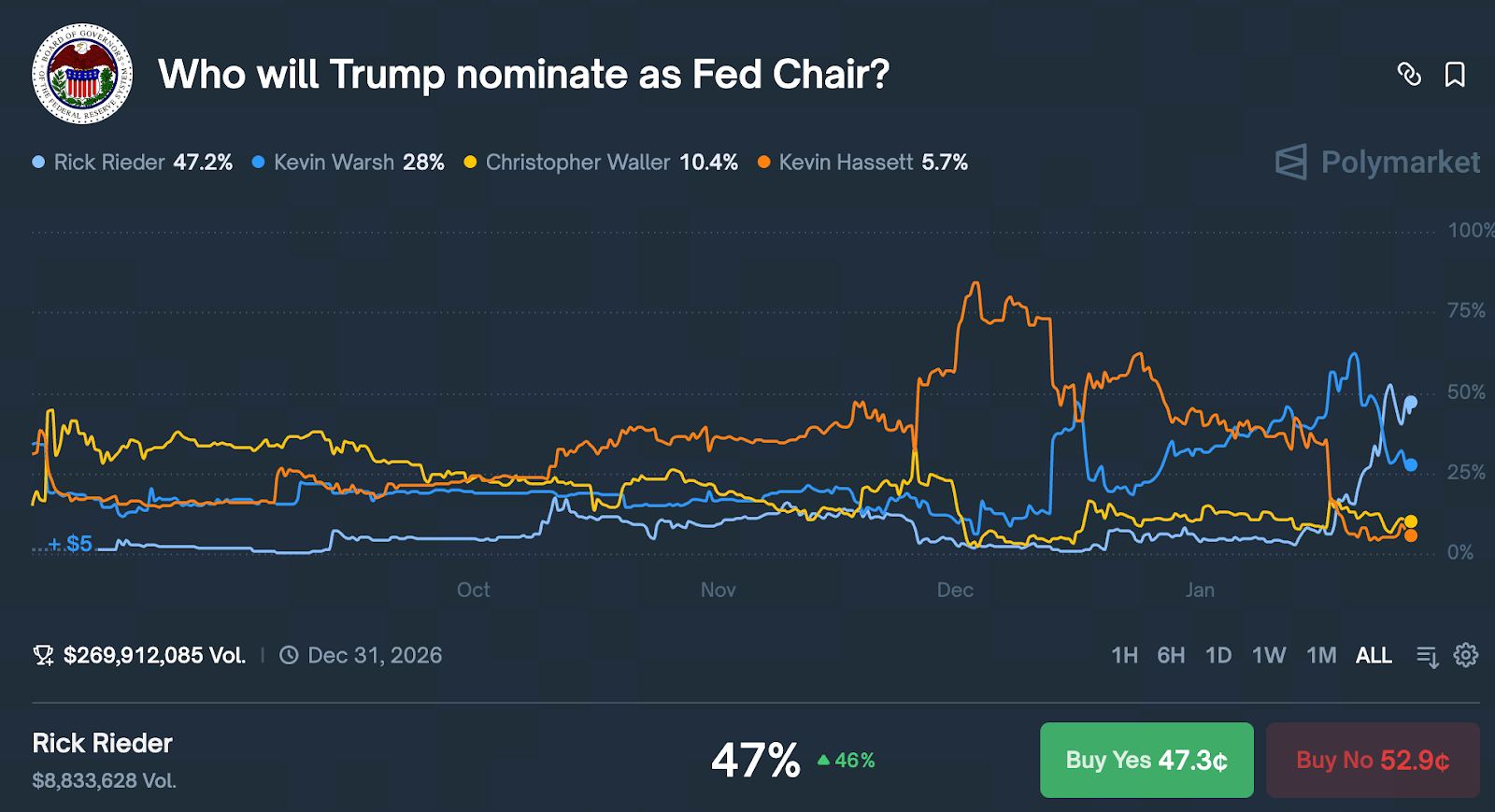

Source: https://polymarket.com/event/who-will-trump-nominate-as-fed-chair

Prediction markets use real capital and are seen as more responsive to real-time sentiment shifts than traditional polling. Over the past week, Rick Rieder’s implied probability has jumped from single digits to the 30%–50% range, driven primarily by the following factors:

1. Trump Team Deepens Engagement with Wall Street

Multiple media sources indicate that the new administration is prioritizing candidates with frontline market experience for its financial regulatory and economic leadership roles, aiming to navigate the complex landscape of high interest rates, debt pressures, and the need for financial stability.

2. Macro Environment Favors “Market-Oriented” Policymakers

With inflation easing but fiscal and debt challenges persisting, markets are increasingly seeking policymakers who understand liquidity, risk transmission, and asset pricing. Rieder’s experience aligns squarely with these demands.

Rick Rieder: Background and Market Perception

As BlackRock’s Global Head of Fixed Income, Rick Rieder has managed hundreds of billions of dollars in bond assets and is recognized as one of the most influential figures in the global bond market.

Market participants generally view his policy orientation as:

  • Moderate and neutral, with pragmatic emphasis
  • Strong focus on market liquidity and financial stability
  • Less reliance on macroeconomic models, with greater attention to price signals and risk feedback

As a result, many investors believe that if Rieder becomes Fed Chair, monetary policy could become more predictable and stable, reducing policy uncertainty and providing medium-term support for both equities and bonds.

However, there are also clear reservations in the market:

  • His Wall Street background may raise concerns about the Fed’s independence
  • BlackRock’s scale could present potential conflicts of interest

Therefore, while prediction market bets have surged, there is still significant uncertainty regarding his nomination.

Initial Asset Price Reactions: Macro Pricing Adjusts

With Rieder viewed as a relatively “dovish/moderate” candidate, related assets have already seen marginal repricing:

1. US Dollar Index (DXY) Softens Short-Term

The market has modestly increased the probability of medium-term rate cuts, weighing on the dollar.

2. Treasury Prices Climb, Yields Fall

Yields on 10-year Treasuries have declined as traders reassess the likely path of future policy rates.

3. Sentiment Improves for Tech and Growth Stocks

If future rate pressures ease, high-valuation assets stand to benefit directly, with risk appetite for the Nasdaq clearly recovering.

If Rick Rieder Becomes Chair, What Policy Direction Is Likely?

Current market pricing reflects several anticipated scenarios:

Policy pace will likely be steady, avoiding extremes: Rieder’s background emphasizes stability, making aggressive rate moves or rapid pivots less likely.

Policy communication will center on market feedback: His longstanding engagement with institutional investors gives him strong expectation management and communication skills.

Greater focus on financial market stability: Especially bond market liquidity, which could become a key factor in policy decisions.

Uncertainty and Potential Risks Remain

While prediction markets show positive signals, several risk factors remain:

  • The Trump team’s internal candidate selection is not yet final
  • The Fed Chair nomination requires Senate confirmation
  • Prediction markets are subject to emotional swings and herd behavior
  • Sudden changes in macro data or financial conditions could alter the candidate list at any time

As such, prediction market probabilities serve better as sentiment and directional indicators than as definitive conclusions.

Conclusion

Prediction market shifts have certainly made Rick Rieder one of the most closely watched Fed Chair candidates, but the final outcome still depends on official appointment. For investors, it is more important at this stage to monitor structural changes among the dollar, Treasuries, and risk assets, rather than overtrading based on a single nomination.

Until an official policy decision is made, market pricing remains driven by “expectations.”

Author: Max
Disclaimer
* The information is not intended to be and does not constitute financial advice or any other recommendation of any sort offered or endorsed by Gate.
* This article may not be reproduced, transmitted or copied without referencing Gate. Contravention is an infringement of Copyright Act and may be subject to legal action.

Related Articles

AI-Native Settlement Layers: How United Stables Is Building the Next Financial Rail
Beginner

AI-Native Settlement Layers: How United Stables Is Building the Next Financial Rail

Stablecoins were originally designed as dollar substitutes within exchanges, primarily used for asset pricing and trade settlement. As on-chain financial ecosystems have matured, their role has expanded beyond simple payments to include collateral assets, cross-chain liquidity mediums, and unified settlement units. In particular, as AI systems and automated agents begin to participate directly in economic activity, demand has risen sharply for programmable value units capable of instant settlement. This shift is pushing stablecoins toward the role of foundational financial infrastructure.
2026-03-25 03:16:17
The ve(3,3) Flywheel Explained: How AERO Tokenomics Powers Aerodrome’s DeFi Economy
Beginner

The ve(3,3) Flywheel Explained: How AERO Tokenomics Powers Aerodrome’s DeFi Economy

In the competition for DeFi liquidity, high-inflation mining alone is no longer enough to build lasting advantages. Aerodrome applies the ve(3,3) economic model to redesign token emissions, voting mechanisms, and revenue distribution, creating a liquidity flywheel centered on governance and cash flow. This article examines AERO tokenomics, the veAERO locking mechanism, and protocol revenue models to explain how Aerodrome builds a sustainable DeFi economic system.
2026-03-25 06:41:58
Aerodrome Tokenomics: How ve(3,3) Powers Base's Most Profitable DEX
Beginner

Aerodrome Tokenomics: How ve(3,3) Powers Base's Most Profitable DEX

AERO is the native token of Aerodrome Finance, a core decentralized exchange and liquidity protocol in the Base ecosystem. It is primarily used for liquidity incentives and ecosystem operations. veAERO is a governance NFT that users receive by locking AERO, representing both voting power and the right to share protocol revenue. Through a dual track structure of AERO as a utility token and veAERO as a governance credential, Aerodrome separates liquidity usage value from long term governance power, allowing participants to act as liquidity providers, governance decision makers, and revenue sharers within the same system.
2026-03-25 06:40:31
DePIN Identity Network and Real World Applications: How Humanity Protocol Brings on-chain Identity Into the Physical World
Beginner

DePIN Identity Network and Real World Applications: How Humanity Protocol Brings on-chain Identity Into the Physical World

Most Web3 identity systems remain confined to on-chain environments and struggle to achieve meaningful adoption in real world settings. Through a DePIN architecture and physical verification hardware, Humanity Protocol aims to bring decentralized identity into access control systems, hospitality, public services, and offline events, allowing on-chain identity to function not just as a digital credential, but as foundational infrastructure for real world access.
2026-03-25 07:40:53
How is the price of PAXG determined? Pegging mechanism, trading depth, and influencing factors
Beginner

How is the price of PAXG determined? Pegging mechanism, trading depth, and influencing factors

PAXG (Pax Gold) is a tokenized asset backed by physical gold reserves, launched by fintech firm Paxos and issued as an ERC-20 token on the Ethereum blockchain. The core concept is to digitally represent real-world gold assets, allowing investors to hold and trade gold via the blockchain network. Because each PAXG token corresponds to a specific quantity of physical gold, its price is theoretically expected to closely track the global gold market.
2026-03-24 19:11:40
How Does PAXG Work? In-Depth Overview of the Physical Gold Tokenization Mechanism
Beginner

How Does PAXG Work? In-Depth Overview of the Physical Gold Tokenization Mechanism

PAXG (Pax Gold) is a tokenized asset backed by physical gold, issued by the fintech company Paxos and traded on the Ethereum blockchain as an ERC-20 token. The core concept is to tokenize physical gold on-chain, with each PAXG token representing ownership of a certain amount of gold. This structure enables investors to hold and trade gold in the form of a digital asset.
2026-03-24 19:12:51





