
Unlocking Allora: The Rise of Decentralized AI Token ALLO and Its Investment Opportunities

Beginner
Quick Reads
Last Updated 2026-03-27 17:48:03
Reading Time: 1m
This report covers market updates, price movements, and exchange listings for Allora (ALLO), a decentralized AI network, providing analysis of potential investment opportunities and associated risks.


Image: https://www.allora.network/

As artificial intelligence (AI) and blockchain technology continue to converge, Allora (token symbol: ALLO) has emerged as a leading project. Allora positions itself as a decentralized intelligence network, leveraging a model collaboration and self-evolution framework to power Web3 and DeFi applications.

What Is Allora?

Allora Labs (formerly Upshot) developed Allora. Its mission is to disrupt the traditional closed AI model landscape. The network unites developers, model providers, and validators, all incentivized and governed by the ALLO token.

Core features include:

  • Model collaboration: Multiple machine learning models work as collaborators within the network, jointly participating in inference, validation, and improvement.
  • Decentralized governance and incentives: The ALLO token is used for inference payments, contributor rewards, and governance participation.
  • Open prediction topics: Users can define topics and rule sets, determining which problems the models will tackle.

This architecture positions Allora as more than just a token. It serves as an infrastructure for intelligent service networks.

Listing Overview and Market Performance
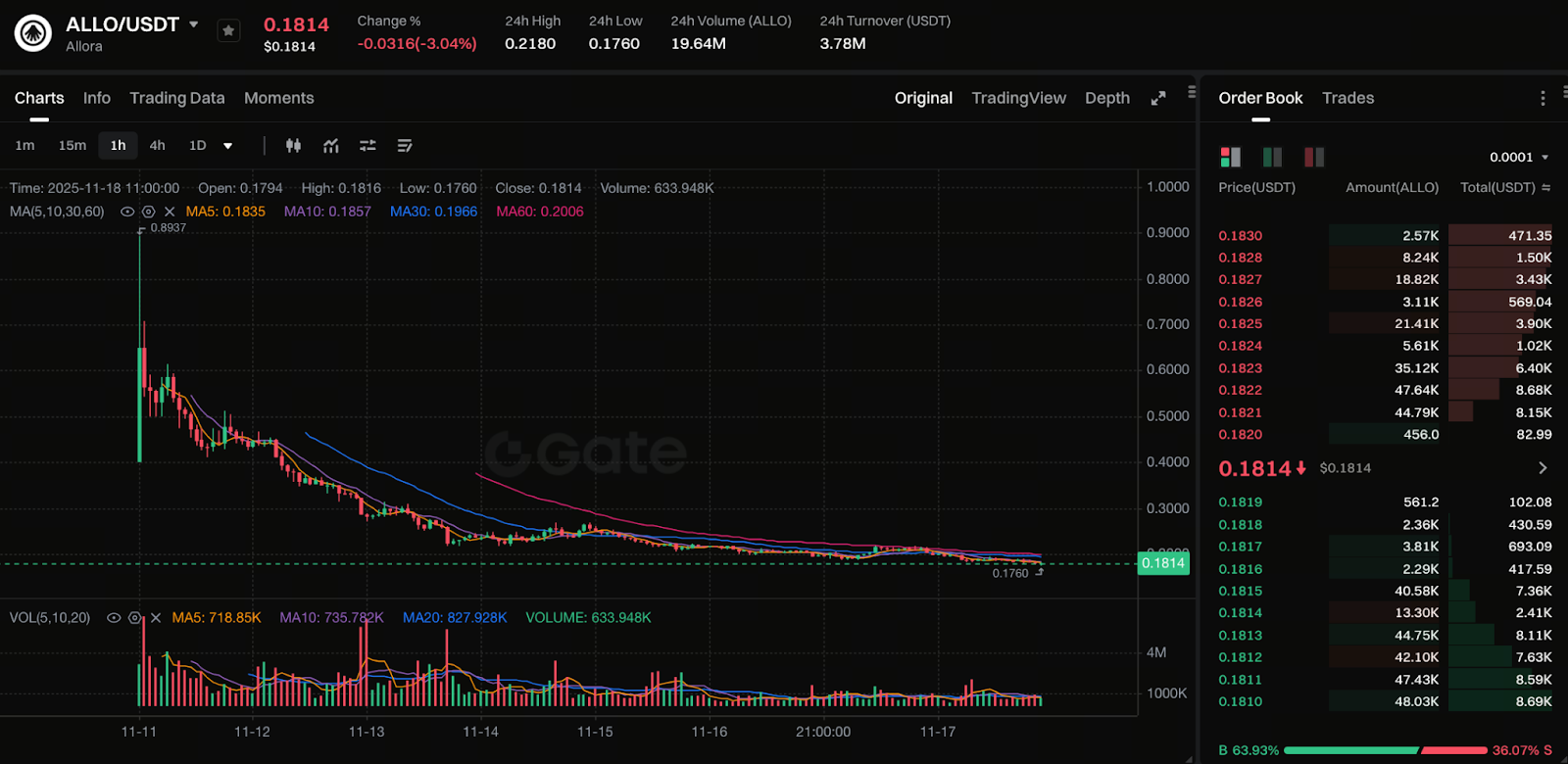

Image: https://www.gate.com/trade/ALLO_USDT

As of November 18, 2025, ALLO/USDT is priced around $0.18, with 24-hour trading volume exceeding tens of millions of dollars.

Price Analysis and Recent Volatility

Allora experienced intense volatility right after its listing, with an initial day drop of over 60%.

Highlights include:

  • Heavy airdrops and token vesting unlocks at launch caused significant selling pressure.
  • Given its total circulating and maximum supply, the current price remains in an early stage.
  • Market sentiment is sharply divided. Some are optimistic about its decentralized AI positioning, while others express concerns about tokenomics, unlock schedules, and mixed market reception.

Technically, if Allora delivers on platform development, real-world deployment of prediction topics, and increased user engagement, the price may rebound. However, relying solely on listing momentum brings considerable risk.

Investment Highlights and Risk Factors

Highlights:

  • Captures two major industry narratives: AI model collaboration and decentralized governance within the AI + blockchain sector.
  • Listed on multiple exchanges, with initial liquidity established.
  • ALLO token supports payment, rewards, and governance functions.

Risks:

  • Sharp initial decline after listing signals high short-term speculation.
  • Early-stage airdrops and unlocks may create ongoing selling pressure.
  • The project is still in its early stages; real-world adoption is yet to be proven.
  • Overall market volatility remains high, with fierce competition in the AI-token sector.

How to Trade ALLO?

To trade ALLO, follow these steps:

  • Register and complete KYC on an exchange supporting ALLO/USDT (e.g., Gate). The current Gate price is about $0.18.
  • Buy USDT or other base currencies and deposit them to your exchange account.
  • Navigate to the ALLO/USDT trading pair and choose your purchase amount.
  • Tip: Use stop-loss orders, increase your position gradually, and monitor project updates and token lock status closely.

Conclusion

Allora (ALLO) represents a pioneering direction in blockchain as a decentralized AI network. While its launch momentum and technical roadmap are promising, both price stability and real-world adoption are still at an early stage. High-risk investors may find it worth watching. Conservative participants should wait for more project maturity and comprehensive ecosystem data before making decisions.

Disclaimer
* The information is not intended to be and does not constitute financial advice or any other recommendation of any sort offered or endorsed by Gate.
* This article may not be reproduced, transmitted or copied without referencing Gate. Contravention is an infringement of Copyright Act and may be subject to legal action.

Related Articles

What is Fartcoin? All You Need to Know About FARTCOIN
Intermediate

What is Fartcoin? All You Need to Know About FARTCOIN

Fartcoin (FARTCOIN) is a representative meme coin within the Solana ecosystem based on an AI-driven narrative. Its core concept originated from an experiment aimed at exploring the "boundaries between AI Agents and humor." More than just a digital asset with social attributes, the project deeply couples absurd humor culture with on-chain financial logic by integrating autonomous AI interaction models.
2026-04-04 22:01:19
Gold Price Forecast for the Next Five Years: 2026–2030 Trend Outlook and Investment Implications, Could It Reach $6,000?
Beginner

Gold Price Forecast for the Next Five Years: 2026–2030 Trend Outlook and Investment Implications, Could It Reach $6,000?

Analyze current gold price trends alongside authoritative five-year forecasts, integrating an evaluation of market risks and opportunities. This gives investors insight into the potential trajectory of gold prices and the main drivers expected to shape the market over the next five years.
2026-03-25 18:13:30
Aster vs Hyperliquid: Which Perp DEX Will Prevail?
Beginner

Aster vs Hyperliquid: Which Perp DEX Will Prevail?

Aster and Hyperliquid are the two representative protocols of the "purpose-built L1 path" within the current decentralized perpetual exchange (Perp DEX) sector. As a pioneer in the field, Hyperliquid has built a deep liquidity moat through its highly mature order book architecture and strong community consensus. Conversely, Aster, as a rising challenger, seeks to leapfrog the competition in high-performance trading through more aggressive multi-chain aggregation logic, private transaction modules, and an underlying execution environment optimized for 2026 market demands.
2026-03-24 11:58:33
AI-Native Settlement Layers: How United Stables Is Building the Next Financial Rail
Beginner

AI-Native Settlement Layers: How United Stables Is Building the Next Financial Rail

Stablecoins were originally designed as dollar substitutes within exchanges, primarily used for asset pricing and trade settlement. As on-chain financial ecosystems have matured, their role has expanded beyond simple payments to include collateral assets, cross-chain liquidity mediums, and unified settlement units. In particular, as AI systems and automated agents begin to participate directly in economic activity, demand has risen sharply for programmable value units capable of instant settlement. This shift is pushing stablecoins toward the role of foundational financial infrastructure.
2026-03-25 03:16:17
ASTER Tokenomics: Buybacks, Burns, and Staking as the Value Foundation of ASTER in 2026
Beginner

ASTER Tokenomics: Buybacks, Burns, and Staking as the Value Foundation of ASTER in 2026

ASTER is the native equity and governance token of the Aster ecosystem, with its core value built upon a radical "Deflationary Engine." Beyond serving as a governance tool, ASTER integrates multiple utilities including staking rewards, trading fee discounts, and liquidity incentives. Through its deep integration with the upcoming dedicated Layer 1 mainnet, it enables direct value capture from protocol cash flow to token holders.
2026-03-25 07:38:07
Hybrid Collateral Stablecoins: Inside United Stables' Stability and Yield Architecture
Beginner

Hybrid Collateral Stablecoins: Inside United Stables' Stability and Yield Architecture

In the early stages of the crypto market, traditional stablecoins mainly relied on single-reserve or single-collateral models. Their primary focus was price stability and payment convenience, which allowed them to become foundational tools for on-chain trading and capital flows. As the market has entered a more mature financial phase, however, this structure has begun to reveal limitations, including high concentration risk and the difficulty of balancing liquidity with yield. These constraints have driven the evolution toward multi-layer collateral and portfolio-based designs, such as the dual-layer hybrid collateral architecture proposed by United Stables, which seeks to redefine the underlying logic of stable assets.
2026-03-25 03:17:39





