ADI Chain is an Ethereum-secured Layer 2 (L2) blockchain network launched by the Abu Dhabi–based ADI Foundation, designed for institutional and government scenarios with a focus on stablecoin settlement, cross-border payments, and real-world asset (RWA) tokenization. Across emerging markets in the Middle East, Africa, and Asia, large populations still lack access to robust banking and digital financial services. ADI Chain combines compliance frameworks, high-performance execution, and Ethereum-grade security in a single infrastructure stack, with a stated goal of onboarding roughly one billion people to the chain by 2030.
ADI Foundation was initiated by Sirius International Holding, a digital-focused subsidiary of IHC (International Holding Company) in the United Arab Emirates. Unlike general-purpose public chains built around open DeFi narratives, ADI Chain prioritizes governments, sovereign entities, banks, and enterprises: institutions can run Layer 3 (L3) chains with their own compliance policies on top of ADI L2, while inheriting Ethereum final settlement security through zero-knowledge validity proofs.
What Is ADI Chain? How Does It Relate to ADI Foundation?
Within the ADI Foundation ecosystem, ADI Chain serves as the institutional on-chain settlement and compliance infrastructure layer: the Foundation drives policy and partnership engagement, while the Chain provides an EVM-compatible execution environment and bridging channels. Its positioning centers on institutions, compliance, and emerging markets across the Middle East, Africa, and Asia. The mainnet Chain ID is 36900.
| Entity |
Role |
| ADI Foundation |
Ecosystem governance, institutional partnerships |
| ADI Chain (L2) |
Transaction execution, Gas, L3 registration |
| L3 chains |
Institution-customizable compliant sub-chains |
How Does ADI Chain Work On-Chain? zkSync OS and ZK Proof Mechanics
ADI Chain operates as a zkRollup: transactions execute off-chain and are bundled into batches, with the proof system generating a zero-knowledge validity proof (ZK Proof) for each batch's state transition before submission to the Ethereum mainnet (L1) verifier contract. New state is finalized on L1 only after the proof passes verification; invalid batches cannot be accepted. The technology stack builds on the zkSync OS operating-system layer and the Airbender proof system (FRI/STARK → FFLONK SNARK pipeline), delivering high throughput and low fees while maintaining EVM compatibility.
Documentation indicates that a single ADI L2 instance achieves roughly 2,000–10,000 TPS; deploying multiple L3 chains on top allows further capacity scaling by application or jurisdiction. The Airbender proof pipeline converts STARK-based proofs (using FRI) into FFLONK SNARKs before L1 submission, balancing proof generation efficiency with verifier cost on Ethereum. Gas fees are paid in $ADI through the Custom Gas Token capability, so users and developers can interact on L2 without separately managing ETH for routine operations. Compared with L1 Ethereum, batched transactions and compressed proofs can reduce fees by approximately 90%–95%, making high-volume institutional workflows economically viable on-chain.
| Layer |
Execution location |
Proof and finality |
Typical latency |
| L3 chains |
L3 local Sequencer |
Proof submitted to ADI L2 |
Sub-second soft confirmation |
| ADI Chain (L2) |
L2 Sequencer |
ZK proof submitted to Ethereum L1 |
Minutes-level L2 confirmation |
| Ethereum (L1) |
Verifier contract |
State root finalization |
Hours-level L1 finality |
The Sequencer provides soft confirmation, enabling sub-second user interaction; cryptographic finality propagates upward through L3 → L2 → L1. L3 compliant chains explains the Commit, Prove, and Execute settlement stages for L3 batches in further detail.
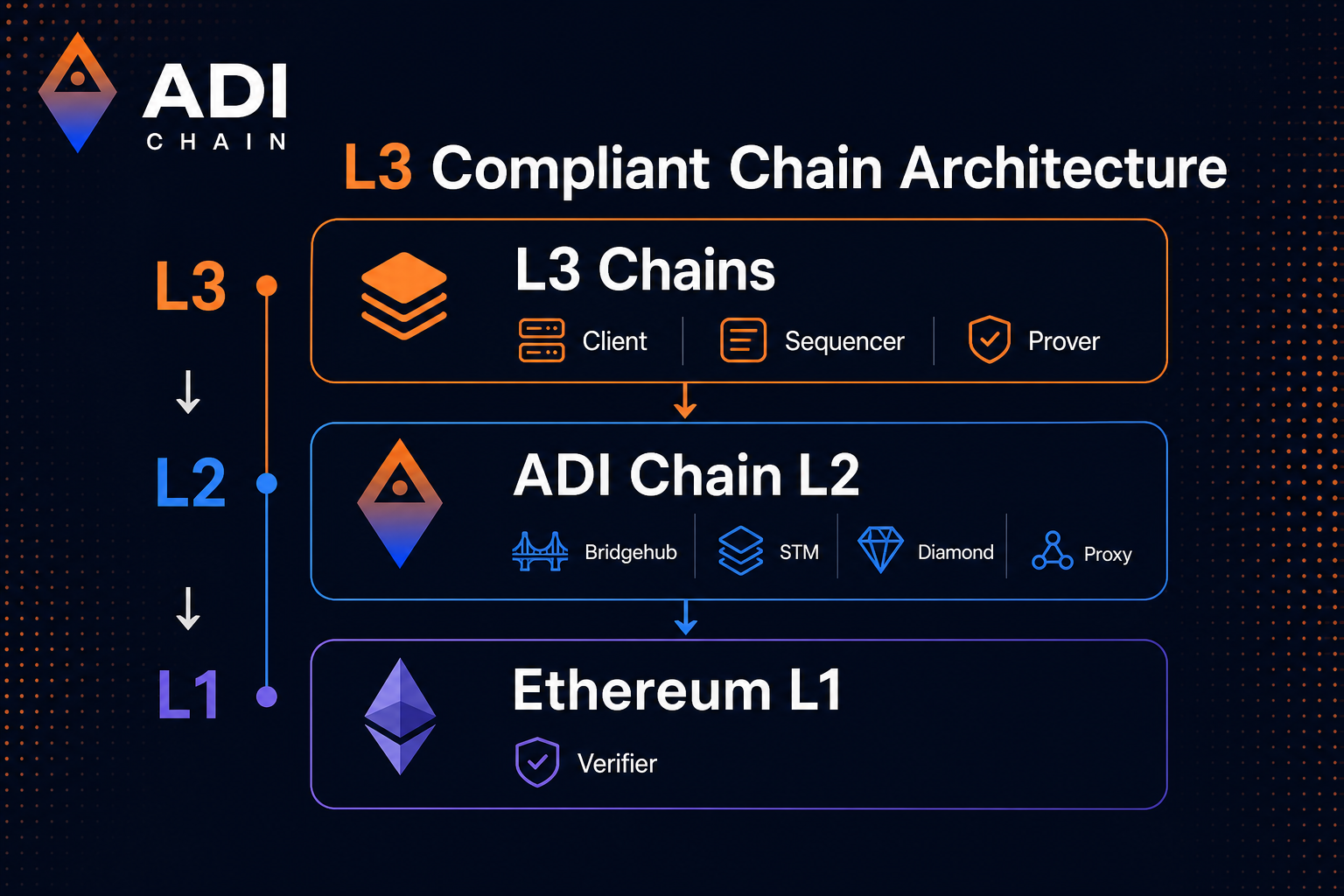 Figure 1. ADI Chain's layered proof and finality architecture from L3 through L2 to Ethereum L1.
On bridging, a unified portal supports asset deposits and withdrawals across L1, L2, and L3; cross-chain messages are validated through ZK proof verification rather than relying solely on multisig or optimistic assumptions. This design keeps asset movement aligned with the same cryptographic security model that governs state transitions on each layer. The enterprise integration layer includes Hyperledger FireFly middleware, which can auto-generate REST APIs and connect to DID/KYC services, allowing traditional IT systems to interact with ADI Chain without building custom blockchain adapters from scratch.
What Are ADI Chain's L3 Compliant Chains? How Can Institutions Customize by Jurisdiction?
L3 chains are Layer 3 ZK Rollups that settle on ADI Chain (L2), which itself settles on Ethereum (L1). Each layer passes security guarantees upward through validity proofs: L3 transactions execute locally first, batch proofs are submitted to L2 for verification, and L2 then proves the combined state—including L3 settlement—to L1. Institutions, governments, or industry consortia can operate independent L3 chains, setting compliance parameters by legal jurisdiction, business line, or privacy requirements while remaining interoperable within the ADI ecosystem.
L3 deployments share ecosystem registration infrastructure such as Bridgehub and StateTransitionManager, while each L3 maintains its own Sequencer, Prover, and Diamond Proxy, with state kept isolated from other L3 instances. Deployment models fall into three categories: fully ADI-managed (ADI operates Sequencer and Prover on the institution's behalf), customer self-operated (the institution runs its own infrastructure), and hybrid (shared components with institution-controlled policy layers). Compliance integration aligns with FATF Travel Rule and ADGM frameworks, enabling a "single L2 ecosystem, multiple compliance domains" model where different jurisdictions or business units can enforce distinct rules without fragmenting the underlying settlement layer.
What Is the $ADI Token Used For? How Is the Economics Structured?
$ADI is the core utility token of the ADI Chain ecosystem, serving three functions: native Gas on L2 and associated network domains, in-ecosystem settlement medium, and staking incentives. All L2 smart contract calls, transfers, and dApp interactions pay Gas in $ADI; value flows among enterprises, developers, validators, and users within the ecosystem also use $ADI as the settlement unit. For staking, holders can deposit $ADI into treasury-backed staking pools to earn rewards; the model does not rely on inflationary minting of new tokens and is designed to support long-term value anchoring.
The genesis total supply is 999,999,999 tokens (approximately one billion). The allocation structure is as follows: Community Fund 35% (72-month linear unlock, 1.39% circulating at Token Generation Event / TGE), Treasury Reserve 25% (108-month unlock, 5% circulating at TGE), Private Investors 12% (72-month unlock, 12-month cliff), Partners 10% (72-month unlock, 12-month cliff), Team 10% (72-month unlock, 12-month cliff), Token Incentive Pool 4% (100% circulating at TGE), Liquidity 4% (100% circulating at TGE). First-year unlocks typically occur on the 9th of each month. $ADI token utility expands on allocation logic, staking mechanics, and Gas binding in a dedicated overview.
| Allocation |
Share |
Unlock period |
Cliff |
| Community Fund |
35% |
72 months |
None (1.39% released at TGE) |
| Treasury Reserve |
25% |
108 months |
None (5% released at TGE) |
| Private Investors |
12% |
72 months |
12 months |
| Partners |
10% |
72 months |
12 months |
| Team |
10% |
72 months |
12 months |
| Token Incentive Pool |
4% |
Immediately available |
None |
| Liquidity |
4% |
Immediately available |
None |
The L1 $ADI token contract address is 0x8b1484d57abbe239bb280661377363b03c89caea (as recorded in ADI Network mainnet documentation); after bridging to L2, it serves as native Gas.
What Problems Does ADI Chain Address? Stablecoin and RWA Use Cases
Cross-border institutional settlement often relies on USD stablecoin rails, exposing both non-USD counterparties to exchange-rate spreads and foreign-exchange risk even when neither party's domestic currency is the dollar. ADI Chain offers an alternative path built on "sovereign stablecoins + compliant L3 + low-cost settlement": the UAE is advancing a dirham-backed stablecoin under the CBUAE regulatory framework, allowing local-currency settlement without forcing participants through an intermediate USD conversion layer. Globally, ADI participates in the Open USD initiative alongside BlackRock, Mastercard, and other institutions to build shared payment rails that interoperate with existing financial infrastructure. On RWA, partnerships with SettleMint and Brickken advance asset tokenization under ADGM, bringing regulated financial instruments such as bonds, funds, and real estate onto programmable ledgers. In Kenya, use cases cover medical records and carbon credits; across Africa, M-Pesa explores on-chain payments that connect mobile-money users to blockchain settlement.
| Application area |
Typical scenarios |
Compliance / partner elements |
| Sovereign stablecoins |
Dirham-backed stablecoin, cross-border institutional settlement |
CBUAE regulatory direction, Open USD |
| RWA tokenization |
On-chain shares of bonds, funds, real estate, and other assets |
ADGM, SettleMint, Brickken |
| Inclusive finance |
M-Pesa on-chain payments, retail remittances |
M-Pesa, Mastercard |
| Public data |
Medical records, carbon credits, utility data |
Government and health-tech partners |
The shared logic across these scenarios is embedding regulated assets and compliant workflows into programmable on-chain infrastructure, rather than retrofitting compliance onto a general-purpose DeFi environment after the fact. ADI Chain vs Arbitrum and Base provides a horizontal comparison across compliance capabilities, L3 support, and ecosystem focus relative to general-purpose L2s.
Who Are ADI Chain's Ecosystem Partners? Wallets and Self-Custody Access
The ADI Chain ecosystem spans strategic institutions (Mastercard, BlackRock, Franklin Templeton, FAB, ADGM, M-Pesa), infrastructure providers (Fireblocks, Chainlink, Alchemy, zkSync), market listings (Crypto.com, Kraken, KuCoin, and others), and application layers (Predictstreet, Zoniqx, and others). Wallet access centers on ADI Wallet: the Beta release supports iOS and Android with Passkey authentication replacing seed phrases, reducing recovery-phrase management burden for retail and institutional users who prefer device-native security. Tangem hardware wallets natively support $ADI and sell co-branded products through retail channels in the UAE, giving users a hardware-backed custody option alongside the mobile wallet.
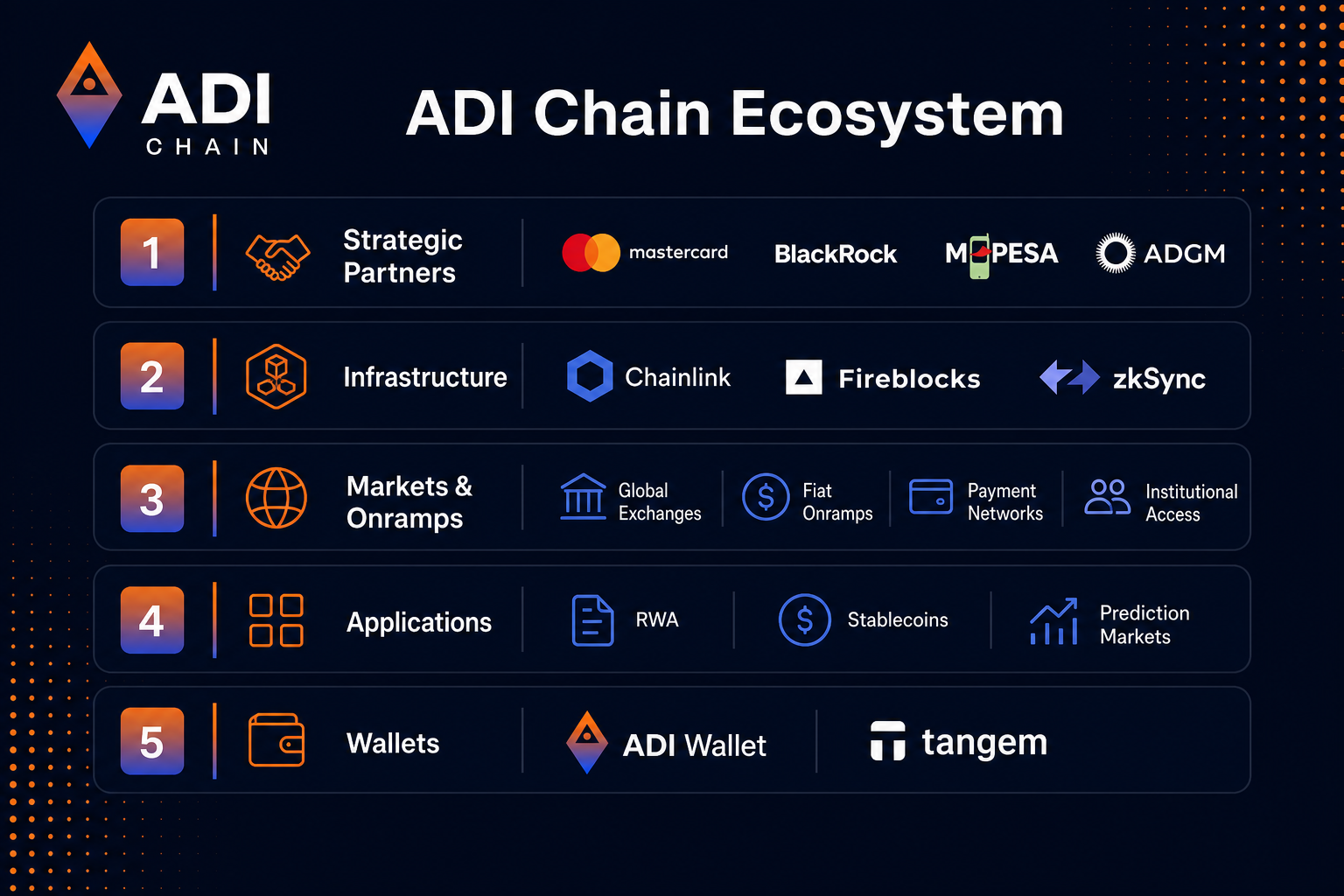 Figure 2. ADI Chain strategic institutions, infrastructure, markets, applications, and wallet ecosystem layers.
The ecosystem expansion model runs three parallel tracks: institutional backing, developer tooling, and retail access. Institutions supply compliance and asset origination; infrastructure lowers deployment barriers; wallets and retail channels shorten the path to end-user reach.
What Are the Advantages and Risks of Using or Participating in the ADI Chain Ecosystem?
Advantages include Ethereum-grade security, ZK proofs, EVM compatibility, and L3 compliance customization; Custom Gas Token reduces ETH management friction for day-to-day operations; FireFly middleware shortens enterprise IT integration cycles by exposing familiar REST endpoints. Risks include an early-stage ecosystem where application density remains lower than on leading general-purpose L2s; high GPU and Sequencer requirements for self-operated L3 deployments, which raise operational complexity for institutions choosing the customer-operated model; mainnet RPC rate limits that can constrain L3 throughput during peak demand; residual bridge and contract key-management risk common to any multi-layer architecture; and the long-term $ADI unlock schedule that gradually increases circulating supply over multi-year vesting periods. The network currently does not support ERC-7702, ERC-4844, or certain debug RPC methods, which may affect developers expecting full parity with the latest Ethereum feature set.
| Dimension |
Advantages |
Risks and limitations |
| Security model |
ZK proofs + Ethereum L1 finality |
Time window between soft confirmation and L1 finality |
| Compliance |
L3 customizable by jurisdiction |
Cross-border scenarios still require case-by-case local law compliance |
| Performance |
2,000–10,000 TPS (L2) |
L3 proving requires GPU infrastructure |
| Ecosystem |
Top-tier institutional partners |
Application density still lower than leading general-purpose L2s |
| Token |
Clear Gas and staking utility |
Long unlock periods; circulating supply structure warrants monitoring |
The comparison above describes mechanisms and structural factors, not investment judgments. Institutions evaluating options can assess ADI Chain alongside general-purpose L2s such as Arbitrum and Base across compliance, L3 support, and partner resources.
Summary
ADI Chain is an institutional-grade zkRollup L2 on Ethereum, advanced by ADI Foundation to bring stablecoins, RWAs, and compliant finance on-chain. $ADI serves as native Gas and settlement token; L3 chains support jurisdiction-specific compliance domains. Ecosystem partners include Mastercard, BlackRock, and M-Pesa; ADI Wallet and Tangem lower self-custody barriers.
FAQ
What is ADI Chain?
ADI Chain is an Ethereum-secured Layer 2 blockchain launched by ADI Foundation, using zkRollup and zero-knowledge validity proofs to provide stablecoin settlement, RWA tokenization, and customizable L3 compliant chain infrastructure for governments, banks, and enterprises, with priority focus on the Middle East, Africa, and Asia.
Is ADI Chain a public chain or a Layer 2?
ADI Chain is a Layer 2 (L2), not a standalone L1 public chain. Transactions execute on ADI L2, and state is finalized on the Ethereum mainnet through ZK proofs; institutions can also deploy L3 chains that settle on L2.
What is ADI Chain's relationship with Ethereum?
ADI Chain runs as a zkRollup on Ethereum: L2 state transitions are finalized only after L1 verifier contracts validate the proofs, and assets can move between L1 and L2 through bridging.
What is the $ADI token used for?
$ADI pays Gas fees on ADI Chain (and associated L3 domains), serves as an in-ecosystem settlement medium, and can be staked in treasury-backed pools to earn rewards. L2 uses a Custom Gas Token model, so separate ETH holdings are not required for L2 Gas.
What are L3 chains on ADI Chain?
L3 chains are Layer 3 ZK Rollups that settle on ADI L2. Institutions can operate independent chains by legal jurisdiction or business requirement, set compliance policies, and inherit dual-layer security through L2 and Ethereum. L3 and L2 share ecosystem registration infrastructure such as Bridgehub.
How does ADI Chain differ from Arbitrum and Base?
The core differences lie in target users and compliance architecture: ADI Chain prioritizes governments and institutions, offering native L3 compliant chains and sovereign stablecoin/RWA deployment resources; general-purpose L2s such as Arbitrum and Base focus more on open DeFi and consumer applications, with compliance and L3 customization typically assembled at the application layer.
Is ADI Chain secure?
ADI Chain uses ZK validity proofs, so invalid state cannot be accepted on L1; the Sequencer provides sub-second soft confirmation, while cryptographic finality requires proof verification on L2 and L1. Users should still account for residual risks from bridge contracts, operational keys, and self-operated L3 infrastructure, and distinguish soft confirmation from L1 finality.







