Within the blockchain ecosystem, most storage solutions still rely on a “pay as long as you use it” model, where data remains available only if fees continue to be paid. Arweave attempts to solve this problem through a “permanent storage” mechanism, allowing data to remain accessible over the long term without repeated renewals, thereby improving reliability and accessibility.
From the perspective of digital assets and the data economy, Arweave is not only a storage network, but also a form of “data asset infrastructure.” It turns data into a long term, verifiable, and accessible resource, enabling blockchains not only to record transactions, but also to support a complete data layer.
Source: arweave.com
What Is Arweave (AR)
Arweave is a blockchain network focused on permanent data storage. Its core goal is to make data “uploaded once, stored forever.” Unlike traditional blockchains, which are mainly used to record transactions, Arweave treats data itself as the primary object of storage, giving the blockchain stronger capacity to carry information.
In terms of technical design, Arweave does not use a conventional blockchain structure. Instead, it introduces a special way of organizing data, allowing the network to store large amounts of information while maintaining security. This design makes it suitable not only for financial use cases, but also for content storage, data archiving, and other applications.
Arweave can be understood through the concept of a “blockchain storage network.” It is not just a chain, but also a decentralized data layer that provides foundational support for Web3 applications. From there, it is useful to further examine the differences between the “Arweave permanent storage mechanism” and the “blockchain data storage model.”
Overall, Arweave expands blockchain from a “record keeping tool” into “data infrastructure,” giving decentralized applications a broader range of capabilities.
Arweave’s Core Positioning: Permanent Storage Network and the Permaweb Concept
Arweave’s core positioning is to build a “permanent storage network.” Its goal is not only to store data, but also to create an open, data based network structure known as the Permaweb. The Permaweb can be understood as a decentralized internet built on top of Arweave, where all content is designed to remain accessible over the long term.
On the traditional internet, website content depends on servers and centralized platforms. Once a server shuts down or data is deleted, the content may be lost permanently. On the Permaweb, however, once data is uploaded, it can continue to exist over the long term, creating a true “tamper resistant content network.”
This structure provides Web3 with a new layer of infrastructure, allowing applications to be built on top of a stable data environment. Decentralized websites and on-chain archive systems, for example, can rely on Arweave’s storage capabilities. Related topics include “Permaweb architecture” and “Web3 storage infrastructure.”
As a result, Arweave’s value lies not only in storage itself, but also in its redefinition of the data lifecycle on the internet, making “long term accessibility” the default state.
Arweave’s Technical Architecture: Blockweave and Storage Mechanism
The technical core of Arweave is its Blockweave architecture, a structure that differs from traditional blockchains. In Blockweave, each new block must not only link to the previous block, but also randomly reference a historical block, strengthening the network’s dependence on historical data.
This design means that when nodes participate in the network, they need to access and verify portions of historical data, increasing the likelihood that data will continue to be stored. This mechanism is known as “Proof of Access,” and it requires miners to prove that they actually hold certain historical data before they can qualify to produce blocks.
Compared with traditional chain structures, Blockweave places greater emphasis on data availability, not just transaction consistency. This allows it to support larger scale data storage needs while maintaining security. Related mechanisms include “Blockweave structure principles” and “how Proof of Access works.”
Overall, this architecture directly incorporates “storage behavior” into the consensus mechanism, making data storage part of the network’s operation rather than an added function.
How Arweave Works: Data Uploading, Storage, and Retrieval
In the Arweave network, the data process can be divided into three stages: uploading, storage, and retrieval. When users upload data, they pay a one time fee. This fee covers not only current storage, but also long term preservation in the future.
After data is uploaded, it is stored across distributed network nodes, while the Blockweave structure and consensus mechanism help ensure its long term existence. Nodes receive rewards by participating in storage and verification, creating an incentive to keep maintaining the data.
During the retrieval stage, users can access stored content through network interfaces. The process feels similar to accessing content on the traditional web, but the data comes from decentralized nodes rather than a single server. Related topics include the “Arweave data upload process” and “data retrieval mechanism.”
This operating model allows Arweave to deliver an internet like data access experience without relying on centralized servers.
The Functions and Role of the AR Token: Storage Payments and Incentive Mechanism
AR is the native token of the Arweave network, used to pay storage fees and incentivize node participation. At the user level, AR is used to make a one time payment for long term data storage.
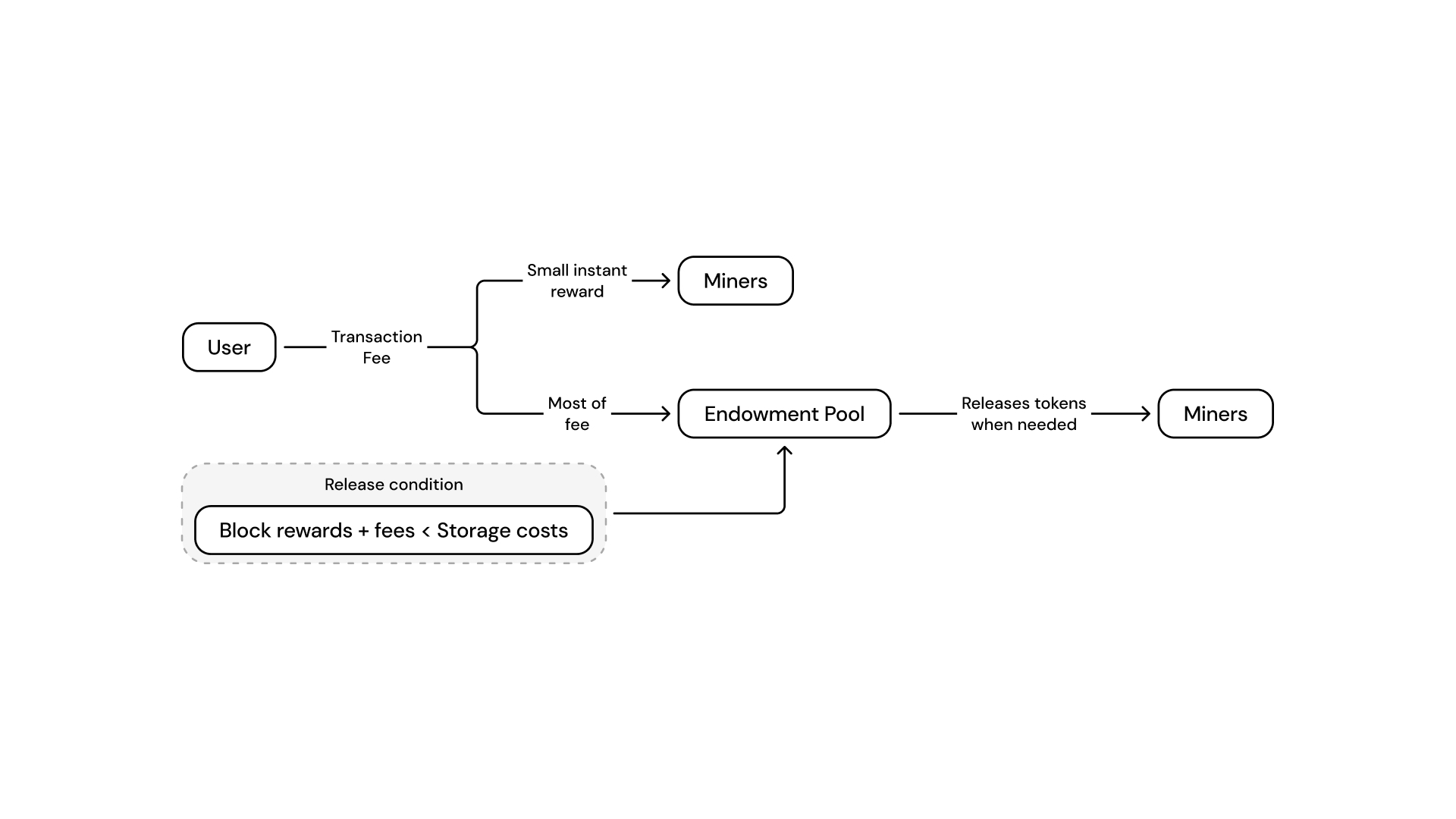
At the incentive level, miners receive rewards for providing storage and verification services. These rewards come not only from block rewards, but may also come from economic mechanisms within the network, such as the release of reserve funds.
One of Arweave’s key innovations is the Endowment mechanism. Most of the fees paid by users are not immediately distributed to miners. Instead, they enter a reserve pool, which is used to subsidize storage costs in the future. This design enables the network to support “permanent storage.”
Overall, AR is more than a payment tool. It is the core element that sustains the long term storage economic model. Related topics include “Arweave Tokenomics” and the “Endowment Model.”
Arweave Use Cases: Data Storage, NFTs, and Decentralized Websites
Arweave is mainly used in scenarios that require long term data preservation. In the NFT sector, for example, metadata typically needs to remain accessible over the long term, and Arweave can provide stable storage support.
For content storage, users can upload articles, images, or files to the network, enabling long term preservation that is resistant to tampering. This feature is suitable for archival records, academic data, and public information storage.
Arweave also supports decentralized websites, meaning Permaweb applications. These websites do not need to rely on traditional servers. They can continue running over the long term while keeping their content unchanged. Related applications include “NFT storage solutions” and “decentralized website architecture.”
For this reason, Arweave plays more of a “data layer” role in Web3 than that of a single application platform.
Differences Between Arweave and Other Storage Protocols: IPFS / Filecoin Comparison
In decentralized storage, Arweave, IPFS, and Filecoin are common solutions, but they differ clearly in design philosophy. Arweave focuses on “permanent storage,” while IPFS is more of a data distribution protocol, and Filecoin emphasizes a storage marketplace.
In terms of storage model, Arweave uses a one time payment model, while Filecoin uses an ongoing payment mechanism. This means Arweave is better suited to long term storage needs, while Filecoin is more flexible but requires continuous fee maintenance.
In terms of incentives, Arweave uses a reserve pool mechanism to smooth out long term costs, while other protocols usually distribute fees directly to nodes. Related comparisons include “Arweave vs IPFS” and “Filecoin storage model comparison.”
Overall, these three approaches represent different storage philosophies: permanence, distribution, and market based storage.
Arweave’s Advantages, Limitations, and Common Misconceptions
Arweave’s main advantage lies in its permanent storage capability, allowing data to exist over the long term without continuous maintenance costs. This is highly important for applications that require strong reliability.
However, the system also has certain limitations. For example, permanent storage means that once data is uploaded, it is difficult to delete, which may create problems in some scenarios. In addition, its economic model depends on the assumption that long term storage costs will decline, which has led to discussions about sustainability.
One common misconception is to view Arweave as an ordinary storage network. In reality, it is closer to “data infrastructure.” Its core lies in the combination of storage and verification mechanisms, rather than simple data hosting.
Therefore, understanding Arweave requires looking at both its technical structure and its economic model, rather than focusing on only one dimension.
Conclusion
Through its Blockweave architecture and Endowment economic model, Arweave builds a blockchain network centered on “permanent storage.” Its core value lies in turning data from a “short term resource” into a “long term asset,” providing stable data infrastructure for Web3.
Although challenges remain around cost and sustainability, Arweave offers a distinctive path in decentralized storage: using a one time payment to achieve long term data availability. This model opens up new possibilities for blockchain applications.
FAQ
What Is Arweave (AR)?
Arweave is a blockchain network that supports permanent data storage through a one time payment model.
What Is the Permaweb?
The Permaweb is a decentralized network built on Arweave, where all content can remain accessible over the long term and resist tampering.
How Does Arweave Achieve Permanent Storage?
It combines the Blockweave architecture and Proof of Access mechanism with the Endowment economic model to create long term incentives.
What Is the Difference Between Arweave and IPFS?
Arweave emphasizes permanent storage, while IPFS focuses more on data distribution and does not guarantee long term preservation.
How Are Arweave Storage Fees Calculated?
Users pay a one time fee, and part of that fee enters a reserve pool used to support future storage costs.







