Traditional internet payment systems are primarily designed around humans and platforms, but machine-to-machine economic activities demand infrastructure with lower latency, greater automation, and stronger trust. SEALCOIN delivers a scalable decentralized architecture for Machine-to-Machine (M2M) transactions—powered by device identity verification, on-chain settlement, and Smart Contract mechanisms.
As blockchain extends beyond finance into AI, IoT, and real-world infrastructure, the machine economy has emerged as a key frontier where Web3 merges with smart devices. The Transactional IoT network represented by SEALCOIN goes beyond device connectivity to equip machines with autonomous trading and collaboration capabilities.
What Is the Core Goal of SEALCOIN?
SEALCOIN's core mission is to enable machines—like internet users—to autonomously handle payments, resource calls, and data exchanges. While traditional IoT platforms focus on "device connectivity," SEALCOIN takes the next step by building an economic system for machines.

In an autonomous machine economy, devices require identity verification, real-time payments, and trusted interactions. For instance, self-driving cars may need to automatically pay parking fees, industrial robots may need to purchase data services in real time, and AI Agents may need to autonomously invoke APIs and computing resources.
How Does SEALCOIN Work?
SEALCOIN’s operational logic can be understood as a "decentralized payment network for the machine world." The system comprises four layers: device identity, distributed ledger, automatic settlement, and market.
Device Identity Authentication
SEALCOIN assigns a trusted digital identity to each IoT device and AI Agent. Devices must pass security authentication and key verification to ensure transaction sources are trustworthy and verifiable.
This identity mechanism affects not only transaction security but also whether devices can participate in the machine market and service network. Closely tied to this mechanism are two key components of the machine economy: "SEALCOIN’s PoSy security model" and "device staking."
Hedera Distributed Ledger Network
SEALCOIN is built on Hedera to record transactions, achieve consensus ordering, and enable on-chain payments. Hedera’s high throughput and low fees make it ideal for high-frequency, micro-value machine payments.
Compared to traditional blockchains, Hedera emphasizes real-time performance and enterprise-grade scalability, making it a common choice for IoT and data trading infrastructure.
Smart Contracts and Automatic Settlement
SEALCOIN uses Smart Contracts to facilitate automatic transactions between machines. For example, drones can automatically locate charging stations and pay when battery levels run low; smart sensors can sell data in real time and settle automatically.
The entire process operates without a centralized payment platform—transactions and settlements are executed automatically via on-chain rules.
What Role Does QAIT Play in the SEALCOIN Ecosystem?
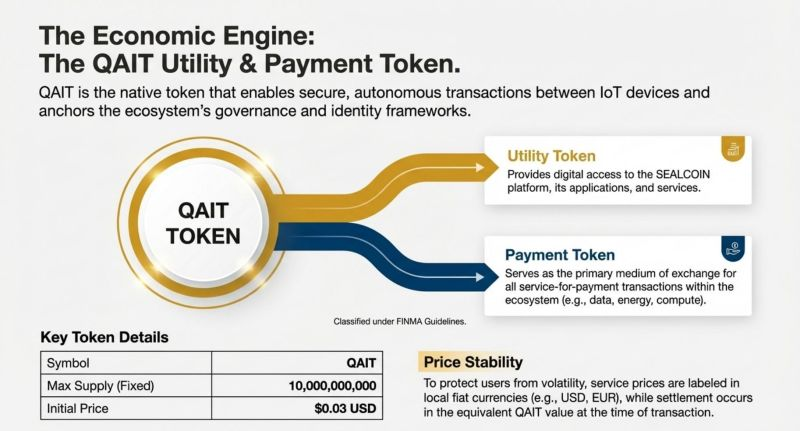
QAIT is the native utility and governance Token of the SEALCOIN ecosystem, serving functions in payments, network security, and ecosystem governance.
Machine Payment Medium
QAIT is used for real-time payments and settlements between machines—covering data call fees, API service fees, automated resource procurement, and AI Agent task execution fees. As many machine economy transactions are high-frequency and small-value, a low-cost, automated payment medium is essential.
Governance and Ecosystem Participation
QAIT holders can participate in protocol governance, including decisions on network parameter adjustments, ecosystem proposals, and system upgrades. This governance structure allows SEALCOIN to evolve continuously without centralized control.
PoSy Security Mechanism
SEALCOIN introduces a Proof-of-Security (PoSy) mechanism to verify device trustworthiness. Devices must use QAIT to participate in security verification and staking. If a device acts maliciously or violates rules, the staked assets may be penalized. The PoSy mechanism enables the machine network to establish an on-chain trust system.
What Is the Autonomous Machine Economy?
The autonomous machine economy refers to a network where devices, AI Agents, and automated systems independently complete economic activities. In this system, machines not only execute tasks but also possess the ability to pay, trade, and collaborate on resources.
In traditional internet environments, users typically initiate transactions. The machine economy, however, emphasizes autonomous collaboration between devices. For example, smart cars can automatically pay charging fees, smart grids can settle energy trades automatically, AI Agents can autonomously procure computing resources, and industrial equipment can exchange sensor data in real time.
These scenarios together form a Machine-to-Machine (M2M) economic system. SEALCOIN is regarded as one of the key payment and identity infrastructure components in this machine economy.
The biggest difference between SEALCOIN and traditional IoT platforms is whether they support "autonomous machine transactions."
| Comparison Dimension |
Traditional IoT Platform |
SEALCOIN |
| Core Goal |
Device Connectivity |
Autonomous Device Transactions |
| Identity System |
Centralized Accounts |
Decentralized Device Identities |
| Payment Model |
Platform Settlement |
On-Chain Real-Time Payment |
| Data Exchange |
Centralized API |
Decentralized Market |
| Automation Capability |
Limited |
AI Agent Autonomous Collaboration |
| Trust Mechanism |
Platform Guarantee |
Cryptography and PoSy |
Traditional IoT focuses on device networking and data management, while SEALCOIN emphasizes the flow of value and economic collaboration among machines.
What Are the Application Scenarios for SEALCOIN?
SEALCOIN is designed around "autonomous device transactions," with use cases spanning multiple IoT and AI domains.
Smart Energy Networks
Smart grids and energy devices can automatically complete electricity trading and fee settlement, enabling a decentralized energy market.
Autonomous Driving and Smart Transportation
Vehicles can automatically pay parking fees, tolls, and charging fees, reducing human intervention.
AI Agent Service Market
AI Agents can autonomously call data, purchase API services, and execute automated tasks.
Industrial IoT
Industrial equipment can coordinate production resources and maintenance services in real time, improving the efficiency of automated collaboration.
DePIN and Device Networks
SEALCOIN is also used in DePIN scenarios, providing payment and identity layer support for real-world device networks.
What Challenges Does SEALCOIN Face?
Although the machine economy holds long-term potential, its infrastructure is still in the early stages.
The IoT industry currently suffers from standard fragmentation—different hardware manufacturers and protocols lack unified standards, potentially hindering device interoperability. AI systems engaging in autonomous transactions may also raise issues of liability attribution and data regulation.
The value of the machine economy depends on device scale and ecosystem participation, requiring long-term network expansion. Additionally, device identity, data privacy, and automated transaction security remain significant challenges.
Summary
SEALCOIN builds decentralized payment and device identity infrastructure around the autonomous machine economy, enabling IoT devices, AI Agents, and smart systems to autonomously handle payments, resource collaboration, and data trading.
As the ecosystem’s core Token, QAIT not only serves payment and governance functions but also supports device trustworthiness through the PoSy mechanism.
FAQs
What is QAIT used for?
QAIT is used for machine payments, device access, on-chain governance, market settlement, and the PoSy security mechanism. It is the core functional Token in the SEALCOIN ecosystem.
What is the autonomous machine economy?
The autonomous machine economy is an economic network where devices and AI Agents can autonomously complete payments, data exchanges, and resource collaboration without human intervention.
Which blockchain does SEALCOIN use?
SEALCOIN is built on the Hedera distributed ledger technology, enabling a high-throughput, low-cost machine payment network.
What is PoSy (Proof-of-Security)?
PoSy is SEALCOIN’s security verification mechanism that enhances device trustworthiness through staking and identity authentication, reducing the risk of malicious devices.