AI and energy systems are undergoing a concurrent structural transformation—this is not a one-industry cyclical shift but a fundamental reallocation at the infrastructure level. As computing power emerges as a critical global competitive resource, the mode and stability of energy supply directly dictate the pace of AI system expansion. In this context, the battery industry’s role is being redefined, evolving from a traditional EV support sector into an integral part of AI infrastructure.
Samsung SDI stands as a prime example of this structural change.
It is not merely an EV battery manufacturer; it is a core South Korean energy enterprise actively riding two growth curves: power batteries and energy storage systems (ESS). Against the backdrop of rapid AI data center expansion, this “dual-cycle superposition” is reshaping the valuation logic of the entire new energy value chain.
How the AI and Energy Storage Dual Cycles Are Reshaping the Global Energy System
Over the past decade, the battery industry’s core growth stemmed from rising EV adoption. But in the AI era, the energy demand structure has shifted dramatically. AI data centers require high-density, continuous computation, meaning their energy needs go beyond “total volume increases” to “significantly higher stability requirements.” As AI model training scales up, data centers become acutely sensitive to power supply fluctuations—any interruption can halt computations or cause data loss.
Under this paradigm, energy storage systems transition from auxiliary equipment to core infrastructure. Batteries are no longer confined to vehicles; they now enter data center power regulation systems.
Thus, the industry now has two parallel drivers: long-term demand growth from EVs, and AI-driven demand for energy stability. This “dual-cycle structure” has become the core logic for revaluing the global battery industry.
South Korea’s New Energy Value Chain: From Materials to System Integration
South Korea has built a relatively complete new energy value chain, spanning upstream materials, midstream battery manufacturing, and downstream applications. Upstream includes lithium battery materials, cathode/anode materials, and high-end electronic chemicals—this segment determines battery performance fundamentals. Midstream is anchored by Samsung SDI, LG Energy Solution, and SK On, which together hold a significant share of the global power battery market. Downstream extends to automotive, ESS, and industrial energy solutions.
Samsung SDI’s position in this chain goes beyond manufacturing; it extends into materials and systems, giving it a semi-vertical integration profile. This structure enables faster responses to market changes during technology upgrade cycles.
In-Depth Analysis of Samsung SDI’s Industry Positioning and Technology Roadmap
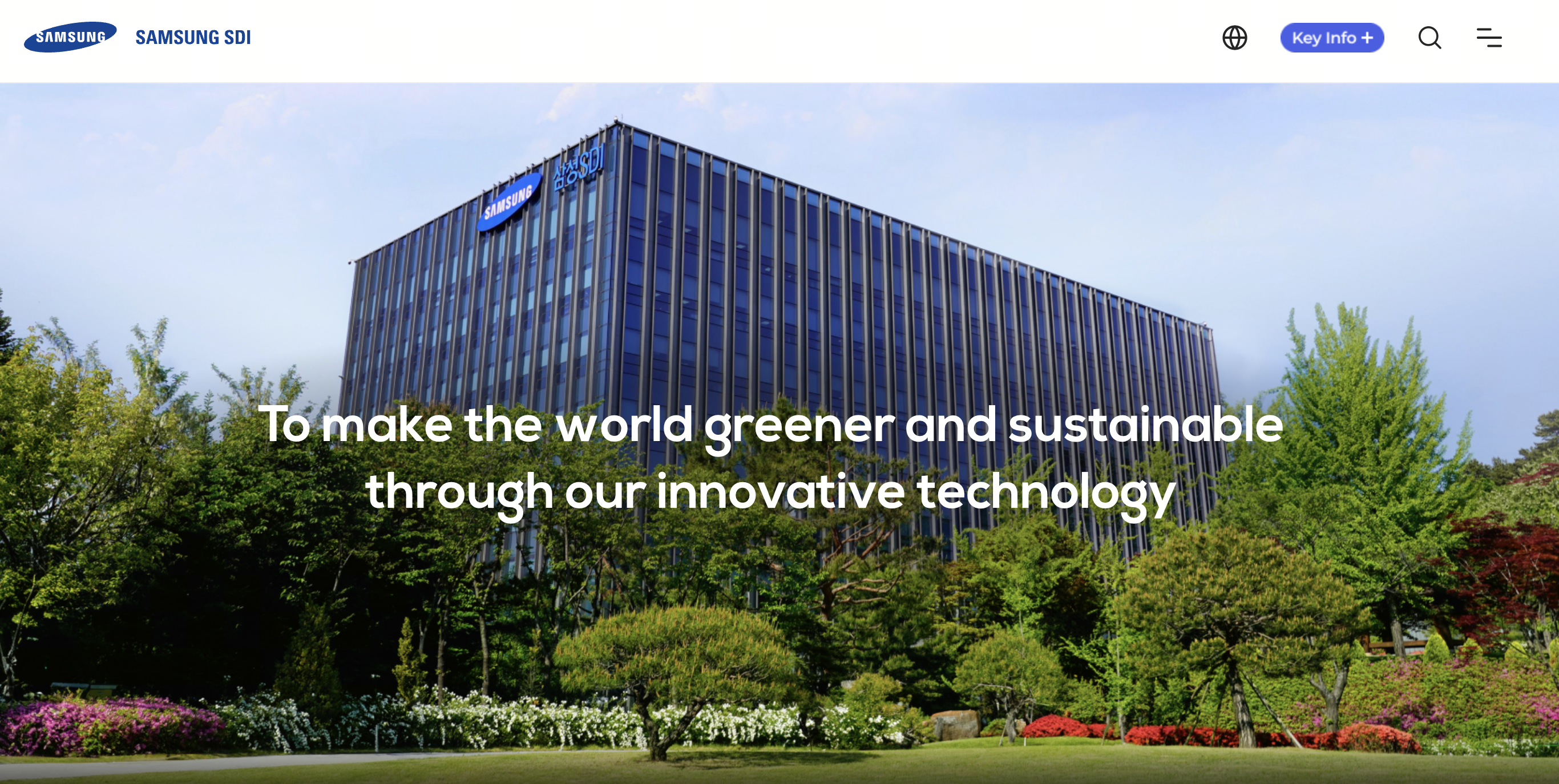
Samsung SDI’s positioning in the global battery industry is distinctly differentiated. Its core strategy prioritizes technology over scale. The company has long focused on high-nickel battery systems, emphasizing high energy density and safety, targeting the premium EV market. This tilts its customer base toward high-end brands like BMW and Mercedes-Benz, rather than low-cost mass-market models.
At the same time, Samsung SDI is advancing solid-state battery R&D—widely seen as the next frontier in battery technology. Solid-state batteries offer higher energy density and lower safety risks than traditional lithium-ion cells, though commercialization remains nascent.
In energy storage, the company is expanding its ESS portfolio, transforming from an “EV battery supplier” into an “energy system solution provider.”
Competitive Landscape and Divergence with LG Energy Solution and SK On
South Korea’s battery industry has a clear tripartite structure. LG Energy Solution leads in market share, SK On relies on Hyundai and SK Group orders, and Samsung SDI differentiates through technology. LG prioritizes scale expansion, using production capacity to capture market share; SK On is more dependent on automotive group supply chains; Samsung SDI emphasizes technological moats and premium positioning.
This divergence creates a complementary structure within the industry, and each company commands a different valuation logic in capital markets. Samsung SDI’s volatility is more tied to technology cycles than pure capacity expansion.
How AI Data Centers Become a New Engine for Energy Storage Demand
The rapid expansion of AI data centers is transforming energy demand patterns. Traditional data centers rely on stable grid power, but AI clusters are highly sensitive to power fluctuations. In this context, energy storage plays a critical role in load smoothing, backup power, and energy efficiency. This shift fundamentally alters the battery industry’s demand structure—no longer tied solely to automakers, but now also linked to AI infrastructure development.
Samsung SDI holds a natural advantage here, covering both power batteries and ESS.
How Gate’s Korean Stock Trading Connects South Korean New Energy Assets
With Gate’s launch of Korean stock trading, South Korean new energy assets enter a global unified trading system. The key change is account structure unification and settlement asset standardization. Investors no longer need a local Korean brokerage account; they can trade KOSPI stocks through a single platform.
The system uses USDT as the pricing and settlement asset, allowing Korean stocks to coexist with other global asset classes in one account, boosting allocation efficiency.
Complete Process and Mechanism for Investing in Samsung SDI on Gate
In practice, the investment process follows four standardized steps within a unified account.
-
Complete registration and identity verification to obtain stock trading permissions.
-
Transfer USDT from your spot account to the stock account as trading capital.
-
Enter Korean stock trading, search for Samsung SDI, and access the trading interface. When placing an order, you can choose market or limit orders.
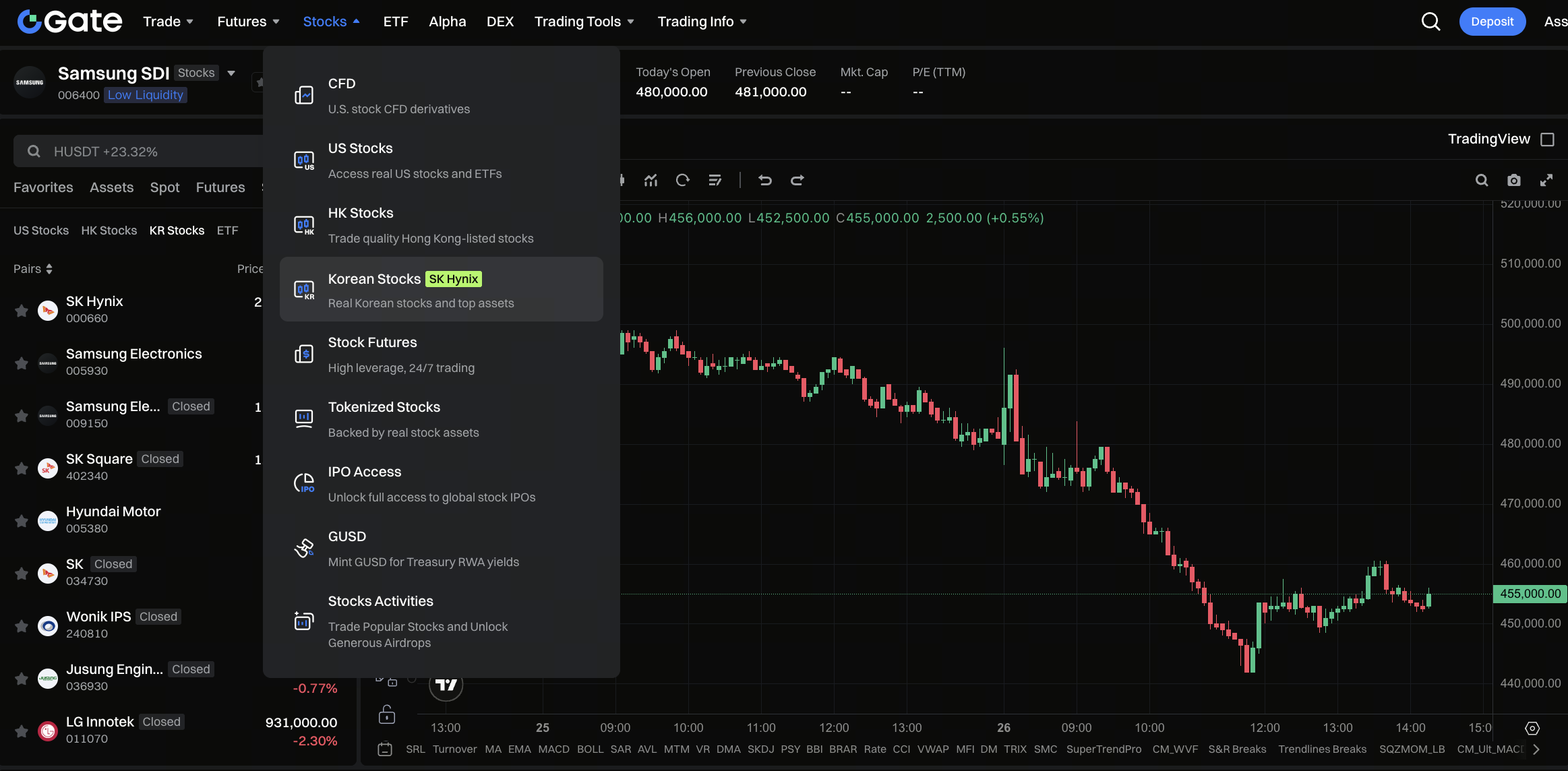
- After execution, positions automatically enter the unified asset system, managed alongside US and Hong Kong stocks for cross-market portfolio allocation.
Industry Cycles, Profit Structure, and Market Pricing Logic
Samsung SDI’s valuation is driven by three main cycles. First, the EV cycle determines baseline demand. Second, the energy storage cycle defines the new growth curve. Third, the raw material cycle impacts profit margins. When EV demand slows, energy storage demand becomes a growth buffer; falling lithium and nickel prices improve margins; and technology upgrades trigger valuation re-rating.
Thus, its stock performance exhibits a clear multi-cycle superposition, rather than being driven by a single industry cycle.
Risk Structure: Long-Term Uncertainty for New Energy Assets
Despite its long-term growth narrative, Samsung SDI remains a high-volatility asset. Key risks include industry cycle shifts (e.g., periodic EV sales slowdowns), technology roadmap uncertainty (e.g., solid-state battery commercialization timelines), and global supply chain changes that may affect order stability.
Moreover, the energy storage market is still in early expansion, with demand volatility higher than traditional energy sectors, giving the asset a strongly cyclical profile.
Conclusion: South Korea’s Battery Leader in the Energy System Assetization Trend
Samsung SDI’s role is evolving profoundly—from a battery manufacturer to an energy infrastructure provider. In the AI and energy storage dual-cycle era, the battery industry is no longer just a subset of new energy; it is a critical component of the global energy system.
By incorporating South Korea’s KOSPI new energy assets into a unified trading system, Gate enables global investors to participate directly in this structural cycle, building a more comprehensive asset allocation framework amid the global energy transformation.
FAQs
Q1: What is Samsung SDI’s core business?
Power batteries, energy storage systems (ESS), and high-end electronic materials.
Q2: How is it different from LG Energy Solution?
SDI focuses on technology routes and the premium market; LG focuses on scale expansion.
Q3: Why does AI affect the battery industry?
AI data centers need stable power, driving energy storage demand.
Q4: Do I need a Korean brokerage to trade on Gate?
No, KOSPI trading can be done directly on the platform.
Q5: Is it more suitable for long-term investment?
It is more of a cyclical growth asset, suitable for medium-to-long-term allocation and structural investment.







