As a major player in the global medical device industry, BDX (Becton, Dickinson and Company) has long focused on medical consumables, diagnostic systems, and life science tools. Unlike many medical companies that specialize in a single device, BDX’s products are widely deployed in hospitals, laboratories, research institutions, and public health systems, making it a cornerstone of global healthcare infrastructure.
BDX Medical Service Scenarios
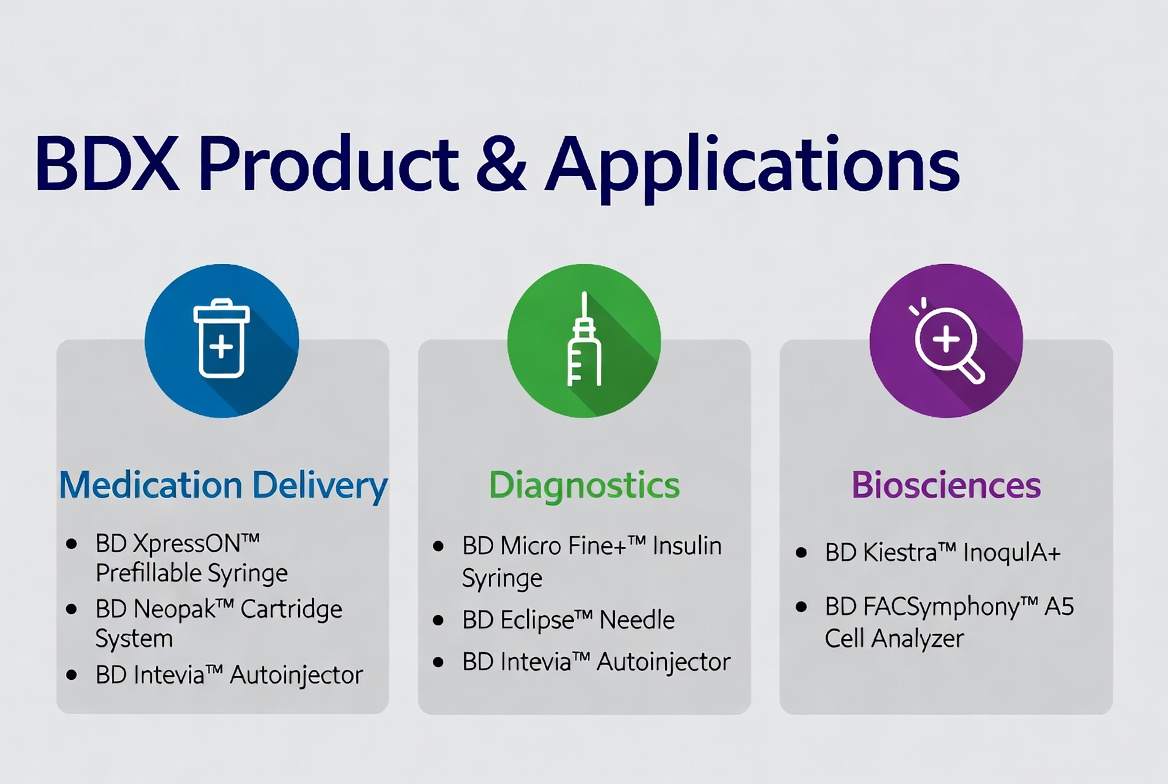
BDX's product portfolio spans multiple critical stages of modern healthcare. From the moment a patient enters the hospital through diagnosis, treatment, recovery, and ongoing health management, BDX products are integrated into the medical workflow.
In clinical settings, BDX provides essential tools such as syringes, needles, infusion systems, catheters, and drug delivery devices. These products are widely used in outpatient clinics, emergency rooms, inpatient wards, and operating rooms — forming an indispensable backbone of daily hospital operations.
At the same time, BDX is deeply involved in disease detection and laboratory operations. Its diagnostic products and automated detection systems are widely deployed in hospital clinical laboratories, disease control agencies, and medical laboratories, helping medical professionals perform sample analysis and disease screening.
Beyond direct medical care, BDX also supports the life science research field. A large number of university labs, biotech companies, and pharmaceutical R&D institutions worldwide use BDX's research tools and experimental consumables. Thus, the company is involved not only in disease treatment, but also in medical innovation and scientific progress.
BDX's Injection and Drug Delivery Systems
When most people think of BDX, syringes and needles come to mind first. In reality, these seemingly simple consumables are among the most fundamental and essential components of modern healthcare.
Every day, hospitals use a vast number of injection products for vaccinations, intravenous infusions, drug injections, and blood collections. This places extremely high demands on product safety, stability, and supply chain reliability. Leveraging decades of manufacturing expertise and a global supply network, BDX has become a trusted partner for countless medical institutions.
As medical technology advances, drug delivery systems have grown in importance. More and more treatment protocols — such as oncology therapy, biologic treatments, and long-term chronic disease management — require precise control over dosage and delivery. By improving injection device design and drug delivery technology, BDX enhances treatment efficiency and reduces clinical risk.
To an individual patient, these products may seem like ordinary tools in a single procedure. But for the entire healthcare system, they form the critical foundation that enables clinical treatment to proceed smoothly.
BDX's Diagnostic Equipment
Modern medicine increasingly emphasizes early detection, early diagnosis, and precision treatment — a shift that has made diagnostic equipment a vital part of the healthcare system.
BDX has a long-standing presence in diagnostics, with products covering sample collection, lab testing, and automated analysis. Whether a patient undergoes a blood test, infection screening, or disease detection, a wide range of diagnostic devices and lab tools work together behind the scenes.
For hospital labs, improving testing efficiency and accuracy is the top priority. As testing volumes grow, traditional manual workflows can no longer keep pace. BDX helps healthcare institutions optimize processes through automated platforms and lab solutions, boosting sample throughput and test efficiency.
In public health management, diagnostic systems also play a crucial role — from disease surveillance and epidemic control to infectious disease screening, all depend on reliable testing technology. As a result, the diagnostics business has become an essential bridge linking BDX to both clinical and public health systems.
BDX's Products
Aging populations and rising chronic disease rates are reshaping the medical industry. More and more healthcare resources are being directed toward long-term disease management rather than short-term acute treatment.
Chronic conditions like diabetes, cardiovascular disease, kidney disease, and cancer require ongoing monitoring and continuous treatment. Patients need regular testing, medication management, and health monitoring — all of which rely on medical devices as critical support.
Many of BDX's products are closely tied to chronic disease management. For example, injection systems enable long-term drug therapy, diagnostic tools facilitate disease monitoring, and lab equipment helps doctors track patient health over time.
As healthcare transitions from "disease treatment" to "health management," the value of medical devices continues to rise. For BDX, this means its products will become even more deeply embedded in the entire patient care cycle.
BDX's Life Science Solutions
Beyond hospitals and clinics, life science research is another key business area for BDX.
Life science research spans basic medicine, biotechnology, drug development, and disease mechanism studies. Whether in university labs or global pharmaceutical companies, a vast array of experimental equipment and research consumables is needed to support scientific work.
BDX's life science tools are widely used in cell analysis, sample processing, experimental testing, and data collection. These products help researchers improve experimental efficiency while ensuring reliable and consistent results.
In recent years, the rapid growth of precision medicine, gene therapy, and the biotech industry has further expanded the life science market. With global R&D investment continuing to climb, life sciences are emerging as a major growth area in the medical device industry — and BDX is a key participant.
Why Global Healthcare Expansion Drives BDX's Long-Term Growth
Over the long term, BDX's success depends not just on individual products or technological breakthroughs, but on the overall expansion of the global healthcare system.
As the world population grows and medical services become more accessible, more countries are increasing their investment in healthcare infrastructure. New hospitals, lab upgrades, and improvements to public health systems all require large quantities of medical equipment and consumables. This trend creates sustained growth opportunities for the medical device industry.
At the same time, aging populations are driving a long-term increase in healthcare demand. Older patients typically need more testing, treatment, and health management services — all of which rely on medical devices. As global healthcare spending rises, the importance of the medical device industry continues to strengthen.
For BDX, whose products span treatment, diagnostics, and research, this means it can benefit simultaneously from multiple trends: growth in medical services, technological advancements, and rising R&D investment. This is a key reason why BDX has maintained its strong industry position for such a long time.
Conclusion
BDX (Becton, Dickinson and Company) is deeply embedded in the global healthcare system through its medical consumables, drug delivery systems, diagnostic equipment, and life science tools. From hospital care and disease detection to chronic disease management and research innovation, BDX's products cover multiple critical touchpoints in the healthcare journey. With an aging population, growing medical demand, and ongoing infrastructure improvements, the importance of the medical device industry continues to rise — and BDX remains a key player in the global medical ecosystem.
FAQ
What is BDX's most well-known product?
BDX is best known for its syringes, needles, infusion systems, and various clinical medical consumables.
Which types of institutions primarily use BDX products?
They are mainly used in hospitals, clinics, laboratories, research institutions, disease control centers, and biotech companies.
Does BDX have a diagnostics business?
Yes. Diagnostics is a core part of BDX, covering sample collection, lab testing, and automated analysis.
Why can BDX benefit from the healthcare industry over the long term?
Because its products address foundational medical needs, with high recurring consumption and repeat purchasing — resulting in relatively stable demand.
Who are the main customers of BDX's life science business?
The main customers include university labs, research institutions, biotech companies, and pharmaceutical firms.
How does global medical demand growth affect BDX?
Growth in healthcare spending, an aging population, and expansion of medical infrastructure all increase demand for medical devices, thereby driving BDX's business forward.