There is no absolute superiority between the two architectures; each is better suited for solving different types of problems. For applications that require open node networks and edge deployment, Bless offers a new computing model; for businesses that need stable enterprise-grade cloud services and a rich product ecosystem, AWS remains one of the most mature cloud computing platforms today.
Understanding their design philosophies, resource management methods, and applicable scenarios helps developers choose the most appropriate computing infrastructure based on actual needs.
What is Bless
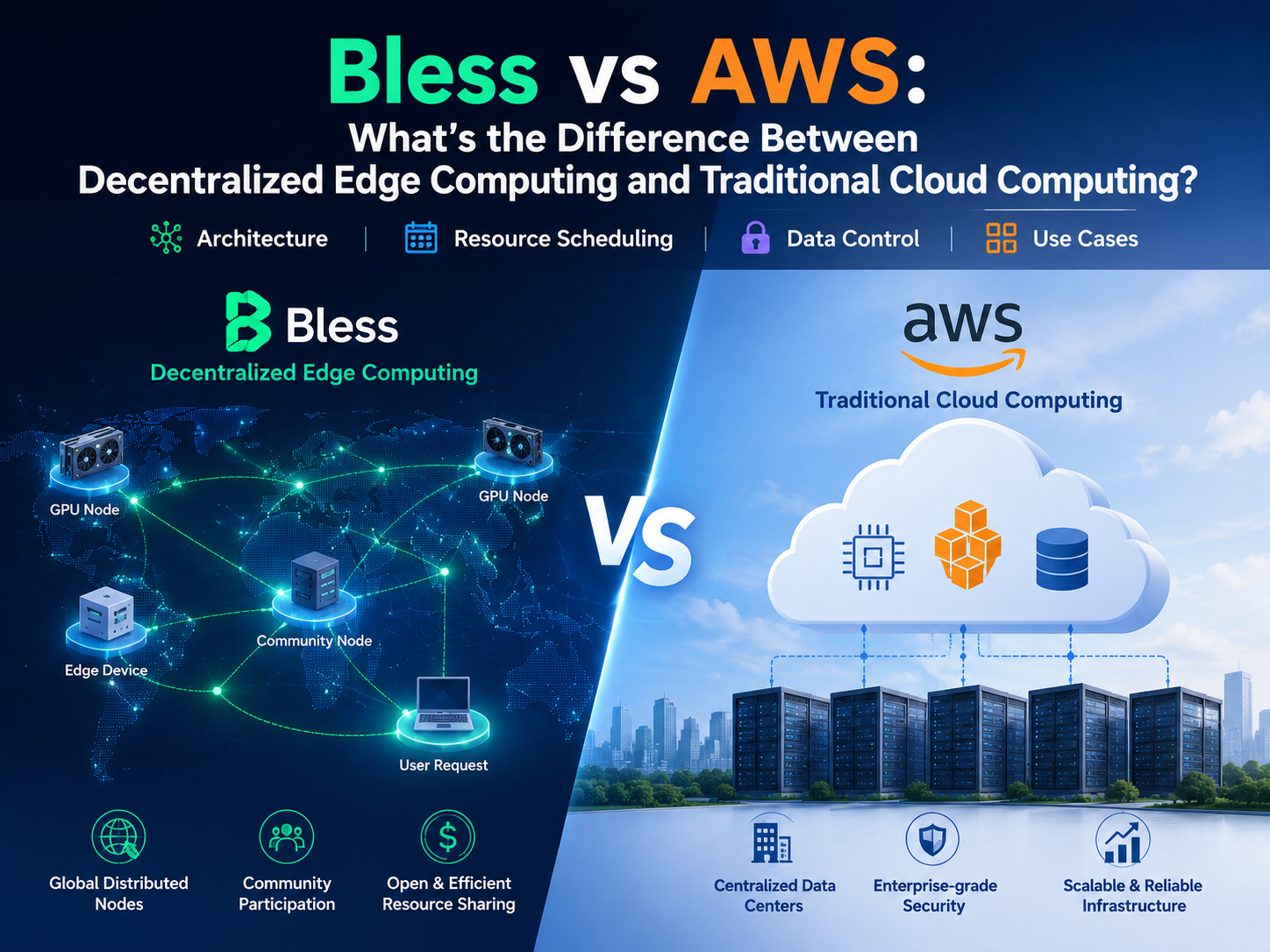
Bless is a decentralized edge computing network that aims to integrate globally distributed computing resources, such as CPUs and GPUs, into a unified Shared Computer, providing on-demand computing power for AI inference, machine learning, and Web3 applications. Compared to traditional cloud platforms, Bless emphasizes open node networks and resource sharing.
Computing resources in the Bless network are jointly provided by nodes in different regions. After a developer submits a task, the network dynamically schedules the task based on resource requirements and node status, rather than relying on a fixed data center. This design enables continuous network scaling and improves computing resource utilization.
For Bless, computing resources themselves are a key part of the network ecosystem, so resource supply, task scheduling, and node incentives together form the entire decentralized computing system.
What is AWS Cloud Computing
AWS (Amazon Web Services) is a cloud computing platform launched by Amazon that provides enterprises and developers with a wide range of cloud services, including computing, storage, databases, networking, security, and AI. Developers can rent virtual servers, GPU instances, and other infrastructure on demand without having to build their own data centers.
AWS resources are primarily deployed across multiple global regions and Availability Zones, built, operated, and maintained uniformly by Amazon. Users can quickly deploy applications through the console or API calls and flexibly adjust resource configurations based on business scale.
After years of development, AWS has formed a complete cloud service ecosystem, widely used in enterprise digitalization, AI training, big data analytics, and SaaS platforms, making it one of the largest public cloud platforms globally.
What are the differences between the two computing architectures?
The most fundamental difference between Bless and AWS lies in how computing resources are organized. Bless connects distributed computing resources from different global nodes into a unified network and schedules tasks through protocols; AWS centrally builds and manages infrastructure and then provides standardized cloud services to users.
Due to the architectural differences, the two also differ in resource expansion methods, network control rights, and deployment models. Bless emphasizes open networks and node collaboration—as more nodes join, the overall computing power of the network can grow continuously; AWS relies on data center expansion and cloud service systems to provide unified management and a stable operating environment for enterprises.
| Comparison Dimension |
Bless |
AWS |
| Basic Architecture |
Decentralized edge computing network |
Centralized cloud computing platform |
| Resource Source |
Globally distributed nodes |
Amazon data centers |
| Network Control |
Protocol coordinates nodes |
Amazon centrally manages |
| Expansion Method |
Nodes continuously join network |
Data centers continuously expand |
| Deployment Model |
Edge node collaboration |
Unified deployment across cloud regions |
From an architectural perspective, Bless is more suitable for building open computing networks, while AWS emphasizes enterprise-grade infrastructure services. They represent two different development paths, not a simple substitution.
What are the differences in resource scheduling and cost structure?
Both Bless and AWS can allocate resources based on computing needs, but their scheduling methods differ. Bless dynamically matches computing tasks among distributed nodes through protocols, while AWS manages server resources centrally and assigns computing instances based on user configurations.
For developers, Bless focuses on the collaborative use of open computing resources, allowing different nodes to continuously join the network and provide hashrate; AWS relies on standardized cloud products and a mature resource management system to deliver stable, predictable computing services. The two models differ significantly in resource acquisition and expansion logic.
The cost structure also reflects the differences between the two architectures. AWS fees typically consist of computing instances, storage, network traffic, and other cloud services, while Bless resource consumption is directly related to computing tasks and resource calls within the network. The specific billing method will be based on the official rules published by Bless.
| Comparison Dimension |
Bless |
AWS |
| Resource Scheduling |
Protocol dynamically matches nodes |
Platform uniformly schedules resources |
| Hashrate Source |
Distributed nodes |
Cloud server clusters |
| Expansion Method |
Nodes continuously join network |
Add cloud instances or expand clusters |
| Cost Composition |
Computing resource calls |
Instance, storage, traffic, and other cloud service fees |
| Resource Management |
Network collaboration |
Platform centralized management |
Different resource scheduling models determine their suitability for different types of businesses. Bless emphasizes resource sharing and open collaboration, while AWS is more suitable for enterprise environments that need stable cloud resources and mature operations.
How do data control rights and security mechanisms differ?
The main difference in data control between Bless and AWS stems from their different network architectures. AWS adopts a centralized cloud service model where data storage, access control, and security mechanisms are uniformly managed by the platform, providing comprehensive identity authentication, permission management, and security product systems.
Bless focuses more on decentralized collaboration of computing resources. According to its official documentation, the network uses a WebAssembly (WASM) execution environment to run computing tasks, improving cross-platform compatibility through a unified runtime and enhancing security isolation during task execution with a sandbox mechanism.
It is important to note that a decentralized network does not mean giving up security; instead, it achieves a security model different from traditional cloud platforms through protocols and node collaboration. Enterprises should choose the appropriate deployment method based on data sensitivity, compliance requirements, and business characteristics.
Which applications are better suited for Bless, and which for AWS?
Bless is more suitable for applications that require open node networks, elastic computing resources, and edge deployment capabilities. For example, AI inference, intelligent agents, Web3 infrastructure, real-time data processing, and some edge computing scenarios can use distributed nodes to reduce latency and improve resource utilization efficiency.
AWS is more suitable for enterprise-level applications, internet platforms, large-scale SaaS services, and businesses that require a complete cloud product ecosystem support. Its mature database, networking, security, AI services, and global infrastructure enable enterprises to quickly build stable production environments.
The two platforms do not replace each other but each has its own advantages in different scenarios. With the development of hybrid cloud and distributed computing, future models may also involve traditional cloud computing working together with decentralized edge computing, allowing developers to choose more flexible infrastructure solutions based on different business needs.
| Application Scenario |
More Suitable for Bless |
More Suitable for AWS |
| AI Inference |
✓ |
✓ |
| Edge Computing |
✓ |
|
| Web3 Infrastructure |
✓ |
|
| Enterprise Business Systems |
|
✓ |
| SaaS Platforms |
|
✓ |
| Large-scale Cloud Services |
|
✓ |
For developers, there is no one-size-fits-all answer when choosing between Bless and AWS. The most important thing is to conduct a comprehensive evaluation based on application type, resource requirements, deployment method, and long-term operational costs.
Summary
Both Bless and AWS can provide computing resources, but they represent two different infrastructure design philosophies. Bless integrates globally distributed hashrate through a decentralized edge computing network, emphasizing open nodes, resource sharing, and dynamic scheduling; AWS relies on mature data centers and cloud service systems to provide enterprises with stable, unified cloud computing capabilities.
As AI applications and edge computing demands continue to grow, the two architectures are more likely to become complementary in the future, rather than simply competing. Understanding each one's resource organization, scheduling mechanisms, and applicable scenarios helps developers choose the more suitable computing platform based on business needs.
FAQ
What is the biggest difference between Bless and AWS?
Bless adopts a decentralized edge computing network, providing computing resources through distributed nodes; AWS uses a centralized cloud computing model, with Amazon building and managing global data centers uniformly.
Can Bless replace AWS?
Bless and AWS have different positioning. Bless is more suitable for open computing networks and edge deployment scenarios, while AWS is more suitable for enterprise-grade cloud services and mature production environments. They are more like different infrastructure choices.
Why does Bless use decentralized edge computing?
Bless aims to improve resource utilization by connecting globally distributed computing nodes, providing more flexible resource scheduling for AI inference and real-time computing, rather than relying on a single data center.
Why is AWS still the mainstream cloud computing platform?
AWS has a mature data center network, a rich set of cloud service products, and a comprehensive enterprise-grade security system, capable of meeting the stability, scalability, and operational needs of large-scale commercial applications.
Which applications are better deployed on Bless?
AI inference, intelligent agents, Web3 infrastructure, real-time data processing, and applications requiring edge deployment capabilities can better leverage the advantages of Bless's decentralized edge computing network.
Can Bless and AWS be used together?
Yes. In practice, enterprises can adopt a hybrid architecture based on different workloads, for example, deploying core business on a traditional cloud platform while using the Bless network for some AI inference or edge computing tasks, balancing stability and resource flexibility.







