With the growth of the Bitcoin Layer2 space, market demand for Bitcoin smart contracts, DeFi, and on-chain applications continues to rise. Stacks is one of the earliest projects to advance the Bitcoin application ecosystem, while BSquared represents the development direction of the new generation of Bitcoin Rollup.
What Is BSquared Network?
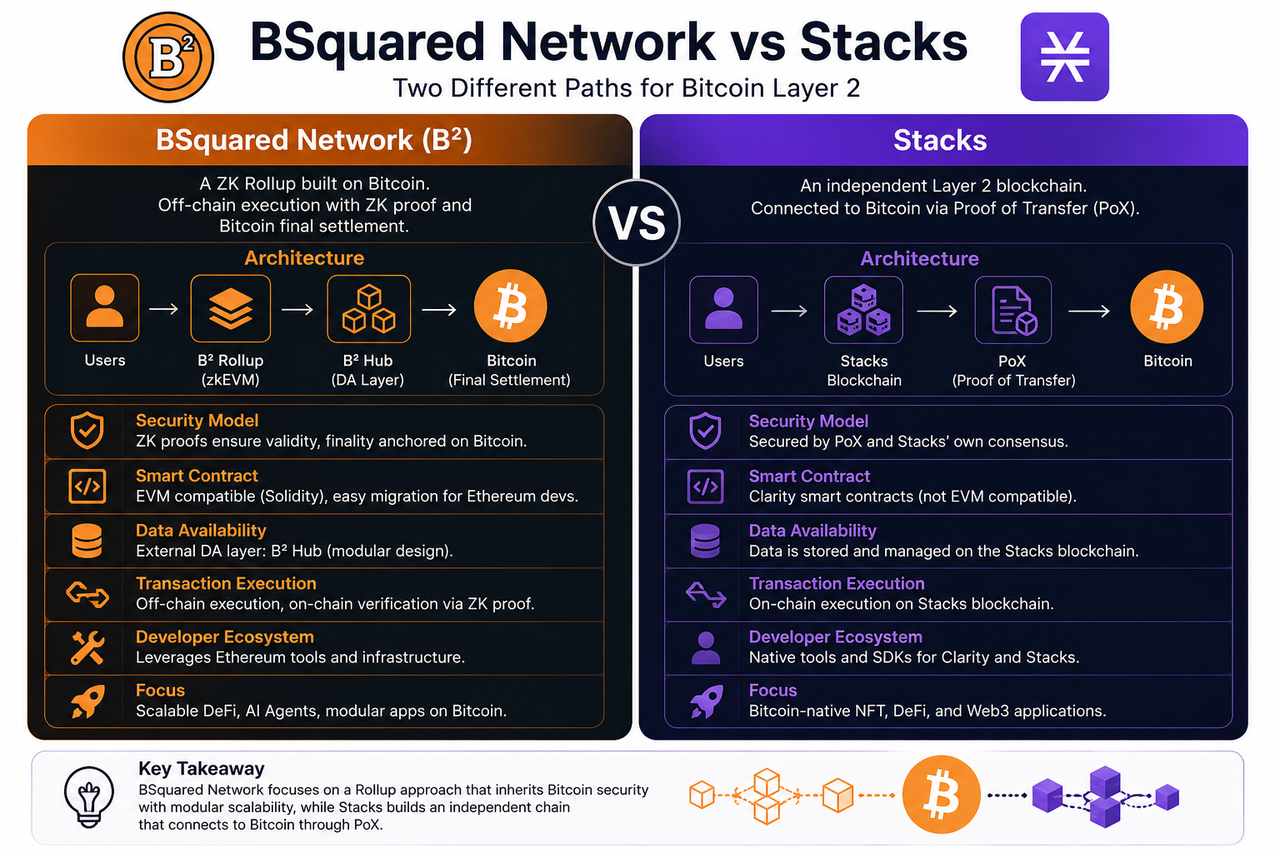
BSquared is a modular ZK Rollup network built on Bitcoin. Its core goal is to extend smart contracts and on-chain application capabilities while inheriting Bitcoin’s security. The network leverages B² Rollup for transaction execution, validates state changes through zero-knowledge proofs, and anchors critical data to the Bitcoin network for final settlement.
Beyond the execution layer, BSquared has built additional modules including B² Hub, Mining², and AI Signal, aiming to create a full ecosystem covering BTC DeFi, AI Agent, and modular applications.
From a technical standpoint, BSquared is closest to the Rollup scaling solutions seen in the Ethereum ecosystem.
What Is Stacks?
Stacks is a smart contract network built around Bitcoin. It connects to the Bitcoin network via the Proof of Transfer (PoX) mechanism and maintains its own block production and verification system. Developers can deploy smart contracts and decentralized applications on the Stacks network.
Stacks introduces the dedicated Clarity programming language to enhance the predictability and security of smart contracts. As an earlier Bitcoin smart contract platform, Stacks has established a mature ecosystem across NFTs, DeFi, and on-chain applications.
What Is the Biggest Difference Between BSquared Network and Stacks?
The biggest difference lies in the underlying architecture.
BSquared follows the Bitcoin Rollup model — off-chain execution and on-chain verification. Stacks, on the other hand, follows an independent chain model with its own blockchain, consensus mechanism, and state management system.
In simple terms, BSquared emphasizes using Bitcoin as the ultimate settlement layer, while Stacks focuses on building an independent smart contract network that remains connected to Bitcoin. This architectural distinction drives their different directions in performance, security models, and ecosystem growth.
How Do the Security Models Differ?
The security model is one of their most fundamental differences.
BSquared uses zero-knowledge proofs to verify execution results and ultimately anchors state to the Bitcoin network. As a result, Rollup state security is highly dependent on the Bitcoin network. Stacks relies on its own node network and PoX consensus to handle block production and state updates.
Although Stacks maintains a connection to the Bitcoin network, its operation does not rely entirely on Bitcoin node verification. Therefore, the two differ significantly in the degree of security inheritance and verification paths.
What Are the Differences in Smart Contract Architecture?
Both BSquared Network and Stacks support smart contracts, but they use different technical stacks.
BSquared uses a zkEVM execution environment that is compatible with Solidity and EVM development tools. Ethereum developers can migrate existing applications to BSquared Network with relatively low cost.
Stacks uses the Clarity smart contract language. Clarity is not EVM-compatible, so developers need to learn a new programming model and development framework.
For teams with EVM experience, the migration barrier differs significantly between the two.
How Do Transaction Execution Mechanisms Differ?
BSquared handles transaction execution primarily on the Rollup layer.
User transactions enter B² Rollup, are ordered by the Sequencer, and executed via zkEVM. The system then generates zero-knowledge proofs and submits them to the Bitcoin network for final verification. Stacks, by contrast, manages transaction execution and block generation through its own network. Nodes participate in consensus via the PoX mechanism and maintain their own state.
Thus, the transaction lifecycle and verification flow are distinctly different.
What Are the Differences in Data Availability Architecture?
Data availability is a crucial aspect of blockchain scaling.
BSquared introduces B² Hub as an independent data availability layer to store and manage Rollup data. This modular design separates the execution, data, and settlement layers. Stacks uses a traditional blockchain architecture where data and state are stored primarily on its own chain.
As a result, BSquared is more aligned with the current modular blockchain trend.
How Do Developer Ecosystems Compare?
The developer ecosystem is a key indicator of Layer2 maturity.
After years of development, Stacks has built ecosystems across NFTs, DeFi, infrastructure, and development tools. Its community primarily revolves around Clarity and Bitcoin-native applications. As a newer Bitcoin Rollup project, BSquared focuses on EVM compatibility, aiming to attract Ethereum developers into the Bitcoin ecosystem.
What Are the Differences in Use Cases?
Both BSquared Network and Stacks support Bitcoin ecosystem application development.
Stacks entered the market earlier, giving it an edge in NFTs, digital collectibles, and Bitcoin-native applications. BSquared focuses more on BTC DeFi, AI Agent, modular infrastructure, and cross-ecosystem deployment.
Thanks to its zkEVM architecture, BSquared can support a wider range of EVM-compatible use cases.
BSquared vs Stacks: Core Comparison
| Dimension |
BSquared Network |
Stacks |
| Technical Route |
ZK Rollup |
Independent Smart Contract Chain |
| Consensus Mechanism |
ZK Proof + Bitcoin Finality |
Proof of Transfer (PoX) |
| Smart Contracts |
Solidity, EVM-Compatible |
Clarity |
| Execution Environment |
zkEVM |
Stacks VM |
| Data Layer |
B² Hub |
Stacks Chain |
| Final Settlement |
Bitcoin |
Stacks Network |
| Migration Cost |
Lower |
Higher |
| Primary Positioning |
Bitcoin Rollup |
Bitcoin Smart Contract Platform |
Summary
BSquared Network and Stacks both aim to expand the Bitcoin ecosystem but have chosen different paths. BSquared, built on ZK Rollup architecture, enhances scalability via zero-knowledge proofs and Bitcoin final settlement. Stacks builds a complete smart contract platform through its own blockchain and PoX consensus.
From security models to development frameworks, execution mechanisms, and ecosystem focus, the two represent the two main directions: Bitcoin Rollup vs. Bitcoin Smart Contract Chain. As the Bitcoin Layer2 market continues to evolve, both architectures are likely to play key roles in different scenarios, jointly driving the growth of the Bitcoin application ecosystem.
FAQs
What is the biggest difference between BSquared and Stacks?
The biggest difference is the underlying architecture. BSquared uses ZK Rollup with Bitcoin final settlement, while Stacks has its own blockchain and PoX consensus mechanism.
Is BSquared compatible with Ethereum development tools?
Yes. BSquared uses a zkEVM architecture that supports Solidity and the EVM toolchain.
Why does Stacks use the Clarity language?
Clarity is a language designed specifically for smart contracts, emphasizing predictability and security to reduce common smart contract risks.
Which project relies more on Bitcoin network security?
BSquared’s state verification and final settlement are more directly dependent on the Bitcoin network, whereas Stacks connects to Bitcoin through the PoX mechanism.