Gate Stocks connects a USDT balance with supported stock and ETF trading on Gate. For Amazon Stock (AMZN), users should confirm product availability, regional eligibility, order types, fees, and product rules inside their account before placing any order.
Buying Amazon Stock with USDT is an operational process, not an investment recommendation. The key task is to understand how USDT funding, Gate Stocks access, order confirmation, fee review, and risk checks fit together before using the product.
Quick Process
| Step |
Action |
Key Check |
| 1 |
Prepare a Gate account |
Confirm account access and eligibility |
| 2 |
Deposit USDT |
Match the correct deposit network |
| 3 |
Open Gate Stocks |
Search Amazon Stock (AMZN) |
| 4 |
Review order details |
Check quantity, estimated cost, fees, and rules |
| 5 |
Submit the order |
Confirm only after all details are clear |
This quick process gives users a concise overview before the detailed tutorial. Each step should still be checked inside Gate because product availability, fee rules, and trading conditions may change as of June 2026.
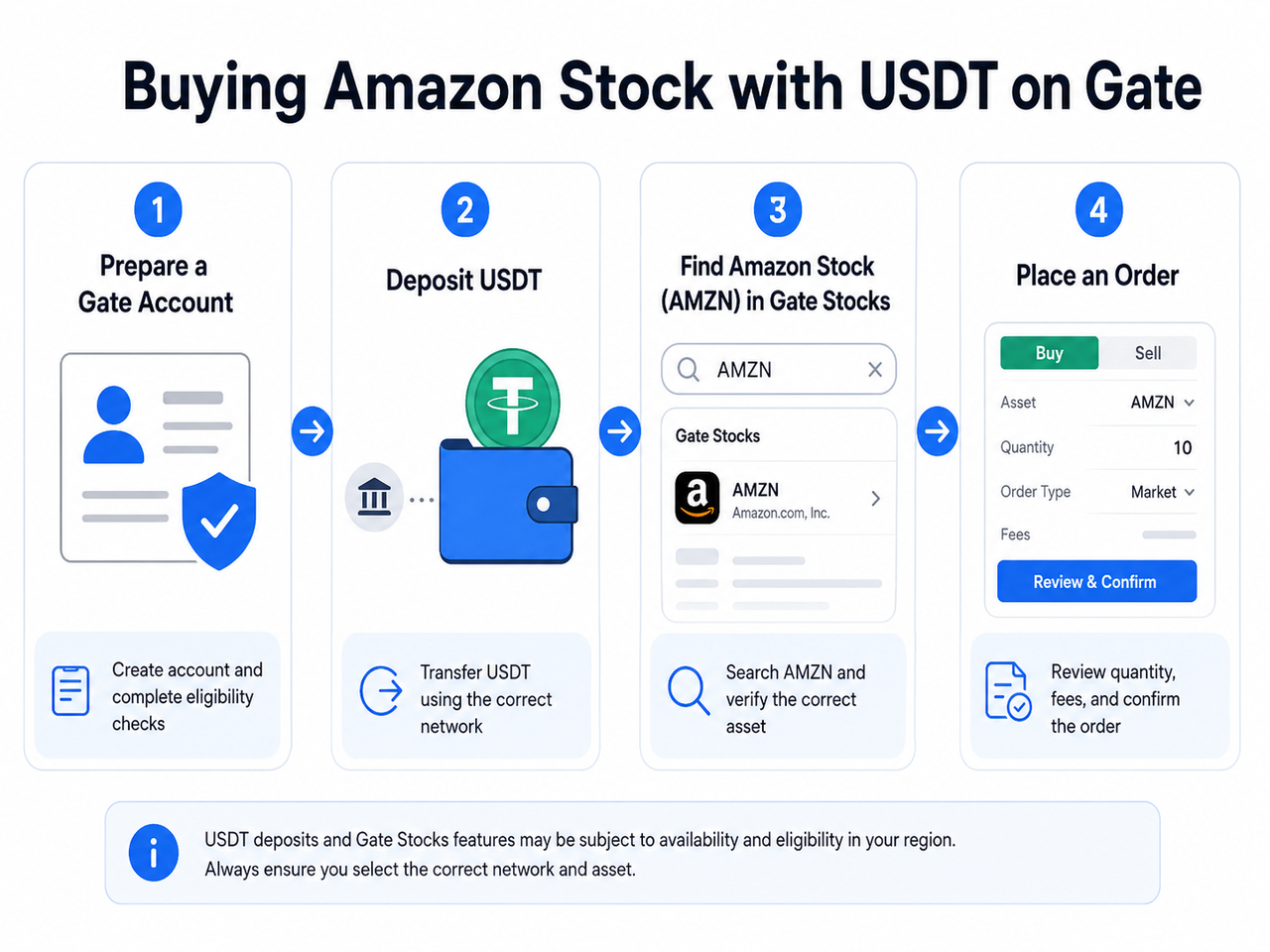
What Do You Need Before Buying Amazon Stock on Gate?
Before buying Amazon Stock with USDT, users need a Gate account, access to Gate Stocks, and a sufficient USDT balance. Identity verification may be required depending on account status, region, and applicable product rules as of June 2026.
Users should also check whether Gate Stocks is available in their region. Stock-related products may be subject to local rules, eligibility requirements, and account-level restrictions. Amazon Stock (AMZN) availability should be verified directly inside Gate before any order is placed as of June 2026.
| Requirement |
What to Check |
Why It Matters |
| Gate account |
Registration and login access |
Required before using Gate services |
| Identity verification |
Account eligibility and regional rules |
May be required for stock-related products |
| USDT balance |
Available USDT in the account |
Used for buying supported stock products |
| Product access |
Amazon Stock (AMZN) availability |
Supported assets may vary as of June 2026 |
| Product rules |
Fees, order types, rights, settlement |
Helps users understand the transaction before ordering |
This checklist helps users avoid starting an order before account, funding, and product conditions are confirmed. Stock products require careful review because availability, fees, trading access, and rights-related rules may differ from ordinary crypto spot trading.
Step 1: How to Deposit USDT on Gate
To buy Amazon Stock with USDT, users first need USDT in their Gate account. USDT can usually be transferred from an external wallet or another platform, while supported funding methods may vary by region and account status as of June 2026.
When depositing USDT, users should carefully select the correct network. USDT exists on multiple blockchain networks, and the deposit network selected in Gate should match the withdrawal network selected from the sending wallet or platform.
After the transfer is submitted, the deposit status should be checked inside the Gate account. Blockchain transfers may require confirmations before funds become available, so users should wait until the USDT balance is fully credited before attempting to buy Amazon Stock (AMZN).
The same USDT funding logic also applies across other crypto-funded market access topics, including trading gold, silver, and oil with crypto assets, where settlement assets, product rules, and risk checks matter before execution.
Step 2: How to Find Amazon Stock on Gate
After USDT arrives, users can go to the Gate Stocks section and search for Amazon Stock (AMZN). The ticker is important because many assets may have similar names, and users should confirm they are viewing the correct stock product before placing an order.
The asset page should be reviewed carefully before any order is entered. Key details may include the product name, ticker, trading session, supported order types, fee information, minimum order requirements, settlement rules, and any rights-related notes as of June 2026.
Gate Stocks should not be confused with other stock-linked structures. The difference between Gate Stocks, brokers, and stock CFDs matters because settlement, product rules, leverage, and rights may work differently across each access method.
Step 3: How to Place an Order for Amazon Stock
Once Amazon Stock (AMZN) is found, users can select the supported order type shown in their account. If market orders are supported as of June 2026, they may execute near the available market price, but the final execution price can differ from the estimate shown before submission.
If limit orders are supported as of June 2026, users can set a specific price, but execution is not guaranteed. A limit order may remain unfilled if the market does not reach the selected price or if available liquidity is insufficient.
Before submitting the order, users should review the quantity, estimated USDT cost, estimated trading fee, available balance, and order details. Gate’s stock service references fractional access from 0.01 share as of June 2026, but users should confirm the current minimum order requirement inside the actual Amazon Stock (AMZN) order panel before placing an order.
The broader process of buying U.S. stocks with USDT follows the same basic structure: fund the account, locate the supported stock, review product details, and confirm the order only after checking the final information.
What Are the Trading Fees for Amazon Stock on Gate? (As of June 2026)
Gate’s stock service references trading fees starting from 0.023% (As of June 2026). The exact fee applied to an Amazon Stock (AMZN) order may depend on current Gate rules, account status, product details, and any applicable updates (As of June 2026).
Users should verify the current fee schedule through official Gate sources before placing an order (As of June 2026). Besides trading fees, users should consider spreads, execution differences, settlement-related costs, and any other product-specific charges shown before order confirmation (As of June 2026).
No platform fee, commission, or hidden-charge statement should be assumed beyond the current official fee display and account confirmation screen (As of June 2026). The difference between USDT stock trading commission and traditional broker fees matters because cost structures can vary by product type, market access route, and account setup (As of June 2026).
What Risks Should You Understand Before Buying Amazon Stock?
Buying Amazon Stock with USDT on Gate involves market risk. Amazon Stock (AMZN) can rise or fall based on company performance, broader equity market conditions, interest rates, sector sentiment, and macroeconomic factors. Past performance does not guarantee future results.
Users should also understand stock-specific risk. Amazon’s retail business, cloud services, advertising segment, earnings, regulatory issues, and competitive environment may all affect the stock price.
Liquidity risk may also apply. Available liquidity, trading hours, order book depth, execution speed, and spread conditions can affect the final result of an order. A market order may execute differently from the estimate shown before submission.
Regulatory and regional risk should be considered because Gate Stocks availability may vary by jurisdiction as of June 2026. Product-rule risk is also important because rights, settlement, dividends, minimum order size, and supported order types may change or may differ from a traditional brokerage account as of June 2026.
Users comparing stock price exposure with direct brokerage ownership should understand how stock economic rights and shareholder rights may differ across product structures as of June 2026.
Summary
Buying Amazon Stock with USDT on Gate is a step-by-step process. Users prepare a Gate account, deposit USDT, open Gate Stocks, search for Amazon Stock (AMZN), review product rules, check fees, and place an order only after confirming the details.
The most important step is verification. Fees, supported assets, minimum order size, order types, regional availability, dividend handling, and rights-related rules should all be checked through official Gate sources as of June 2026.
The same tutorial logic also applies across related stock access pages such as buy Google Stock with USDT, where users still need to confirm product availability, funding rules, order details, and risk factors before trading as of June 2026.
FAQs
Is the Amazon Stock purchased on Gate the same as buying through a traditional broker?
Amazon Stock purchased on Gate may provide stock market access through Gate Stocks, but users should not assume every rule is identical to a traditional broker. Rights, settlement, account structure, transfer options, and dividend handling should be verified through official Gate sources as of June 2026.
What is the minimum amount required to buy Amazon Stock on Gate?
The minimum amount required to buy Amazon Stock on Gate should be confirmed inside the Gate Stocks order panel before placing an order. Gate’s stock service references fractional access from 0.01 share as of June 2026, but the current minimum may depend on product and account rules.
Can I sell my Amazon Stock position at any time?
Amazon Stock positions on Gate may be sold according to supported trading rules, market access, trading hours, liquidity, and account eligibility as of June 2026. Users should check whether the product is currently tradable and whether any restrictions apply before submitting a sell order.
Are dividends available when holding Amazon Stock on Gate?
Amazon Stock dividend handling on Gate should be verified through official Gate sources as of June 2026. Users should not assume that dividend treatment, shareholder rights, or economic rights are identical to a traditional brokerage account without checking the current product rules.
Does Gate charge custody or account maintenance fees for Amazon Stock?
Any custody, account maintenance, trading, spread, or product-specific fees related to Amazon Stock on Gate should be checked through official Gate sources before ordering (As of June 2026). Users should review the fee display and confirmation screen carefully before submitting an order.
Stock investing involves market risk, and prices may fluctuate significantly. Please make decisions carefully based on your own risk tolerance. This article does not constitute investment advice.







