Stablecoins have become essential infrastructure for digital asset markets and on-chain finance. As the stablecoin ecosystem grows, attention is shifting from issuance volume and payment functionality to value distribution. More industry participants are now asking: who should benefit from the economic value created by stablecoin networks?
In this context, CASH introduces the Open Stablecoin concept. Beyond maintaining its U.S. dollar peg and enabling payments, CASH aims to redefine the stakeholder dynamics in the stablecoin ecosystem through a revenue-sharing mechanism.
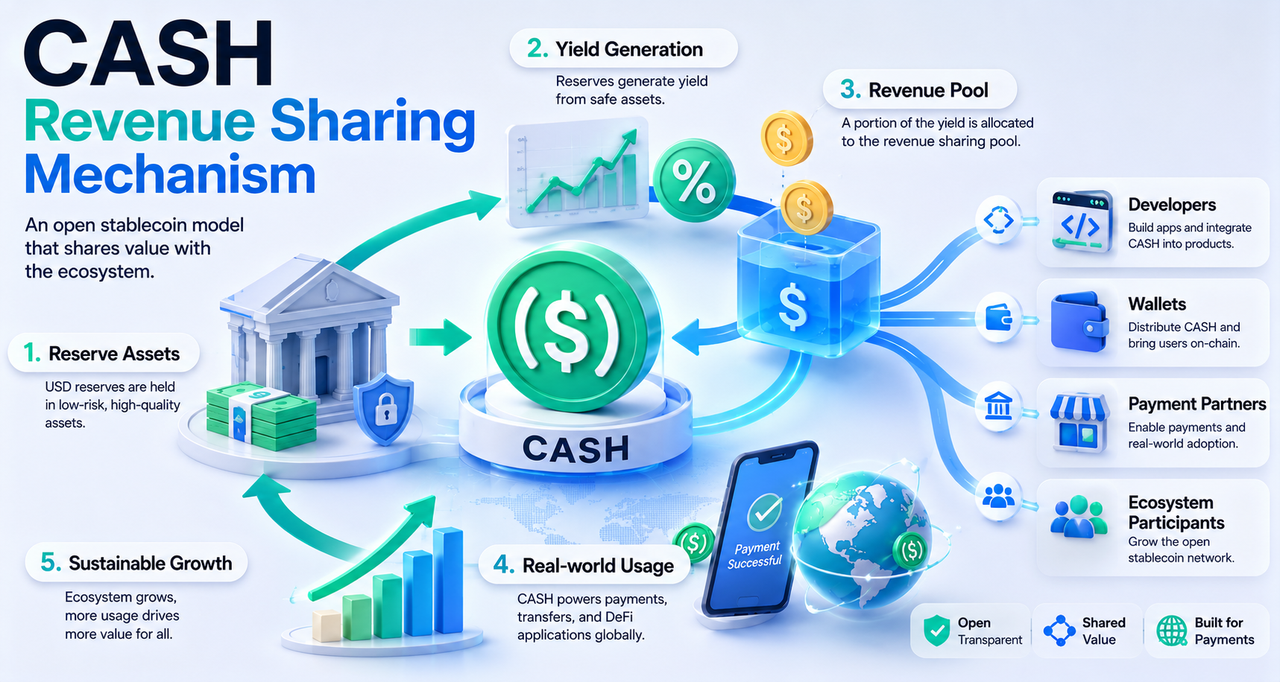
What Is CASH's Revenue-Sharing Mechanism?
CASH's revenue-sharing mechanism is an economic model that distributes a portion of the income from stablecoin reserve assets to ecosystem participants.
In traditional stablecoin networks, revenue is typically concentrated with the issuer. The Open Stablecoin model, however, broadens distribution. As the ecosystem expands, more participants can share in the network's economic value.
This approach transforms developers, wallet providers, and payment platforms from mere infrastructure users into key stakeholders in ecosystem growth.
Where Does Stablecoin Revenue Usually Come From?
Understanding CASH's revenue-sharing mechanism starts with understanding where stablecoin revenue originates.
Most fiat-backed stablecoins hold substantial reserves, typically consisting of cash deposits, short-term U.S. Treasuries, and other highly liquid assets.
Because these assets generate interest, stablecoin issuers earn a steady stream of reserve income.
The larger the stablecoin, the larger its reserves, and the higher the potential income.
For this reason, reserve income has become a cornerstone of stablecoin business models.
How Does CASH's Revenue-Sharing Mechanism Work?
Under the CASH model, reserve assets are managed similarly to traditional stablecoins.
When these assets generate income, a portion is distributed to ecosystem participants according to predefined rules.
The process typically involves three layers:
Reserve Assets Generate Yield
Reserve funds are allocated to low-risk assets, creating a continuous income stream.
Revenue Enters the Distribution Pipeline
A portion of the income flows into an ecosystem incentive pool, rather than being retained by a single entity.
Ecosystem Participants Receive Their Share
Eligible wallets, developers, and platforms receive proportional revenue shares based on their participation.
This design fosters a more open value circulation loop within the stablecoin network.
Which Participants Are Eligible for Revenue Distributions?
CASH's open ecosystem involves several distinct roles.
Wallet Providers
Wallets serve as a primary user gateway for stablecoins.
When a wallet integrates CASH and drives user adoption, it may become a participant in the revenue-sharing system.
Developers
Developers create payment apps, financial tools, and digital products that generate real-world use cases for stablecoins.
An open revenue model incentivizes them to contribute to ecosystem development.
Payment Platforms
Payment platforms connect merchants and users, acting as a crucial bridge between stablecoins and the real economy.
Since payment network growth often relies on platform participation, service providers may also receive ecosystem revenue.
Enterprise Partners
By integrating CASH into their products, enterprises bring new users and use cases, qualifying them for value distribution as well.
What Impact Could Revenue Sharing Have on the Ecosystem?
Revenue sharing reconfigures the incentive structure of traditional stablecoin networks.
When developers and platforms can participate in value creation, the momentum for ecosystem expansion is no longer limited to the issuer.
This model may lead to the following changes:
| Traditional Stablecoin Model |
CASH Open Model |
| Revenue concentrated with the issuer |
Revenue distributed across the ecosystem |
| Issuer-driven growth |
Multi-stakeholder growth |
| Developers as users |
Developers as stakeholders |
| Single incentive structure |
Diversified incentive structure |
The open ecosystem model aims to evolve stablecoins from financial products into network-based infrastructure.
How Does CASH's Revenue Sharing Differ from DeFi Incentives?
Revenue-sharing mechanisms and DeFi liquidity incentives are often mentioned together, but they are fundamentally different.
DeFi incentives typically rely on token issuance or additional reward programs.
CASH's revenue sharing, however, mainly comes from the income generated by reserve assets.
In other words, DeFi incentives depend on new token supply, while Open Stablecoin revenue sharing draws from value produced by existing economic activity.
These two models reflect distinct economic logics and incentive sources.
What Challenges Does Revenue Sharing Face?
While innovative, the Open Stablecoin model faces several challenges.
First, revenue distribution rules must remain transparent and sustainable.
Second, regulatory frameworks for stablecoins and revenue sharing vary across jurisdictions.
Furthermore, as the number of open ecosystem participants increases, balancing incentive efficiency with management complexity becomes a key long-term challenge.
These are not issues unique to CASH; they are areas the entire Open Stablecoin track must continue to explore.
Summary
CASH's revenue-sharing mechanism is a core component of the Open Stablecoin model. Unlike traditional stablecoins that reserve income for the issuer, CASH redistributes a portion to developers, wallets, payment platforms, and ecosystem partners, creating a more open value-creation system.
At its core, CASH does not alter the fundamental principle of using reserve assets to maintain a stable value. Instead, it innovates at the economic model level.
FAQs
What is CASH's revenue-sharing mechanism?
It is a system that distributes a portion of the income from stablecoin reserve assets to developers, wallet providers, and ecosystem partners, rather than keeping it solely with the issuer.
What is the source of CASH's revenue?
CASH's revenue primarily comes from returns on reserve asset management, such as cash management yields and short-term U.S. Treasury returns — all low-risk asset returns.
What is the biggest difference between CASH and traditional stablecoins?
The key difference lies in the value distribution model. Traditional stablecoins typically have the issuer capture most reserve income, while CASH uses an open revenue-sharing mechanism.
Will the revenue-sharing mechanism affect CASH's stability?
No. The revenue-sharing mechanism is an economic model design independent of the reserve backing and U.S. dollar peg. The stablecoin's value stability depends on reserve management and the issuance/redemption system.