The core distinction between CASHCAT and typical meme coins centers on whether the narrative anchor can be sustained and reiterated over time, and whether the parameters, on-chain context, and community template are unified into a coherent communication language. To get a full view of the project, start with Cash Cat (CASHCAT): a culture-driven, non-functional utility project that publicly clarifies it is not officially affiliated with Robinhood.
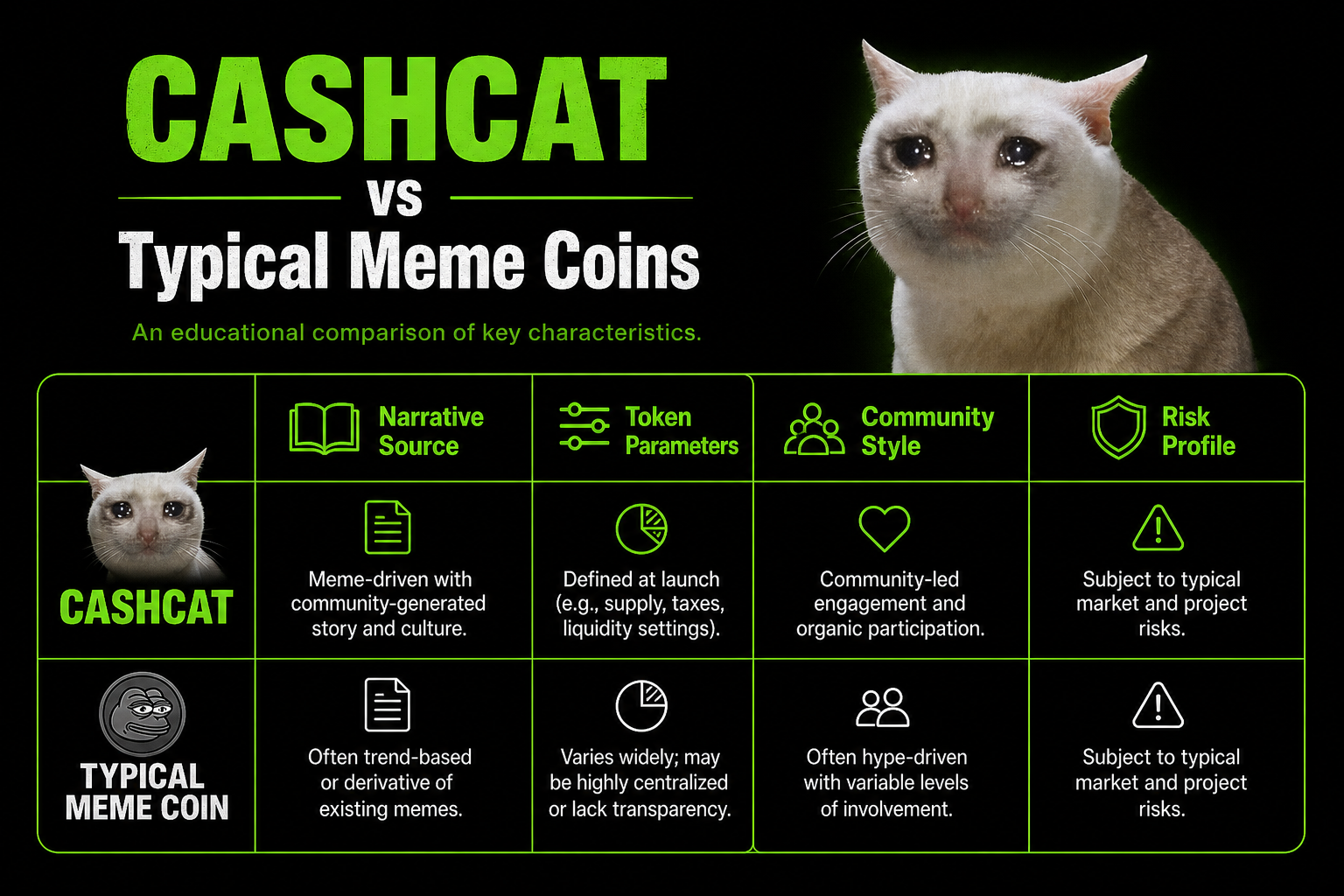
Comparison matrix: CASHCAT versus typical meme coins, focusing on narrative source, on-chain context, token parameters, and community style.
What Is CASHCAT?
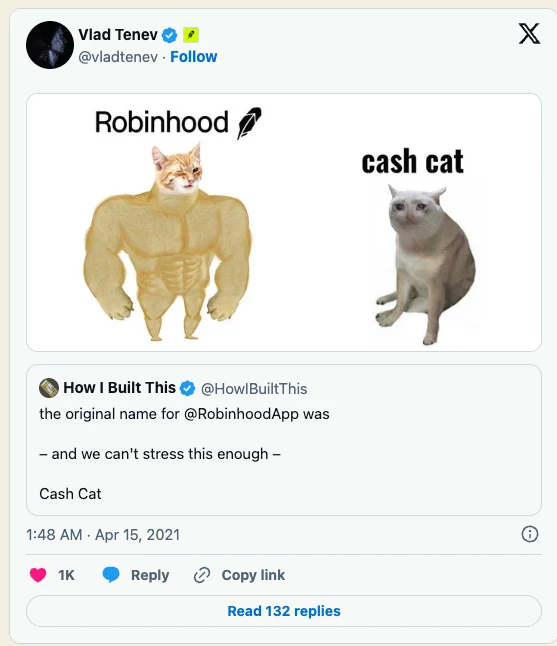
CASHCAT, a meme token launched on Robinhood Chain, turns the internet lore of “Robinhood was once called Cash Cat” into an on-chain symbol. The project’s focus is not on complex features, but on leveraging historical naming memes, social media-friendly catchphrases, and on-chain tradability. It’s best understood as a “meme-native cultural asset”: first, check for narrative consistency, then verify parameters and on-chain actions.
Growth for these projects typically depends on narrative consistency and community coordination. When the core narrative remains stable, users can easily repeat the story across platforms. CASHCAT’s public messaging often includes “Zero utility (per its narrative commitment)” to remind users to focus on the communication structure and risk boundaries, rather than protocol revenue models, during evaluation.
What Is a Typical Meme Coin?
A typical meme coin is a token driven by cultural symbols, social media sentiment, and community consensus. Common narratives include animal imagery, trending memes, celebrity topics, and on-chain events. These coins launch and spread quickly, but are easily replaced by new trends; there’s wide variation in disclosures around supply, tax rates, and liquidity pools.
Compared to CASHCAT, typical meme coins aren’t inherently “weaker” or “stronger”—they’re just evaluated on different criteria. For meaningful comparisons, ask: Is the narrative repeatable? Are the parameters verifiable? Is the community template unified? Are the risks clearly disclosed?
| Narrative Type |
Common Source |
Communication Features |
| Visual |
Animal or character visuals |
Memorable, but highly competitive |
| Trending |
Short-lived events or memes |
Rapid rise and fall |
| Celebrity |
Account interactions and public opinion |
Highly sensitive to external factors |
| Historical Meme (CASHCAT) |
Traceable brand anecdotes |
More stable for repeated storytelling |
Table note: Narrative type shapes content lifespan and community narrative costs, but doesn’t directly determine market outcomes. The value in comparison lies in identifying “what makes a project memorable,” not in judging “which is better.”
Quick Reference: Key Differences Between CASHCAT and Typical Meme Coins
A multi-faceted comparison covers narrative, on-chain context, parameter expression, and community approach. CASHCAT emphasizes historical naming memes and the Robinhood Chain’s native environment; typical meme coins often feature diverse narratives and decentralized messaging. CASHCAT’s official communication focuses on 1B total supply, 0/0 tax, and LP burned; similar claims may appear elsewhere, but the ability to verify them varies.
| Dimension |
CASHCAT |
Typical Meme Coin |
| Narrative Anchor |
Early “Cash Cat” naming story |
Visuals, trends, celebrities, or on-chain events |
| On-Chain Context |
Robinhood Chain native narrative |
Commonly multi-chain or trend-driven launches |
| Parameter Expression |
1B supply, 0/0 tax, LP burned |
Tax and LP disclosure varies widely |
| Community Template |
Unified “cat + lore + chain” storytelling |
Relies more on real-time trends and sentiment spikes |
| Evaluation Focus |
Narrative consistency + parameter verifiability |
Trend cycles + symbol recognition |
| Brand Relationship |
Publicly not affiliated with Robinhood |
Most lack major brand endorsements |
Key takeaway: The primary differences are structural, not technical. CASHCAT integrates historical memes, on-chain context, and parameter messaging into a single template; typical meme coins shift between “symbolic memory” and “trend diffusion.” If you’re analyzing narrative repeatability, this comparison is most useful; for protocol cash flow analysis, neither group is a perfect fit.
How Is Tokenomics Communicated Differently?
CASHCAT emphasizes fixed supply, low trading friction, and liquidity pool status. This approach is used to convey transparency, simplicity, and low friction, but parameters alone don’t guarantee quality. The prudent approach is to cross-check official statements with on-chain data. For details, see CASHCAT Tokenomics.
| Dimension |
CASHCAT Approach |
Common Meme Coin Approach |
| Supply Narrative |
Fixed supply + narrative framing |
Fixed or variable; supply stories vary widely |
| Tax Logic |
Explicit 0/0 tax |
Some projects feature transaction or dynamic taxes |
| LP Messaging |
Emphasizes pool and burn status |
May be highlighted or downplayed |
| Explanation Focus |
Ties parameters to lore |
Often ties parameters to trend marketing |
A 0/0 tax structure only means simplified transaction fees—it doesn’t reduce volatility. LP burned is used to signal limited control over the liquidity pool, but must be verified on-chain. Typical meme coins may have complex tax rates and incomplete disclosures; always prioritize verifiability over similar marketing language.
CASHCAT’s community strategy is built around a unified “cat + lore + chain” template, making it easy to reuse across images, posts, and user-generated content. Typical meme coin communities depend more on trending topics and emotional spikes: topics change quickly, but repetition costs may be higher. For an explanation of staged communication, see Roadmeow and Community Growth.
A unified template lowers the barrier to content creation; the tradeoff is that, as narrative freshness wanes, community interaction becomes essential to sustain discussion. Trend-driven communities can surge quickly but have short attention spans. Both approaches are common in the meme sector—the real difference is how discussion is maintained.
When Is This Comparison Most Useful?
This comparison is most valuable for content research, community management, and risk identification: focusing on narrative repeatability, template dissemination efficiency, and alignment between parameters and on-chain activity. For protocol cash flow or roadmap evaluation, the comparative value is limited.
For participants, actionable conclusions matter: first, verify sources and contracts; then, start with small test transactions and review approvals. For process details, see CASHCAT Participation Process; for risk boundaries, see CASHCAT Risks and Limitations. The comparison framework answers “how to evaluate,” while process and risk frameworks answer “how to minimize mistakes.”
What Are the Advantages, Risks, and Limitations of Each?
CASHCAT’s advantages over typical meme coins include a clear narrative anchor, unified messaging, and low barriers to understanding. Risks are typical for meme assets: high volatility, sentiment-driven behavior, information asymmetry, and liquidity shifts. Limitations are also clear: utility is not the core value, so functional project valuation models don’t apply; “not affiliated with Robinhood” means any endorsement must be independently verified.
Typical meme coins may excel in rapid trend adoption or symbol recognition; risks include rapid narrative shifts, incomplete parameter disclosures, and a rise in counterfeit assets. Ultimately, the key is whether the project’s goals align with the user’s: if you’re seeking long-term product development, neither category fits; if you’re studying cultural narrative and community dynamics, CASHCAT’s boundaries are more defined.
Summary
The core differences between CASHCAT and typical meme coins are in narrative structure, on-chain context, parameter communication, and community templates—not technical complexity. CASHCAT blends historical naming memes with Robinhood Chain’s context, creating a repeatable and scalable communication path, while publicly clarifying its lack of Robinhood affiliation. Understanding this helps quickly build a comparison framework and refocus evaluation on verifiable facts and risk identification.
FAQ
What is the main difference between CASHCAT and regular meme coins?
The main difference is the narrative anchor. CASHCAT is based on a traceable historical naming meme and a unified Robinhood Chain context; most meme coins rely on short-term trends, animal imagery, or celebrity topics. The more stable the anchor, the easier it is to repeat the narrative—but this doesn’t change the high volatility of meme assets.
Does a historical narrative anchor guarantee greater safety?
No. The narrative anchor shapes communication, but doesn’t reduce market or contract risk. Security depends on contract verification, liquidity, access management, and operational discipline. Historical memes are no substitute for on-chain verification.
Why focus on communication templates when comparing meme coins?
Templates determine community content output and dissemination speed. The more unified the template, the easier it is to generate high-frequency repetition; the more trend-dependent, the faster the surge—and the faster the decline. For meme projects, communication structure often explains discussion density better than complex features.
How does CASHCAT’s tokenomics differ from typical meme projects?
CASHCAT’s public messaging highlights 1B supply, 0/0 tax, and LP burned, tying parameters to its lore. Typical meme projects may use similar parameters, but differ widely in tax models, LP disclosure, and verifiability. Always prioritize parameter verification.
What’s most often overlooked in comparative analysis?
Goal misalignment. Many compare meme projects as if they were functional protocols, which distorts conclusions. First, confirm that project goals and evaluation frameworks match, then look at narrative, parameters, and community templates. Remember: CASHCAT is publicly not affiliated with Robinhood.
After comparison, what should you check before participating?
Translate conclusions into risk checks and operational steps: verify official sources and contracts, understand volatility and liquidity boundaries, and follow a stepwise process—prepare, execute, review. Comparison addresses understanding; pre-participation checks prevent mistakes and information asymmetry. Both are essential.