Coinbase (COIN), a digital asset trading platform listed on Nasdaq, operates at the intersection of federal securities regulation, commodities derivatives oversight, anti-money laundering compliance, and state-level money transmission licensing. Its revenue structure and operational boundaries are directly shaped by compliance costs and regulatory engagement.
A longstanding debate in US digital asset regulation centers on whether assets should be classified as securities or commodities. Coinbase takes a compliance-first approach to its retail and institutional trading, custody, staking, and stablecoin ecosystem. License acquisition, public disclosure, and enforcement litigation are integral mechanisms underpinning the fundamentals of COIN stock. Revenue streams outlined in Coinbase’s business model and product lines such as USDC and Coinbase One may be subject to regulatory shifts, potentially resulting in fee adjustments, service delistings, or increased compliance investment.
Which US Regulatory Bodies Oversee Coinbase?
Coinbase Global, Inc. is governed by a dual-layered US regulatory framework spanning both federal and state levels. Each agency has distinct responsibilities covering public disclosure, securities trading enforcement, derivatives, anti-money laundering, and state-level fund transfer oversight.
| Regulatory Agency |
Full Name |
Primary Functions |
Relevance to Coinbase |
| US Securities and Exchange Commission |
Securities and Exchange Commission (SEC) |
Regulates securities issuance and trading, public company disclosures |
COIN must adhere to SEC disclosure rules; securities enforcement affects the range of listed assets |
| Commodity Futures Trading Commission |
Commodity Futures Trading Commission (CFTC) |
Oversees commodities and derivatives markets |
Crypto assets classified as commodities and related derivatives fall under CFTC jurisdiction |
| Financial Crimes Enforcement Network |
Financial Crimes Enforcement Network (FinCEN) |
Anti-money laundering (AML) and money services business (MSB) compliance |
Must meet MSB registration, KYC, and suspicious activity report (SAR) requirements |
| New York Department of Financial Services |
New York Department of Financial Services (NYDFS) |
State-level financial services and BitLicense oversight |
Operating in New York requires a BitLicense or equivalent credential |
| State Regulatory Agencies |
State Banking / Financial Services Departments |
Money transmission licensing (MTL) |
Fiat and digital asset transfers require state-specific MTLs |
This table illustrates the division of responsibilities, rather than a single agency regulating all crypto activities. The SEC’s influence on Coinbase is twofold: as a public company, Coinbase must file 10-K and 10-Q reports; as a trading platform, the SEC’s enforcement stance on “which tokens are unregistered securities” impacts the listing roster and staking product design. The CFTC covers crypto assets considered commodities; FinCEN mandates robust AML procedures. State-level MTLs form the backbone of fiat on/off-ramp operations, while New York’s BitLicense imposes stricter requirements for capital and cybersecurity.
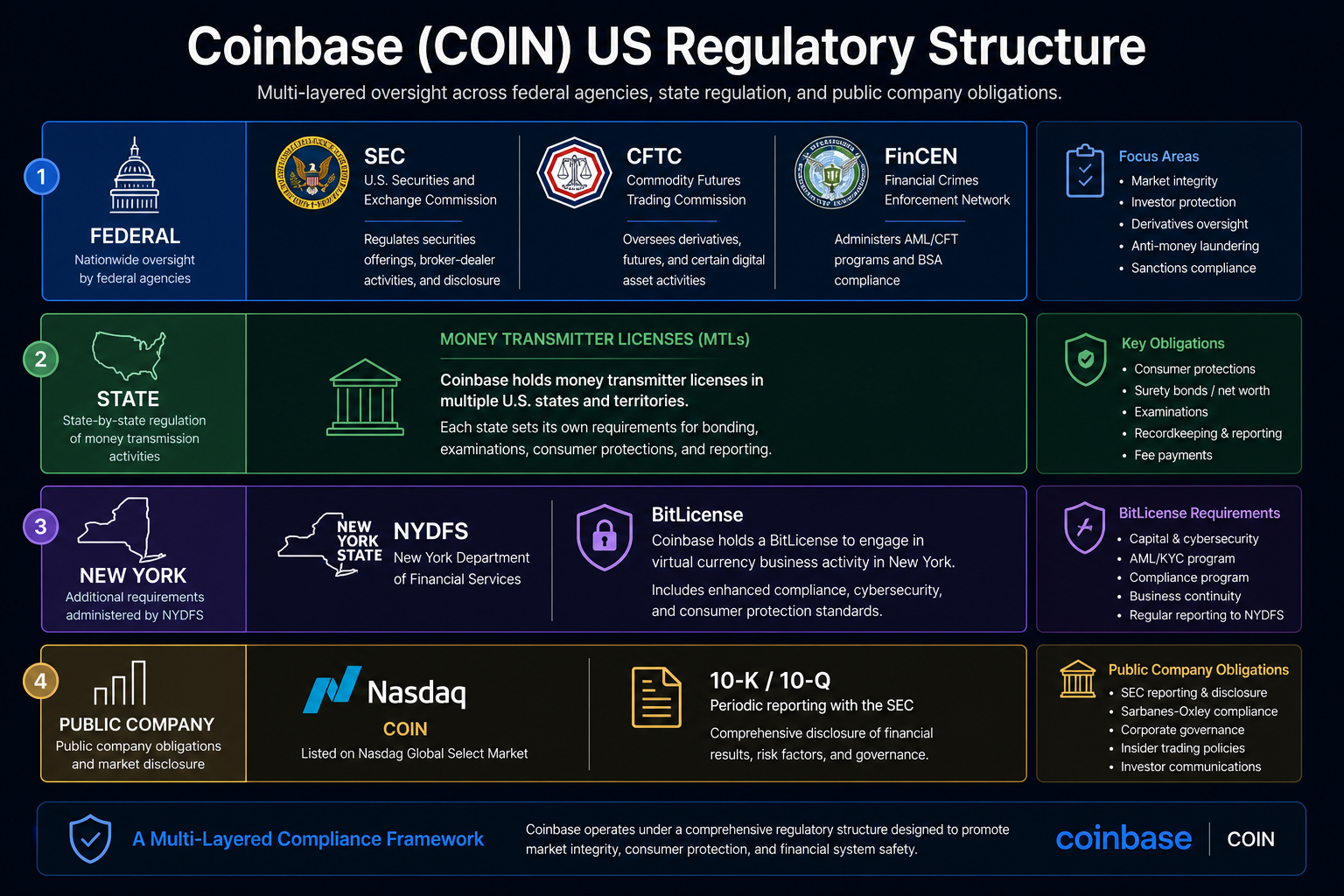
Figure 1. Coinbase’s multi-layered compliance structure: federal securities and commodities regulation, AML obligations, state-level money transmission licenses, and BitLicense form the core compliance framework.
Listing Disclosure and Compliance Obligations
After its Nasdaq debut, COIN is subject to ongoing disclosure requirements under the Securities Act of 1933 and the Securities Exchange Act of 1934—key pillars of public company governance and investor transparency.
| Disclosure Document |
Filing Frequency |
Key Content |
Compliance Focus |
| Form 10-K |
Annual |
Business overview, risk factors, financial statements |
Risk factors often highlight regulatory uncertainty, litigation, and license dependency |
| Form 10-Q |
Quarterly |
Quarterly financials, operational updates |
Compliance costs, updates on regulatory matters |
| Form 8-K |
Event-driven |
Major contracts, litigation, regulatory notifications |
Real-time signals such as enforcement actions, settlements, or product delistings |
| Proxy Statement |
Annual |
Shareholder meetings, executive compensation, governance |
Board compliance expertise and risk-based incentives |
The “Risk Factors” section in the 10-K is a structured entry point for assessing COIN’s regulatory exposure, typically covering regulatory policy shifts, token security status disputes, licensing costs, and cybersecurity. When analyzing financials, cross-reference risk factors with compliance and legal expenditures in the MD&A section. Insider trading rules and Form 4 filings pertain to corporate governance and are distinct from the trading execution process for buying COIN on Gate.
Licensing and State-Level Regulatory Architecture
Coinbase’s license portfolio determines where and how it can offer services across US states. The principle is “territorial compliance”: for any fiat transfer initiated in a given state, Coinbase must hold a valid MTL there; if a license lapses or is penalized, services in that state may be restricted. Institutional custody and Prime involve additional custody qualifications, insurance, and SOC audits, which differ from retail MTL requirements.
The USDC ecosystem, jointly operated by Coinbase and Circle, adds another compliance dimension: Circle, as issuer, is subject to monetary regulation, while Coinbase must ensure distribution and promotion comply with relevant rules. Regulatory changes may impact trading, custody, and stablecoin revenue streams simultaneously.
| License Type |
Coverage |
Business Impact |
| Money Transmission License (MTL) |
State-level fiat transfers |
Determines fiat deposit and withdrawal availability by region |
| BitLicense |
New York State |
Grants New York users access to crypto trading and custody |
| MSB Registration (FinCEN) |
Federal |
Establishes AML compliance baseline across the platform |
| Custody Qualification / Trust Arrangement |
Institutional custody |
Defines the scope of Prime and institutional custody services |
Maintaining these licenses results in ongoing compliance costs—legal, compliance personnel, audits, and system upgrades are all included in operating expenses and interact with trading revenue cycles.
How Litigation and Policy Changes Affect Business Operations
Regulatory enforcement and legislative proposals affect COIN’s business through three main channels, helping investors distinguish between news events and fundamental drivers.
Channel 1: Product boundary adjustments. If regulators classify a token as an unregistered security, Coinbase may delist the asset, suspend staking, or restrict access for US users, directly impacting trading fees and user activity.
Channel 2: Rising compliance costs. Litigation, settlements, or new regulations drive up legal and system costs, reflected in the “Legal Proceedings” notes and administrative expenses in the 10-K.
Channel 3: Shifting market expectations. Regulatory uncertainty influences institutional investors’ risk premiums, affecting market sentiment and requiring separate analysis from specific product changes.
Legal disputes between the SEC and Coinbase regarding digital asset listing rules and whether staking services constitute securities issuance exemplify COIN’s regulatory risk profile. Federal legislation, if enacted, could clarify jurisdictional boundaries or introduce new registration requirements. Policy shifts are also instructive when comparing COIN vs. HOOD: Robinhood is primarily regulated as an SEC/FINRA broker-dealer, while Coinbase’s revenue and regulatory exposure are more concentrated in digital assets.
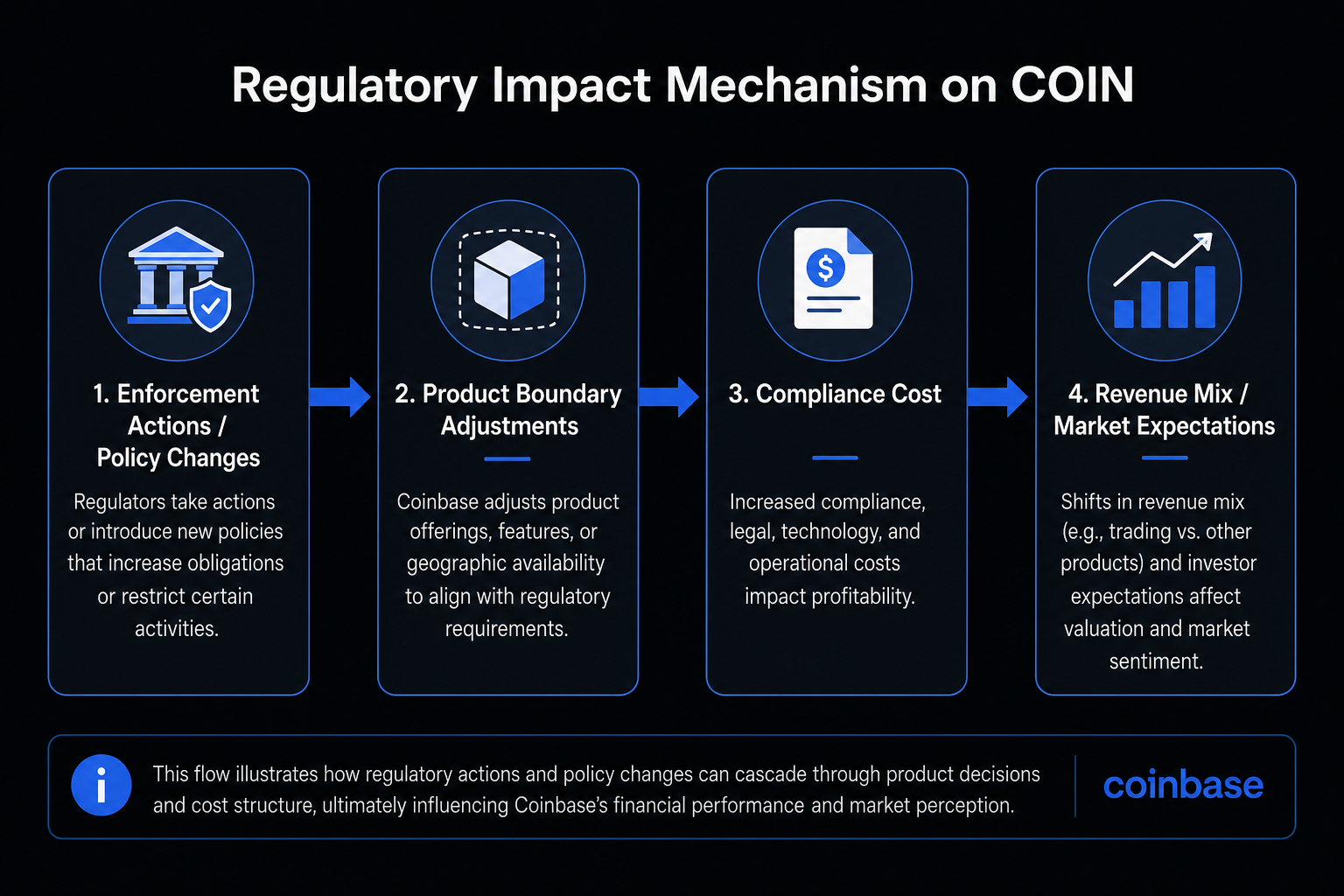
Figure 2. Three channels through which litigation and policy changes impact Coinbase: product boundary adjustments, higher compliance costs, and market expectation shifts.
Key Compliance Signals for Investors
To monitor COIN’s regulatory compliance, establish a repeatable signal framework: 10-K/10-Q risk factors and legal proceedings (SEC EDGAR), state MTL status (state regulator websites), asset delistings and staking limitations (8-K and product announcements), enforcement and settlement updates (court records), and federal legislative developments (congressional records). Disclosed events should be directly linked to financial statement impacts, while potential policy shifts should be incorporated into scenario analysis—not treated as certainties.
When trading COIN stock, distinguish between compliance signals and platform execution risks: ticker, trading hours, fees, and USDT denomination pertain to the Gate Stocks platform, while regulatory signals relate to the fundamentals of Coinbase Global, Inc.
Summary
Coinbase Global, Inc. (COIN) operates under a multi-layered compliance regime at the federal and state levels: the SEC oversees public disclosures and securities enforcement, the CFTC covers commodities and derivatives, FinCEN enforces AML obligations, and state MTLs and the New York BitLicense define geographic service boundaries. Litigation and policy changes affect business through product adjustments, compliance costs, and market expectations. Investors can monitor these variables via 10-K risk factors, 8-K event disclosures, and license status.
FAQ
Is Coinbase regulated by the SEC?
As a Nasdaq-listed company, Coinbase Global, Inc. must comply with the SEC’s ongoing disclosure requirements, including 10-K, 10-Q, and 8-K filings. The SEC also determines whether digital assets are securities, affecting which tokens Coinbase can list and its staking product design—covering both public disclosure and trading platform securities compliance.
What are the main risks of Coinbase stock?
COIN’s primary risks include: trading revenue’s high correlation with crypto market cycles, regulatory uncertainty in US digital asset policy, industry competition, custody and cybersecurity, and rising compliance costs from state licensing and enforcement litigation. On the trading side, be mindful of ticker selection, order types, and platform fee rules.
How does COIN differ from HOOD?
COIN is a crypto-focused trading platform, generating revenue mainly from trading fees and subscriptions, with regulatory exposure centered on SEC digital asset enforcement, FinCEN, and state MTLs. HOOD is a diversified retail broker, with revenue from payment for order flow, net interest, and Gold subscriptions, and is regulated primarily under SEC/FINRA broker-dealer rules. Their business focus and risk profiles are structurally distinct.
What licenses does Coinbase need to operate?
Operating in the US requires federal MSB registration and state-level MTLs for fiat transfers; New York requires a NYDFS BitLicense. Institutional custody and Prime also require additional standards for custody, asset segregation, and audits.
How can investors track Coinbase’s regulatory developments?
Use SEC EDGAR to review 10-K, 10-Q, and 8-K filings, focusing on risk factors and legal proceedings. Product delistings, state service changes, and enforcement settlements are typically disclosed via 8-K; state regulator websites provide MTL license status.