As DeFi gradually expands from a market for technical enthusiasts to a broader user base, user experience has become an important area of competition across the industry. In the past, most users had to use a wallet, a cross-chain bridge, a DEX aggregator, and yield protocols at the same time to complete a full on-chain workflow. Defi App attempts to bring these functions together through a super app model, while MetaMask still represents the development path of traditional wallet products.
What Is Defi App?
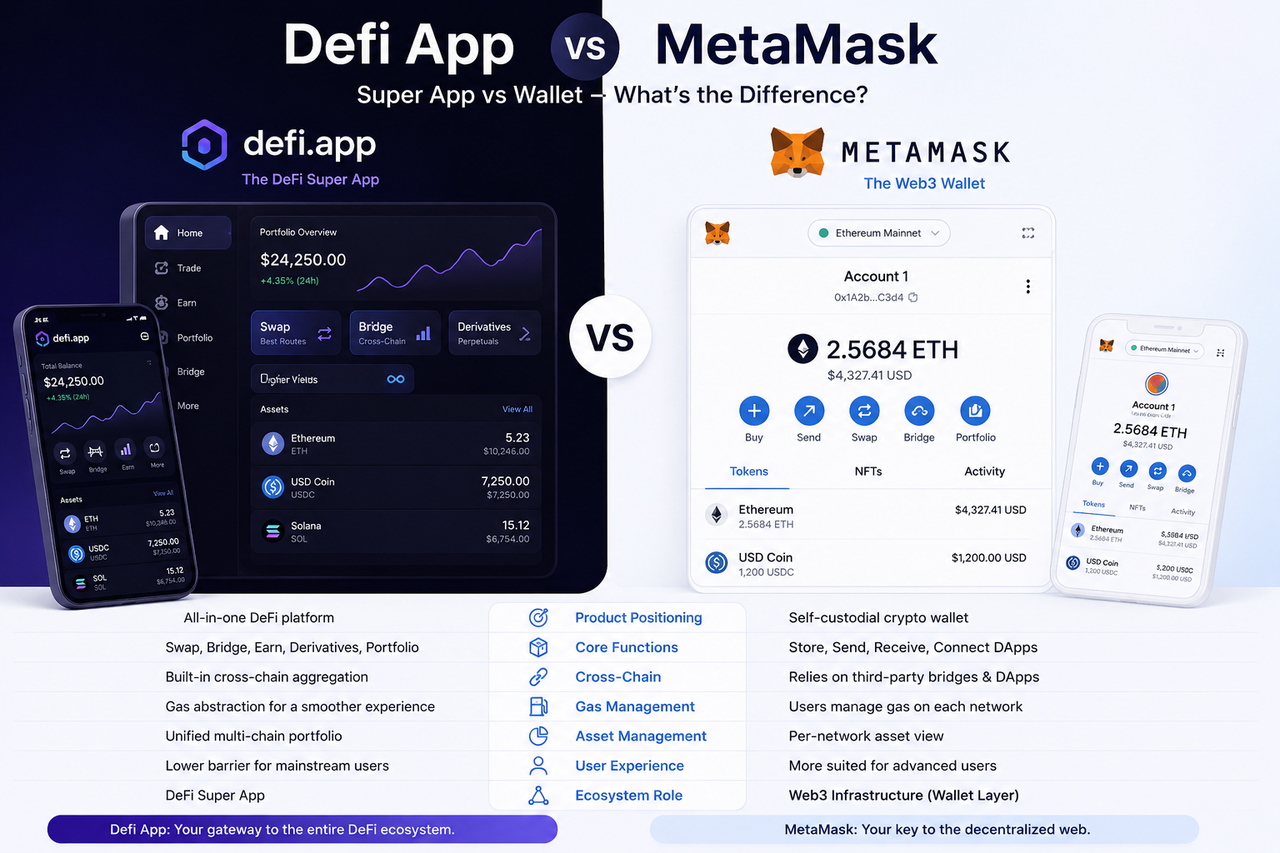
Defi App is a DeFi super app built for the multichain ecosystem. Through account abstraction, automated routing, and gas optimization mechanisms, it brings asset management, cross-chain trading, yield access, and on-chain interactions into one unified platform.
Defi App is designed to reduce the need for users to switch between different protocols. Users can complete asset swaps, cross-chain operations, and fund management in a single interface, without visiting multiple DeFi platforms separately.
From a product positioning perspective, Defi App is closer to an “on-chain financial operating system,” with a focus on simplifying complex on-chain experiences.
MetaMask is one of the most widely used self-custodial crypto wallets today. It initially served the Ethereum ecosystem and later expanded to multiple EVM-compatible blockchain networks.
MetaMask’s core functions include account management, private key control, asset storage, and connection to decentralized applications, or DApps. Through MetaMask, users can access decentralized exchanges, NFT marketplaces, lending protocols, and other Web3 services.
In essence, MetaMask belongs to wallet infrastructure rather than a complete DeFi platform.
The biggest difference between Defi App and MetaMask comes from product positioning.
MetaMask mainly solves the question of “how to enter a blockchain network”. Users create wallets, manage accounts, and authorize on-chain actions through MetaMask.
Defi App mainly solves the question of “how to use DeFi services”. The platform not only provides wallet functions, but also integrates trade execution, liquidity routing, and asset management experiences.
The two can be understood this way:
This difference in positioning determines the later direction of their feature design.
User experience is one of the clearest differences between Defi App and MetaMask.
MetaMask follows the traditional Web3 tool model. Users need to add networks themselves, manage gas tokens, connect protocols, and understand the on-chain interaction process.
Defi App uses account abstraction and automated execution mechanisms to hide part of the underlying complexity.
Wallet Management Experience
MetaMask emphasizes user control.
Users need to understand concepts such as seed phrases, private key management, and network configuration.
Defi App places greater emphasis on lowering the barrier to entry, making the operating flow feel closer to a traditional internet product.
Operational Flow Experience
In MetaMask, a complex cross-chain transaction may involve several protocols and multiple signatures.
In Defi App, the same process may be combined into a single operation.
As a result, the two products are aimed at somewhat different user groups.
Cross-chain capability is one of the important differences between the two.
MetaMask itself does not provide a complete cross-chain execution system.
Although MetaMask can connect to cross-chain bridges and third-party protocols, users still need to complete the bridging process themselves.
Defi App treats cross-chain capability as one of its core functions.
When users initiate a cross-chain transaction, the system can automatically find liquidity sources, execute bridging steps, and complete delivery on the destination chain.
This difference makes Defi App closer to a cross-chain financial gateway, while MetaMask is closer to an access tool.
Gas management has long been a major challenge in the DeFi user experience.
MetaMask follows the traditional blockchain model, where users must hold the gas token of the relevant chain to complete transactions.
For example:
| Network |
Required Gas |
| Ethereum |
ETH |
| Base |
ETH |
| Polygon |
MATIC |
| BNB Chain |
BNB |
Without the required gas asset, transactions usually cannot be executed.
Defi App improves this process through gas abstraction and backend settlement mechanisms.
Users do not need to repeatedly prepare gas assets across different chains, reducing friction in a multichain environment.
MetaMask’s main functions revolve around the wallet.
Users usually need to combine it with other protocols to complete:
-
Asset swaps
-
Yield management
-
Cross-chain operations
-
Lending activities
-
Derivatives trading
Defi App brings these functions into one unified ecosystem.
From a product structure perspective, MetaMask is closer to the infrastructure layer, while Defi App is closer to the application layer.
This difference is similar to the relationship between a browser and an internet platform.
Both Defi App and MetaMask use a self-custodial model, and users generally retain control over their assets.
However, their risk structures differ in certain ways.
MetaMask’s risks are mainly concentrated around:
In addition to the risks above, Defi App also involves:
Therefore, although both belong to the self-custodial ecosystem, the range of technical risks they face is not exactly the same.
Which Users Are Better Suited to Defi App?
Defi App is better suited to the following types of users:
Users Who Want to Simplify DeFi Workflows
Defi App can reduce the complexity caused by switching between multiple protocols.
Users Who Frequently Make Cross-Chain Transactions
Automated routing and cross-chain execution can improve operational efficiency.
Users Who Want Unified Asset Management
Multichain assets can be viewed and managed in the same interface.
MetaMask is better suited to the following scenarios:
Users Who Want Full Control Over Wallet Configuration
MetaMask provides a high degree of flexibility and user control.
Users Who Frequently Use Different DApps
MetaMask has become a standard connection tool for many Web3 applications.
Users Who Need Broad Ecosystem Compatibility
A large number of blockchain protocols natively support MetaMask access.
| Comparison Dimension |
Defi App |
MetaMask |
| Product Positioning |
DeFi super app |
Self-custodial wallet |
| Main Goal |
Unified on-chain financial gateway |
Wallet and account management |
| Cross-Chain Capability |
Built-in automated cross-chain execution |
Relies on third-party protocols |
| Gas Management |
Optimized through gas abstraction |
Prepared by users themselves |
| Asset Management |
Unified multichain view |
Wallet view |
| Functional Scope |
Trading, yield, cross-chain, and more |
Wallet connection and authorization |
| User Barrier |
Relatively lower |
Relatively higher |
| Ecosystem Role |
Application-layer platform |
Infrastructure tool |
Conclusion
Defi App and MetaMask are not necessarily direct competitors. Instead, they represent two different product paths in the Web3 ecosystem. MetaMask focuses on wallet infrastructure, giving users asset management and on-chain connectivity. Defi App is designed to bring wallet functionality, trading, cross-chain execution, and asset management into one unified platform.
At the core, MetaMask solves the question of “how to enter the blockchain,” while Defi App solves the question of “how to use blockchain financial services more conveniently.”
FAQs
MetaMask can connect to third-party cross-chain bridges and DeFi protocols to enable cross-chain transactions, but users usually need to operate the related process themselves.
Why Is Defi App Called a DeFi Super App?
Defi App is called a DeFi super app because it brings wallet, cross-chain, asset swaps, yield management, and on-chain interactions into the same platform.
What Does Defi App’s Gas-Free Experience Mean?
The Gas-Free experience means users do not need to manage gas tokens across multiple blockchain networks themselves. The system optimizes gas payment and settlement through backend mechanisms.
Defi App and MetaMask both use a self-custodial model, so users retain control over their assets. The types of risks they face differ, and security depends more on user habits, protocol design, and risk management mechanisms.







