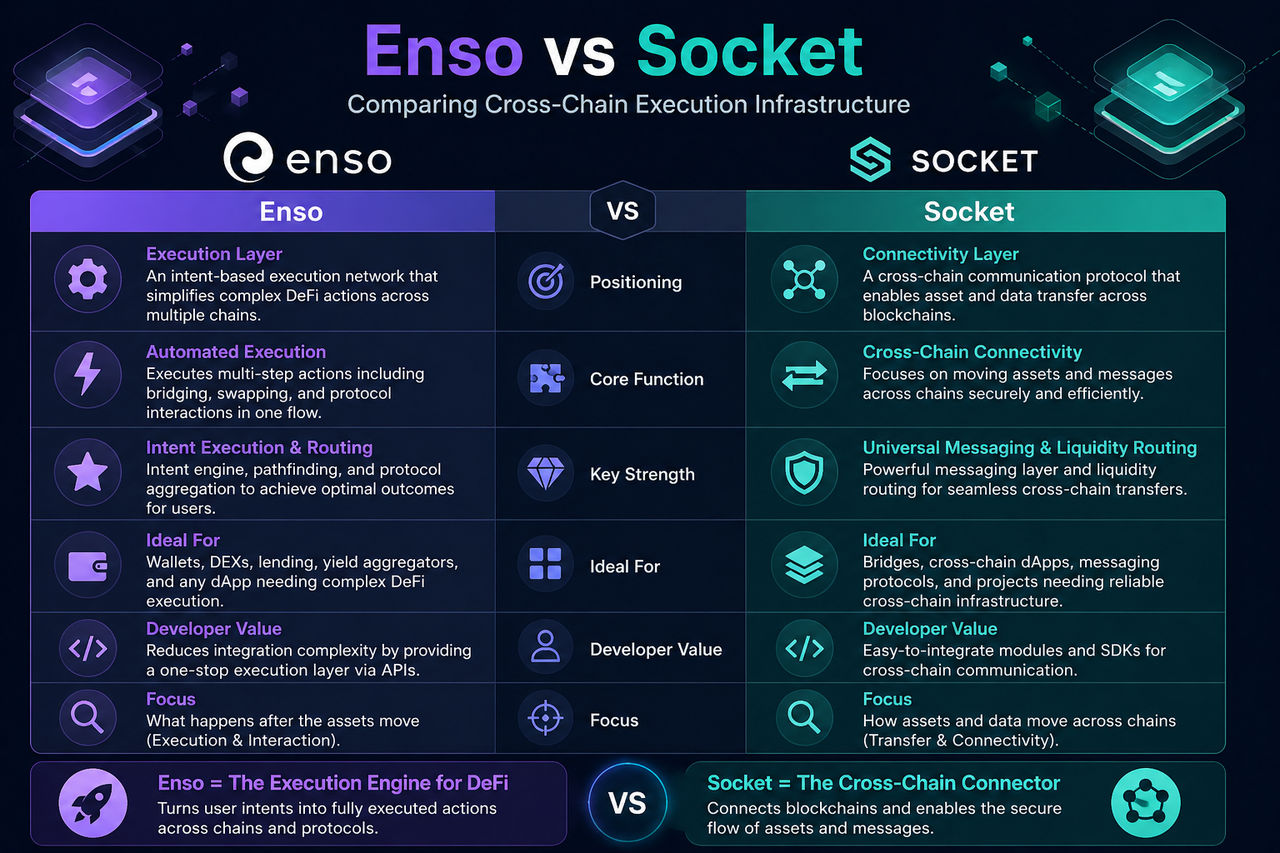
As DeFi moves from single chain ecosystems to multi-chain ecosystems, the need for asset movement and protocol interaction continues to grow. Users no longer complete transactions on just one chain. Instead, they need to transfer assets across multiple blockchains and interact with different protocols. This makes cross chain execution efficiency and protocol compatibility important competitive factors in DeFi infrastructure.
Against this trend, cross chain infrastructure has started to develop in more specialized directions. One type of protocol focuses on transferring assets and data between chains, while another moves further up to the execution layer, taking responsibility for automatically completing complex operations after cross chain transfers. Enso and Socket are representative projects of these two directions.
As multi-chain infrastructure protocols, Socket is mainly responsible for connecting assets and data across different blockchains, enabling cross chain movement through bridging and messaging. Enso, by contrast, focuses on the execution layer, helping users automatically complete complex operations after crossing chains, such as swaps and protocol interactions.
| Comparison Dimension | Enso | Socket |
|---|---|---|
| Core Positioning | DeFi execution infrastructure, Execution Layer | Cross chain connectivity infrastructure, Connectivity Layer |
| Main Function | Automatically executes cross chain transactions, swaps, and protocol interactions | Enables assets and data to move between different chains |
| Core Capability | Intent execution, automated routing, protocol aggregation | Cross chain bridging, messaging, liquidity routing |
| Problem Solved | Simplifies complex DeFi operation flows | Provides multi-chain asset connectivity |
| User Goal | Complete cross chain plus DeFi operations in one flow | Securely complete cross chain transfers |
| Use Cases | Wallets, DEXs, lending, yield aggregators | Cross chain bridges, cross chain communication protocols |
| Interaction Layer | Application execution layer | Underlying connectivity layer |
| Level of Automation | High, can automatically complete multi step tasks | Medium, mainly responsible for cross chain connectivity |
| Industry Role | DeFi automated execution engine | multi-chain communication connector |
Put simply, Socket provides the “connection capability between chains,” while Enso provides the “automated execution capability after connection.” Together, they form important infrastructure for multi-chain DeFi.
The biggest difference between Enso and Socket lies in their protocol positioning. Socket’s core goal is to build connectivity between chains so assets and data can move across different networks. It is therefore more like connectivity layer infrastructure within the cross chain ecosystem.
Enso, on the other hand, focuses on the execution layer. Its goal is to allow users or developers to complete multiple steps, such as cross chain transfers, swaps, and protocol interactions, through a single operation. It does not simply rely on cross chain connectivity. It builds automated execution logic on top of it, making it more like the execution engine of multi-chain DeFi.
Socket’s core capabilities are bridging and messaging. It is responsible for transferring assets from one chain to another and making sure cross chain data interactions run smoothly. For applications that need cross chain asset movement, this is a necessary underlying capability.
Enso’s capability leans more toward automated execution. It plans the execution path automatically based on the user’s goal, then completes steps such as cross chain transfers, swaps, and protocol interactions. This means Socket provides “asset transfer capability,” while Enso provides “task execution capability.” The two operate at different service layers.
Socket is better suited to scenarios that require underlying cross chain connectivity, such as cross chain bridges, interchain messaging, and multi-chain liquidity routing. These applications focus on enabling assets to move safely between different blockchains.
Enso is better suited to wallets, DEXs, lending protocols, yield aggregators, and other application scenarios that require complex automated execution. For these protocols, cross chain connectivity alone is not enough. They also need automated swaps and protocol interactions, which makes Enso’s execution layer capability more valuable.
As DeFi applications become more complex, cross chain connectivity alone can no longer fully meet user needs. Users do not only want to move assets to a target chain. They also want the following steps to be completed automatically, such as swapping assets or depositing them into a protocol. This is why execution layer infrastructure is becoming increasingly important.
Through its Intent execution mechanism, Enso integrates these steps into a single automated execution flow. This reduces operational complexity for users and helps developers lower the cost of building underlying logic. As demand for multi-chain interactions grows, this execution layer capability is becoming a new competitive advantage in infrastructure.
Socket and Enso both belong to multi-chain infrastructure, but they play different roles. Socket mainly handles connectivity between chains, providing underlying support for cross chain asset movement. Enso handles automated execution after the cross chain step, integrating complex protocol interactions into a one stop process.
In the future multi-chain DeFi ecosystem, both the connectivity layer and the execution layer will be key components. Socket provides basic cross chain connectivity, while Enso provides automated execution capability. Together, they are helping multi-chain applications move toward greater efficiency and a better user experience.
Socket mainly handles cross chain connectivity and asset transfers. Enso is responsible for automated execution after crossing chains, including complex operations such as swaps and protocol interactions.
Socket’s core role is to enable assets and data to move between different blockchains, providing connectivity for multi-chain applications.
Because Enso does more than support cross chain transfers. It can also automatically complete asset swaps and protocol interactions after the cross chain step, making it a higher level execution infrastructure.
If an application only needs cross chain connectivity, Socket is more suitable. If it needs to automatically complete complex cross chain operations, Enso’s execution layer capabilities are a better fit.