Ethereum Co-Founder Vitalik Buterin Releases “Trustless Manifesto” Against Centralization

Beginner
Quick Reads
Last Updated 2026-03-27 20:29:45
Reading Time: 1m
Ethereum co-founder Vitalik Buterin recently issued the "Trustless Manifesto," reiterating the fundamental mission of blockchain—trustlessness. He cautioned that Web3 is moving back toward centralization to prioritize convenience. He urged developers to avoid relying on intermediaries and proprietary systems. He emphasized that trust should be optional, not mandatory.

Trustlessness: More Than an Ideal, It’s a Safeguard

Every decentralized system begins with the vision of returning power to its users. As convenience and efficiency become the main drivers in system design, trust gradually returns to the system. From custodial nodes to whitelisted relays, these seemingly benign features inadvertently create new centers of authority.
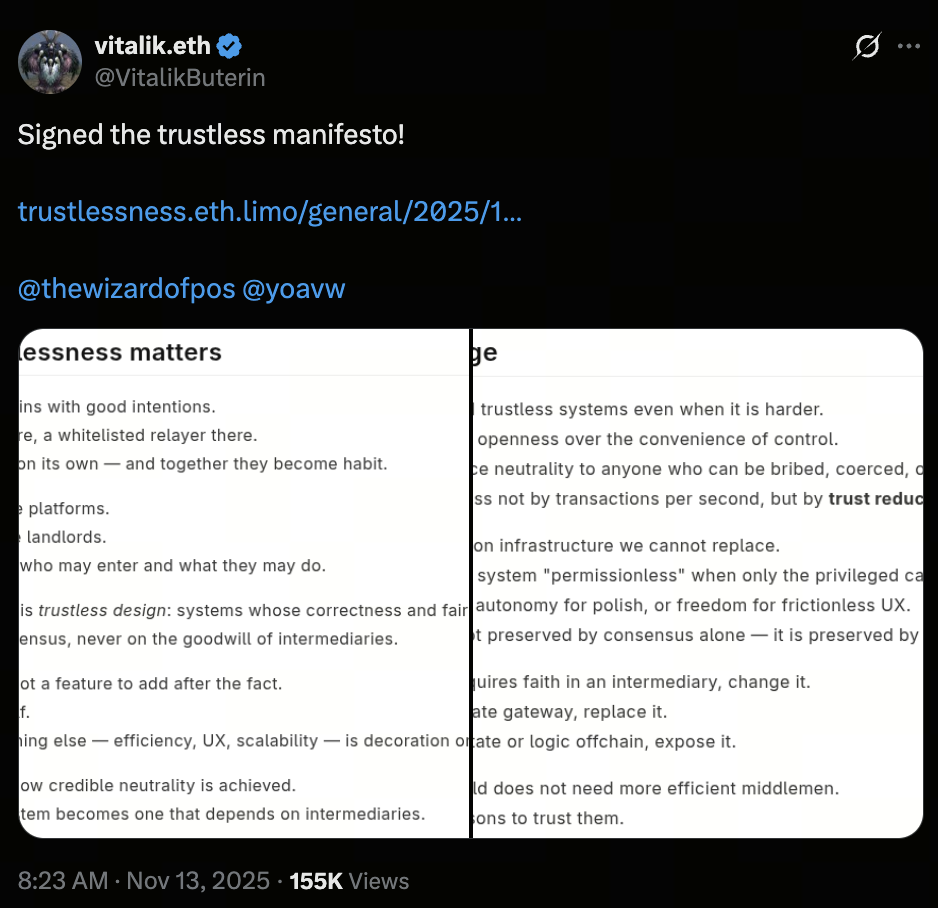

(Source: Vitalik Buterin)

In his “Trustless Manifesto,” Vitalik Buterin asserts that real trustlessness isn’t just a feature—it’s the foundation of blockchain. If a protocol depends on any trusted intermediary, the appearance of neutrality is superficial. Only trust systems built on mathematics, consensus mechanisms, and open protocols can ensure Web3 doesn’t repeat Web2’s centralization cycle.

Ethereum’s Mission

Vitalik Buterin reaffirms Ethereum’s core purpose: it wasn’t created to make finance more efficient or apps more sophisticated, but to empower humans to collaborate freely—without permission and without trust.

Ethereum stands out because it replaces trust with verification and policies with protocols. This approach is more than a technical decision; it represents a clash of values. People should base freedom on individual sovereignty and the right to verification, not on the goodwill of intermediaries.

The Nature of Trustlessness

True trustless systems don’t reject trust—they make trust verifiable. Vitalik Buterin and his team laid out five principles for Trust Minimization:

  1. Self-sovereignty: Users act independently, without relying on third-party agents.
  2. Verifiability: All transactions and actions must be open to inspection, reproduction, and verification by anyone.
  3. Censorship Resistance: No valid action should be arbitrarily blocked or excluded.
  4. Walkaway Readiness: If any part of the system fails, other nodes must be able to take over.
  5. Transparent Incentives: All incentive structures must be public and transparent, not hidden in closed-source code or private agreements.

Ignoring these principles leads decentralized protocols down the same path as centralized platforms.

The Cost of Convenience

Vitalik Buterin points out that the biggest threat to trustlessness isn’t malicious attacks—it’s quiet compromise. Today, most dApps default to centralized RPC nodes;

  • Rollups maintain control over admin keys;
  • Cross-chain bridges rely on trusted nodes;
  • More users are choosing centralized exchanges over self-custody.

Every convenience-driven concession returns trust to the system’s core; every time verification is skipped, it weakens the defense. Ultimately, blockchain risks falling back under the control of trusted intermediaries, which is what it was created to disrupt.

The Developer’s Duty

Vitalik Buterin stresses that developers’ responsibility isn’t to make systems easier to use, but to make them freer. If systems sacrifice verifiability for user-friendliness, or let convenience outweigh neutrality, that’s not progress—it’s regression. He sets out three core design rules for developers:

  • Never rely on critical private information;
  • Never design critical intermediary nodes;
  • Never produce outcomes that cannot be independently verified.

These rules may make development tougher, but this rigor is what preserves the true essence of trustlessness.

The Future of Web3

Ethereum’s scaling is now a reality, and the next challenge is to maintain honesty. As Layer 2 solutions, cross-chain bridges, and modular architectures emerge, remember:

  • User autonomy must never be surrendered to custodians;
  • Verification rights belong to everyone;
  • No one should be quietly excluded from the system.

Trust minimization isn’t about zero risk—it’s about making errors visible, fixable, and accountable. Real trustlessness means mistakes aren’t hidden.

If you want to learn more about Web3, please register at: https://www.gate.com/

Summary

Web3’s mission is not just to decentralize technology, but to remove intermediaries from power and trust. Trustlessness isn’t a fleeting revolution—it’s a long-term resistance. By choosing openness over control and transparency over blind trust, we keep the spirit of Ethereum alive: freedom, censorship resistance, and verifiable trust.

Author: Allen
Disclaimer
* The information is not intended to be and does not constitute financial advice or any other recommendation of any sort offered or endorsed by Gate.
* This article may not be reproduced, transmitted or copied without referencing Gate. Contravention is an infringement of Copyright Act and may be subject to legal action.

Related Articles

AI-Native Settlement Layers: How United Stables Is Building the Next Financial Rail
Beginner

AI-Native Settlement Layers: How United Stables Is Building the Next Financial Rail

Stablecoins were originally designed as dollar substitutes within exchanges, primarily used for asset pricing and trade settlement. As on-chain financial ecosystems have matured, their role has expanded beyond simple payments to include collateral assets, cross-chain liquidity mediums, and unified settlement units. In particular, as AI systems and automated agents begin to participate directly in economic activity, demand has risen sharply for programmable value units capable of instant settlement. This shift is pushing stablecoins toward the role of foundational financial infrastructure.
2026-03-25 03:16:17
The ve(3,3) Flywheel Explained: How AERO Tokenomics Powers Aerodrome’s DeFi Economy
Beginner

The ve(3,3) Flywheel Explained: How AERO Tokenomics Powers Aerodrome’s DeFi Economy

In the competition for DeFi liquidity, high-inflation mining alone is no longer enough to build lasting advantages. Aerodrome applies the ve(3,3) economic model to redesign token emissions, voting mechanisms, and revenue distribution, creating a liquidity flywheel centered on governance and cash flow. This article examines AERO tokenomics, the veAERO locking mechanism, and protocol revenue models to explain how Aerodrome builds a sustainable DeFi economic system.
2026-03-25 06:41:58
How Does PAXG Work? In-Depth Overview of the Physical Gold Tokenization Mechanism
Beginner

How Does PAXG Work? In-Depth Overview of the Physical Gold Tokenization Mechanism

PAXG (Pax Gold) is a tokenized asset backed by physical gold, issued by the fintech company Paxos and traded on the Ethereum blockchain as an ERC-20 token. The core concept is to tokenize physical gold on-chain, with each PAXG token representing ownership of a certain amount of gold. This structure enables investors to hold and trade gold in the form of a digital asset.
2026-03-24 19:12:51
Aerodrome Tokenomics: How ve(3,3) Powers Base's Most Profitable DEX
Beginner

Aerodrome Tokenomics: How ve(3,3) Powers Base's Most Profitable DEX

AERO is the native token of Aerodrome Finance, a core decentralized exchange and liquidity protocol in the Base ecosystem. It is primarily used for liquidity incentives and ecosystem operations. veAERO is a governance NFT that users receive by locking AERO, representing both voting power and the right to share protocol revenue. Through a dual track structure of AERO as a utility token and veAERO as a governance credential, Aerodrome separates liquidity usage value from long term governance power, allowing participants to act as liquidity providers, governance decision makers, and revenue sharers within the same system.
2026-03-25 06:40:31
How is the price of PAXG determined? Pegging mechanism, trading depth, and influencing factors
Beginner

How is the price of PAXG determined? Pegging mechanism, trading depth, and influencing factors

PAXG (Pax Gold) is a tokenized asset backed by physical gold reserves, launched by fintech firm Paxos and issued as an ERC-20 token on the Ethereum blockchain. The core concept is to digitally represent real-world gold assets, allowing investors to hold and trade gold via the blockchain network. Because each PAXG token corresponds to a specific quantity of physical gold, its price is theoretically expected to closely track the global gold market.
2026-03-24 19:11:40
Hybrid Collateral Stablecoins: Inside United Stables' Stability and Yield Architecture
Beginner

Hybrid Collateral Stablecoins: Inside United Stables' Stability and Yield Architecture

In the early stages of the crypto market, traditional stablecoins mainly relied on single-reserve or single-collateral models. Their primary focus was price stability and payment convenience, which allowed them to become foundational tools for on-chain trading and capital flows. As the market has entered a more mature financial phase, however, this structure has begun to reveal limitations, including high concentration risk and the difficulty of balancing liquidity with yield. These constraints have driven the evolution toward multi-layer collateral and portfolio-based designs, such as the dual-layer hybrid collateral architecture proposed by United Stables, which seeks to redefine the underlying logic of stable assets.
2026-03-25 03:17:39





