Ethereum, en tant que l’un des principaux réseaux de Smart Contract au monde, s’appuie depuis longtemps sur le Gas Market pour allouer les ressources nécessaires aux transactions on-chain. À chaque transaction initiée, l’utilisateur doit s’acquitter de Gas afin de rivaliser avec d’autres transactions pour accéder à un espace de bloc limité. Ce mécanisme garantit l’efficacité du réseau, mais il peut aussi engendrer des frais de trading élevés et des délais de confirmation instables lors des congestions.
Avec l’essor rapide de la DeFi, du blockchain gaming et des applications on-chain en temps réel, le modèle d’enchères instantanées du Gas Market traditionnel d’Ethereum rencontre des limites croissantes en matière de performance en temps réel. ETHGas a ainsi été lancé comme nouvelle orientation pour l’infrastructure Ethereum en temps réel. Contrairement au Gas Market traditionnel, ETHGas privilégie la coordination de l’espace de bloc, la pré-confirmation et l’exécution en temps réel, avec pour but d’optimiser les interactions on-chain grâce à une logique innovante de planification des ressources.
Vue d’ensemble : Gas Market traditionnel vs ETHGas
Le Gas Market traditionnel d’Ethereum constitue le mécanisme d’allocation de l’espace de bloc par le réseau Ethereum.
Chaque transaction sur Ethereum requiert le paiement de Gas. Le Gas mesure les ressources de calcul on-chain et détermine la priorité accordée à chaque transaction.
Après soumission, la transaction entre dans le Mempool. Les Validateurs ou Builders privilégient généralement les transactions avec les ordres de Gas les plus élevés, obligeant les utilisateurs à augmenter leurs frais pour obtenir une confirmation plus rapide.
La logique fondamentale de ce mécanisme repose sur :
-
espace de bloc limité
-
compétition entre utilisateurs via des enchères
-
Gas élevé = priorité accrue
-
congestion réseau = hausse des frais de trading
ETHGas, en tant que protocole d’infrastructure Ethereum axé sur le Realtime Blockspace, vise à accroître l’efficacité d’exécution des transactions et à optimiser la coordination des ressources on-chain.
Contrairement au Gas Market traditionnel, ETHGas se concentre sur la coordination anticipée de l’espace de bloc, la pré-confirmation et l’exécution en temps réel. Le modèle classique repose sur une « compétition instantanée ».
Principales différences entre ETHGas et le Gas Market traditionnel
La distinction majeure entre ETHGas et le Gas Market traditionnel d’Ethereum concerne leur gestion de l’espace de bloc.
Ethereum classique considère l’espace de bloc comme une ressource à allouer en temps réel, nécessitant des enchères immédiates pour la priorité des transactions. ETHGas, à l’inverse, traite l’espace de bloc comme une ressource à coordonner et planifier à l’avance, afin d’améliorer l’efficacité d’exécution via un marché de l’espace de bloc en temps réel.
Cette différence impacte également la logique de confirmation des transactions.
Ethereum traditionnel mise sur la confirmation finale on-chain, tandis qu’ETHGas introduit un mécanisme de pré-confirmation, permettant à certaines transactions d’obtenir un retour d’exécution anticipé avant leur inclusion officielle on-chain.
L’expérience utilisateur et le support applicatif diffèrent également. ETHGas vise à simplifier la gestion du Gas pour les particuliers et prend en charge l’abstraction du Gas et l’interaction temps réel.
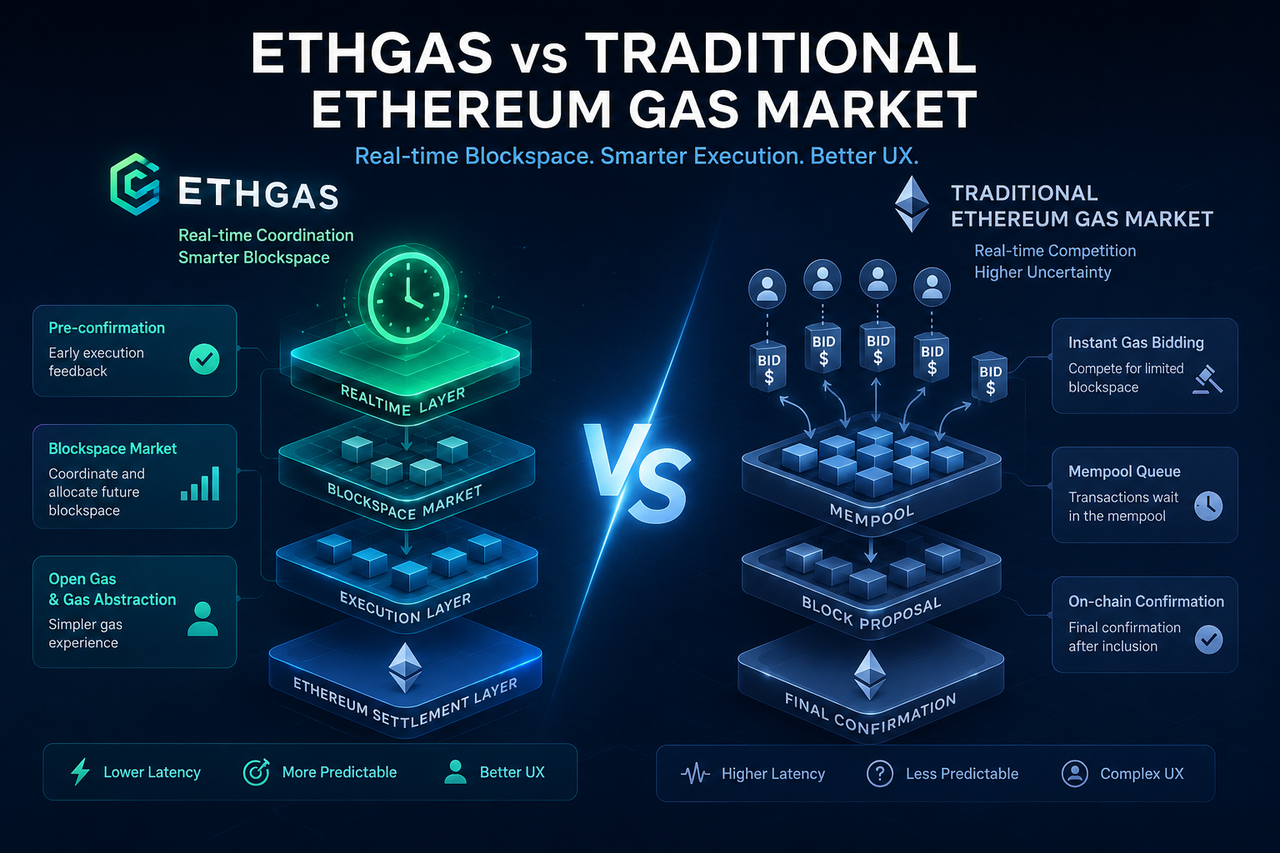
Différences de mécanismes de tarification du Gas
Le Gas Market traditionnel repose avant tout sur des enchères instantanées.
En cas de congestion, les utilisateurs doivent continuellement augmenter leurs ordres de Gas pour accélérer le traitement de leurs transactions. Si ce système permet une allocation dynamique des ressources, il génère aussi une forte volatilité des frais de trading.
ETHGas privilégie la coordination de l’espace de bloc et la planification des ressources en temps réel. Son objectif n’est pas uniquement de rivaliser en augmentant les frais de Gas, mais d’optimiser les parcours d’exécution grâce à un marché de l’espace de bloc.
Par rapport au modèle classique, ETHGas met l’accent sur :
-
la réduction de l’impact des congestions
-
l’amélioration de la certitude d’exécution
-
l’optimisation de l’expérience de trading en temps réel
-
la pré-coordination des ressources de bloc
ETHGas agit ainsi comme une « couche de coordination des ressources » plutôt qu’un simple système d’enchères de Gas.
Différences des mécanismes de confirmation des transactions
Le réseau Ethereum traditionnel repose sur la confirmation finale on-chain.
Après soumission, l’utilisateur attend que la transaction soit incluse dans un bloc et confirmée par le réseau pour obtenir un statut définitif. Ce processus assure la sécurité, mais la rapidité de confirmation dépend de la congestion.
ETHGas introduit la pré-confirmation.
Certaines transactions peuvent recevoir un retour d’exécution anticipé avant d’être inscrites dans un bloc, permettant aux utilisateurs d’obtenir plus rapidement le statut de leur opération et d’améliorer l’interaction en temps réel.
Synthèse des deux modèles :
| Dimension de comparaison |
ETHGas |
Ethereum traditionnel |
| Modèle d’espace de bloc |
Coordination en temps réel |
Compétition instantanée |
| Confirmation des transactions |
Pré-confirmation possible |
Confirmation finale on-chain |
| Gestion du Gas |
Abstraction du Gas prise en charge |
Gestion utilisateur |
| Expérience utilisateur |
Axée sur l’interaction en temps réel |
Axée sur le règlement final |
| Logique d’exécution |
Planification de l’espace de bloc |
Tri par ordre de Gas |
ETHGas ne remplace pas la confirmation du mainnet, mais ajoute une couche d’exécution en temps réel avant le règlement final.
Pourquoi ETHGas mise-t-il sur le Realtime Blockspace ?
Avec des applications on-chain de plus en plus complexes, la demande d’environnements à faible latence et à exécution en temps réel progresse.
Dans le blockchain gaming, les Carnets d’ordres on-chain ou le trading Haute fréquence, les délais de confirmation influent directement sur l’expérience et les résultats d’exécution. Le modèle d’enchères instantanées d’Ethereum classique favorise la compétition, mais montre ses limites en temps réel.
L’approche Realtime Blockspace d’ETHGas vise à pré-coordonner les ressources, réduire l’incertitude lors des congestions et offrir un environnement d’exécution plus stable.
Cette orientation s’inscrit dans la modularisation de l’infrastructure Ethereum, le marché MEV et l’écosystème de l’abstraction de compte.
ETHGas va-t-il remplacer le Gas Market traditionnel ?
Aujourd’hui, ETHGas étend l’infrastructure Ethereum sans remplacer le Gas Market traditionnel.
Le Gas Market du mainnet demeure central, avec son modèle d’enchères instantanées qui garantit compétition et sécurité.
ETHGas constitue une couche de coordination des ressources en temps réel, bâtie sur l’infrastructure existante, pour répondre aux besoins des interactions Haute fréquence et des applications en temps réel.
À l’avenir, les deux modèles coexisteront :
Cette structure reflète la modularisation continue d’Ethereum.
Résumé
ETHGas et le Gas Market traditionnel d’Ethereum sont tous deux centrés sur la gestion de l’espace de bloc, mais diffèrent dans l’allocation des ressources, la confirmation des transactions et la logique d’exécution.
Ethereum classique privilégie les enchères instantanées et la confirmation finale on-chain ; ETHGas met l’accent sur la coordination en temps réel, la pré-confirmation et l’abstraction du Gas, pour accroître l’efficacité des interactions on-chain grâce à une couche d’exécution en temps réel.
À mesure que l’infrastructure Ethereum évolue vers le temps réel et la modularisation, le concept de Realtime Ethereum incarné par ETHGas devient un axe clé pour la planification des ressources on-chain.
FAQ
ETHGas va-t-il remplacer le Gas Market originel d’Ethereum ?
Non, pas à ce stade. ETHGas vise l’exécution en temps réel et la coordination des ressources, tandis que le mainnet gère toujours le règlement final.
Quelle est la principale différence entre ETHGas et Ethereum traditionnel ?
L’allocation de l’espace de bloc. Ethereum classique repose sur les enchères de Gas instantanées ; ETHGas privilégie la coordination en temps réel.
ETHGas modifie-t-il le consensus d’Ethereum ?
Non. ETHGas fonctionne sur l’infrastructure d’Ethereum et ne remplace pas le consensus du mainnet.
Qu’est-ce que le Realtime Blockspace ?
Le Realtime Blockspace est une structure de ressource de bloc pouvant être coordonnée, planifiée et optimisée à l’avance pour l’exécution.
Pourquoi ETHGas prend-il en charge la pré-confirmation ?
La pré-confirmation réduit les délais d’attente et améliore l’interaction on-chain en temps réel.
ETHGas est-il lié au MEV ?
Oui, en partie. La coordination de l’espace de bloc, l’ordonnancement par les Builders et les mécanismes d’exécution sont liés à l’écosystème MEV d’Ethereum.