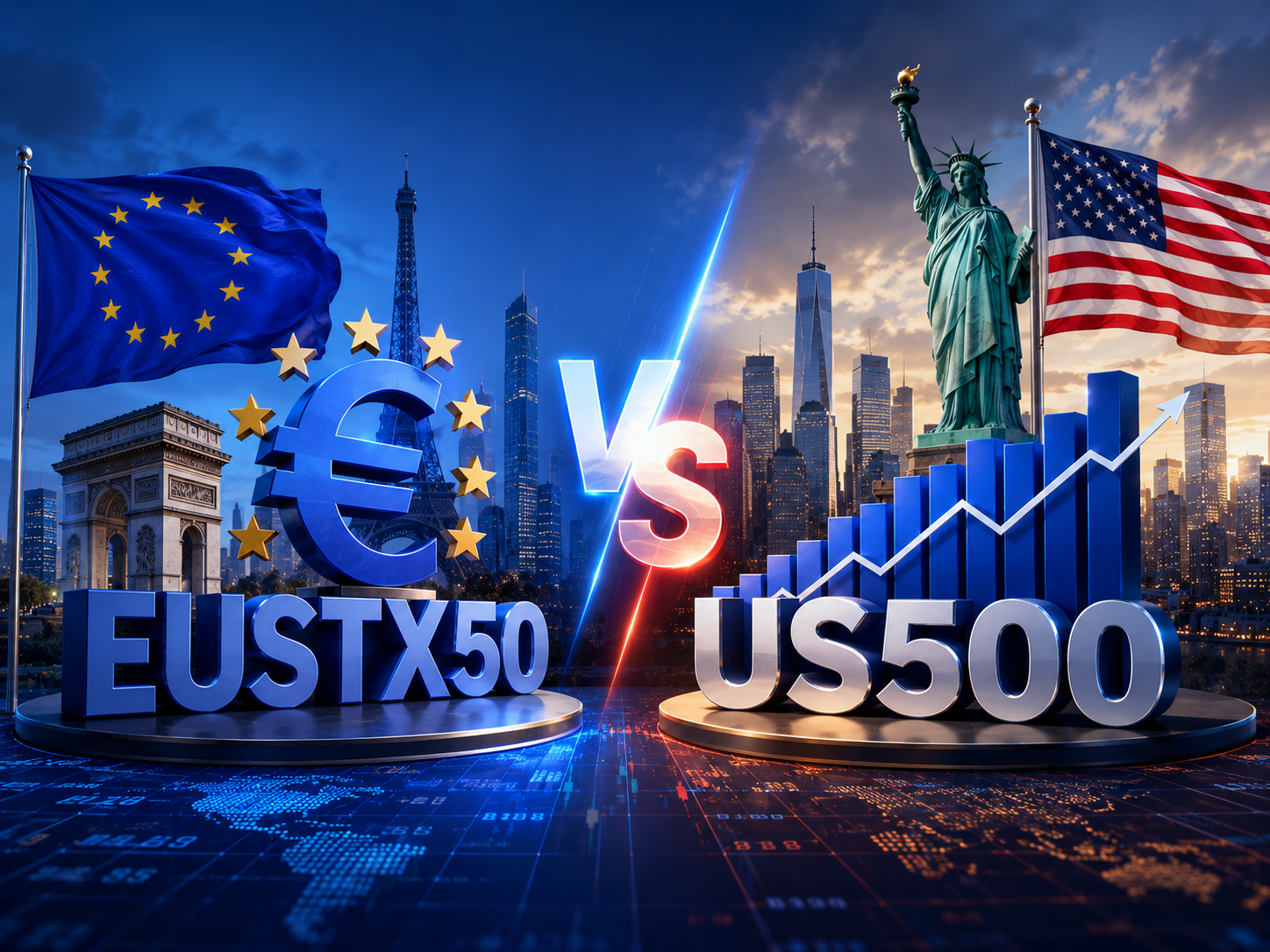
This difference is reflected not only in their constituents, but also in their earnings models, valuation frameworks, and sources of market risk. Understanding the differences between EUSTX50 and US500 helps provide a broader view of global capital flows and the development characteristics of different economies.
What Is EUSTX50
EUSTX50 refers to the Euro Stoxx 50 Index, one of Europe’s most representative blue chip stock indices. It selects 50 of the largest and most liquid companies from large listed companies in the Eurozone, which is why it is widely regarded as an important barometer of the European economy.
Unlike a single country index, EUSTX50 covers several core Eurozone economies, including France, Germany, the Netherlands, Spain, and Italy. Its constituents come from a wide range of industries, including industry, finance, energy, consumer goods, healthcare, and technology, allowing it to reflect the overall operating conditions of European companies in a relatively comprehensive way.
ASML, SAP, LVMH, Hermès, Siemens, Airbus, and Allianz have long held core positions in the index. These companies not only have significant influence in the European market, but are also global leaders in their respective industries.
From a market positioning perspective, EUSTX50 is more like a concentrated expression of Europe’s real economy competitiveness.
What Is US500
US500 is commonly used to track the overall performance of the U.S. S&P 500 Index. As one of the world’s most closely watched stock indices, US500 covers 500 large listed companies in the United States and includes nearly all of the most important industrial forces in the U.S. economy.
Over the past two decades, the continued expansion of the U.S. technology sector has made companies such as Microsoft, Apple, Nvidia, Alphabet, Amazon, and Meta the main drivers of index gains. At the same time, the U.S. capital market has the world’s most mature venture capital system and innovation ecosystem, which has allowed technology companies to keep finding room for growth.
Therefore, US500 not only reflects the operation of the U.S. economy, but also, to a large extent, the development trends of global technology innovation and the digital economy.
From the perspective of global asset allocation, US500 has become an important benchmark for international investors observing risk assets.
Sector Structure Differences Between EUSTX50 and US500
Sector structure is the most fundamental difference between the two indices.
Growth in the U.S. market over the past decade or more has largely revolved around technology innovation. From mobile internet and cloud computing to the artificial intelligence boom, large U.S. technology companies have continued to expand their market share and increase their weight in the index. Today, US500 performance is highly tied to the technology sector.
By contrast, the European market represented by EUSTX50 has a more balanced industry structure.
Europe has a globally leading industrial manufacturing system, luxury goods groups, energy companies, and financial institutions. As a result, index weights are spread more broadly across industrial automation, high end manufacturing, consumer brands, insurance and finance, and energy. ASML represents advanced semiconductor equipment, LVMH and Hermès represent the global luxury consumer market, while Siemens and Schneider Electric represent Europe’s strength in industrial technology.
This structure means the two indices respond differently to economic cycles. When artificial intelligence, software services, and the digital economy enter an expansion phase, the U.S. market usually performs more strongly. When global manufacturing recovers, consumer demand grows, or energy prices rise, the European market is more likely to benefit.
Essentially, US500 leans more toward a growth market, while EUSTX50 leans more toward a mature industry market.
Earnings Model Differences Between EUSTX50 and US500
Differences in industry structure eventually show up in corporate earnings models.
The earnings models of US500 constituents are more often built on technology platforms and intellectual property. Microsoft’s software subscription system, Alphabet’s advertising business, Amazon’s cloud computing services, and Meta’s social platforms are all essentially scalable digital businesses.
The biggest feature of digital businesses is their lower marginal cost. When the user base continues to grow, corporate revenue often grows faster than costs. As a result, U.S. technology companies usually have higher profit margins and faster earnings expansion potential.
EUSTX50 companies, on the other hand, rely more on real economic activity.
Whether it is Airbus manufacturing aircraft, Siemens selling industrial equipment, or LVMH operating a luxury goods business, these companies fundamentally depend on production capacity, supply chains, and global consumer demand. Compared with digital platform companies, this type of business usually grows more slowly, but often offers stronger earnings stability.
Therefore, the U.S. market is more likely to receive a growth premium, while the European market is more likely to appeal to value oriented investors.
Weight Concentration Differences Between EUSTX50 and US500
In recent years, the U.S. market has shown a clear “mega cap effect.”
As the market value of technology giants has continued to rise, Microsoft, Apple, Nvidia, Alphabet, Amazon, and Meta have had an increasing influence on the index. During certain periods, only a few companies can determine the direction of the entire index.
This structure can amplify returns during technology bull markets, but it also increases the market’s dependence on a single sector.
By contrast, EUSTX50 has a more dispersed weight distribution.
Although companies such as ASML, LVMH, and SAP carry relatively high weights, the industrial, financial, consumer, and energy sectors still provide important support for the index. As a result, the European market usually does not experience sharp swings simply because of volatility in one sector.
This difference means US500 has more concentrated upside drivers, while EUSTX50 has more diversified sources of gains.
Risk Source Differences Between EUSTX50 and US500
Because their industry structures differ, the two indices also face clearly different risks.
The biggest risk for US500 today mainly comes from technology sector valuations. If the returns from artificial intelligence investment fall short of market expectations, or if earnings growth among large technology companies slows, the index may face significant valuation adjustment pressure.
In addition, the U.S. market is also affected by antitrust regulation, interest rate changes, and shifts in the competitive landscape of the technology industry.
EUSTX50’s risks, by contrast, come more from the macroeconomic level.
Europe’s economic growth rate is relatively low, and energy price volatility, European Central Bank monetary policy, and changes in the euro exchange rate can all affect corporate profitability. At the same time, European companies are generally highly internationalized, so changes in the global trade environment can also have a meaningful impact on the index.
In other words, the U.S. market is more exposed to growth related risks, while the European market is more exposed to economic cycle risks.
Investment Logic Differences Between EUSTX50 and US500
Capital markets do not price the two indices in the same way.
Investors who allocate to US500 usually do so to participate in returns brought by technology innovation and corporate growth. The market’s focus is often on artificial intelligence, cloud computing, software services, and the potential for future earnings growth.
Investors who allocate to EUSTX50 tend to place more emphasis on stable cash flow, global consumer brand value, and the long term competitiveness of industrial leaders.
This difference determines how the two indices behave in different market environments.
When global liquidity is abundant and risk appetite rises, US500 often performs more strongly. When the market pays more attention to earnings stability, dividend returns, and valuation margins of safety, EUSTX50 is usually more attractive.
Therefore, the two are not simple substitutes for each other. They represent two different investment logics and asset allocation directions.
Conclusion
EUSTX50 and US500 represent the core large cap equity markets of Europe and the United States, respectively, but the economic structures and growth models behind them are fundamentally different. US500 reflects more of the achievements of technology innovation and the digital economy, while EUSTX50 reflects the competitiveness of Europe’s industrial manufacturing, consumer brands, and financial system.
From sector structure and earnings models to weight distribution and sources of risk, the two indices show different market characteristics. Understanding these differences not only helps with analyzing index movements, but also provides a global perspective on the direction of capital market development.
FAQs
What Is the Biggest Difference Between EUSTX50 and US500?
The biggest difference lies in sector structure. US500 is centered on technology companies, while EUSTX50 leans more toward industrial, financial, consumer brand, and energy companies.
Why Does US500 Usually Grow Faster Over the Long Term?
US500 includes many high growth technology companies. Digital businesses have stronger scalability, so earnings growth is usually faster than in traditional industries.
Does EUSTX50 Include Technology Companies?
EUSTX50 includes technology companies such as ASML and SAP, but the overall share of technology is clearly lower than in the U.S. market.
Which Index Is More Affected by the AI Industry?
US500 is more sensitive to the AI industry because companies such as Microsoft, Nvidia, Alphabet, and Amazon are all deeply involved in building AI infrastructure.
Which Index Is More Volatile?
US500 is usually more volatile because technology has a higher weight, and valuations of technology companies often change faster than those of traditional industries.
Why Should Crypto Users Pay Attention to EUSTX50 and US500?
The two indices can reflect changes in global capital flows and risk appetite, making them important references for understanding cross market asset allocation and the global economic cycle.