Understanding the corporate structure of FRA40 not only sheds light on the industry distribution of the French capital market but also helps explain why France has maintained its position as a core European economy for so long. Because the index uses a free-float market-cap weighting methodology, large companies exert a significant influence on its performance. For this reason, studying the composition of its constituents is essential when analyzing FRA40 price action.
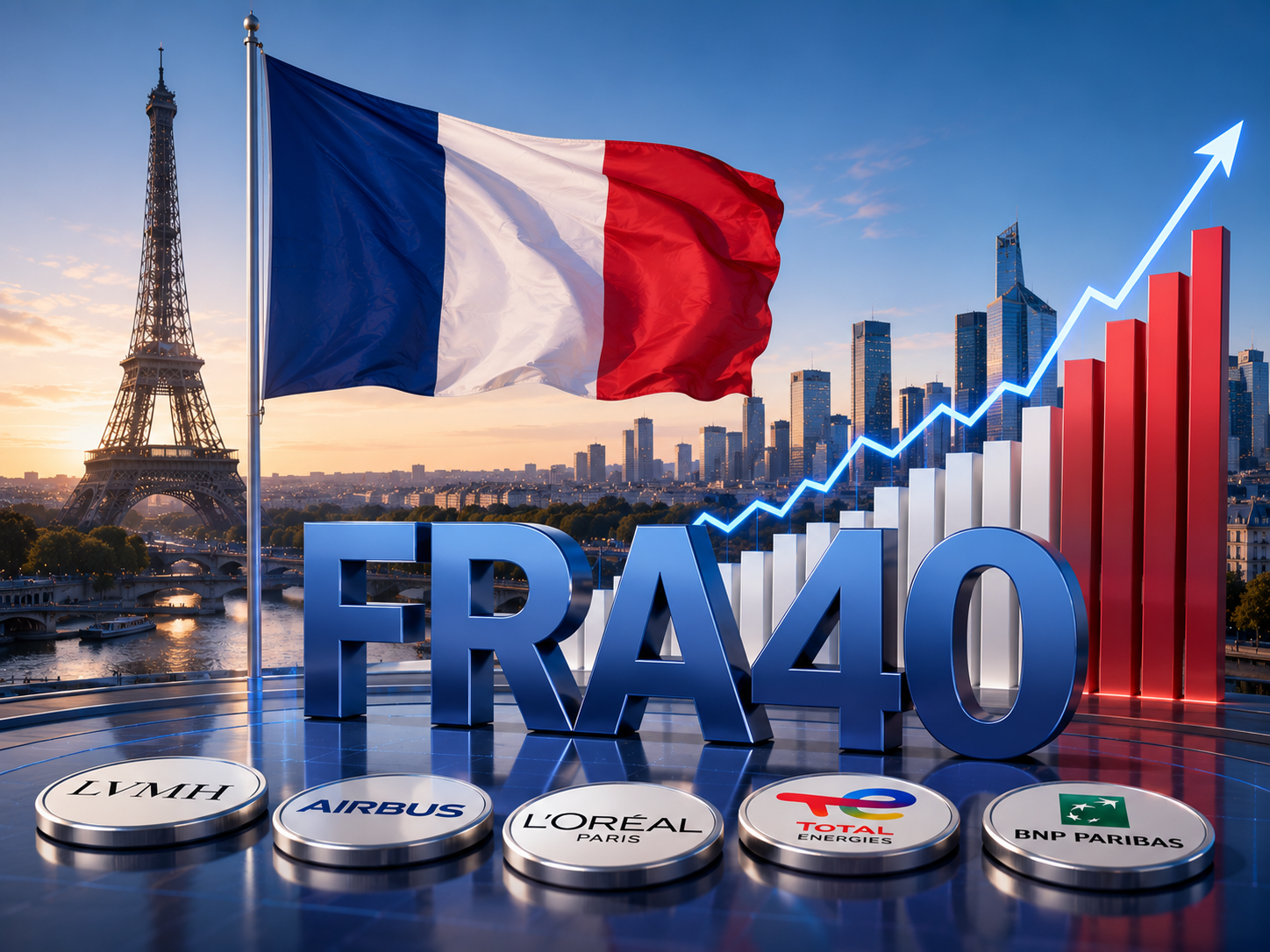
What Are the Constituents of FRA40?
FRA40 tracks the French CAC 40 Index, whose constituents are the most representative companies listed on Euronext Paris. The index committee regularly adjusts the constituent list based on market capitalization, liquidity, and market representativeness to ensure the index consistently reflects the overall performance of France's largest publicly traded companies.
Most of the companies in FRA40 today operate globally, generating revenue not just from France but from across Europe, North America, the Middle East, and Asia. As a result, FRA40 essentially reflects both the French economy and changes in global economic activity.
In terms of size, the majority of the index's companies are European or global industry leaders, with some boasting market capitalizations worth hundreds of billions of euros.
What Are the Key Characteristics of FRA40's Industry Distribution?
FRA40's industry structure differs markedly from that of U.S. indices.
Major U.S. indices are typically dominated by software, internet, and AI companies, whereas the French market leans more toward the real economy, high-end manufacturing, and branded consumer goods. Luxury goods have long carried significant weight, while industrial manufacturing, aerospace and defense, finance and insurance, and energy also command sizable shares.
This structure means FRA40 is more sensitive to global consumer demand, industrial investment cycles, and the European economic environment, rather than being overly dependent on a single sector like a tech-heavy index.
From a broad perspective, FRA40 can be broken down into the following core sectors:
| Industry |
Representative Companies |
| Luxury Goods & Consumer |
LVMH, Hermès, L'Oréal, Kering |
| Industrial Manufacturing |
Schneider Electric, Saint-Gobain |
| Aerospace & Defense |
Airbus, Safran |
| Finance & Insurance |
BNP Paribas, Société Générale, AXA |
| Energy & Utilities |
TotalEnergies, Engie |
| Healthcare |
Sanofi |
This diversification gives FRA40 a stronger sector balance than single-industry indices.
Which Companies Represent the Luxury Sector?
The luxury industry is FRA40's most distinctive component and one of the areas where the French capital market enjoys the strongest global competitiveness.
LVMH, the world's largest luxury goods group, owns iconic brands like Louis Vuitton, Dior, and Tiffany. Thanks to its massive market cap, LVMH has long been one of the highest-weighted companies in FRA40.
Hermès is viewed as the benchmark for global high-end consumer brands. Its scarcity and brand pricing power make it one of the most closely watched consumer companies in Europe.
L'Oréal is the world's largest cosmetics group, spanning both mass-market and premium beauty. Kering owns well-known brands such as Gucci and Saint Laurent.
The common thread among these companies is high brand value and deep global reach. As a result, shifts in global consumption trends often have a direct impact on FRA40's overall performance.
Which Companies Lead the Industrial and Aerospace Sectors?
Beyond luxury, industrial manufacturing is a vital pillar of the French economy.
Airbus, one of the world's largest civil aircraft manufacturers, uses its order cycle to reflect trends in global air transport. High barriers to entry in commercial aviation help Airbus maintain a strong competitive edge.
Safran is a global leader in aircraft engines and aerospace equipment, occupying a critical position in the aviation supply chain. As global aviation recovers, Safran's performance has become an important metric for FRA40.
In industrial automation and power management, Schneider Electric is among the most influential companies worldwide. With the ongoing expansion of data centers, electrification, and industrial digitalization, Schneider Electric's role in Europe's industrial ecosystem continues to grow.
These companies ensure that FRA40 not only represents the French market but also mirrors global industrial and infrastructure investment cycles.
What Role Do Financial and Energy Companies Play in the Index?
Financial and energy stocks provide a stable earnings base for FRA40.
BNP Paribas, one of Europe's largest banking groups, operates across retail banking, corporate finance, and asset management. Société Générale is another key French financial institution with significant influence in the European banking system.
On the insurance side, AXA is one of the world's largest insurers, with operations spanning many countries. The profitability of financial firms is typically tied to interest rates, credit demand, and economic growth, so European Central Bank policy often directly affects these stocks.
In energy, TotalEnergies is the standout. As a major global energy company, its performance is closely linked to international oil prices, natural gas markets, and global energy demand.
Together, the financial and energy sectors act as a stabilizer for FRA40, often providing support during periods of market turbulence.
FRA40 uses a free-float market-cap weighting, so heavyweights have an outsized impact on the index.
When large names like LVMH, Hermès, TotalEnergies, Airbus, or Schneider Electric rise sharply, the index can remain strong even if smaller constituents trade flat.
Conversely, significant drops in a few high-weight stocks can drag down the entire index.
From a market analysis standpoint, studying FRA40 means looking beyond the index itself to focus on earnings reports, profit forecasts, and industry trends of the top-weighted companies.
That's why global investment institutions consistently treat heavyweight stocks as key reference points for assessing FRA40's future direction.
Summary
FRA40 consists of 40 of France's most representative blue-chip companies. Its industry structure highlights the key features of the French economy and the European capital market. Unlike U.S. indices, which are heavily tech-driven, FRA40 places greater emphasis on luxury goods, high-end manufacturing, aerospace, finance, and energy.
LVMH, Hermès, Airbus, Schneider Electric, BNP Paribas, and TotalEnergies form the core of FRA40. Because the index is market-cap weighted, the performance of these heavyweights often dictates overall market direction. Thus, understanding FRA40's corporate makeup and industry profile is essential for analyzing the French stock market and the European economy.
FAQ
How many companies does FRA40 include?
FRA40 is made up of 40 large French blue-chip listed companies. The constituent list is reviewed and adjusted periodically based on market conditions.
Which companies have the highest weights in FRA40?
LVMH, Hermès, TotalEnergies, Schneider Electric, and Airbus are typically among the highest-weighted companies in FRA40.
Why does FRA40 have such a high proportion of luxury stocks?
France boasts the world's leading luxury industry. With massive market caps, companies like LVMH, Hermès, Kering, and L'Oréal naturally command significant weight in the index.
Why is Airbus a constituent of FRA40?
Airbus is headquartered in France and is a leading representative of the European aerospace industry, making it a long-standing core component of FRA40.
How does FRA40 differ from U.S. tech indices?
FRA40 emphasizes consumer brands, industrial manufacturing, and financial services, while U.S. tech indices are more heavily driven by software, internet, and AI companies.