As global capital markets and digital asset markets become increasingly integrated, more investors are looking for ways to participate in stock markets across different countries and regions through a single unified account. Traditional cross-border investing typically requires multiple brokerage accounts, different currency systems, and complex fund transfer processes. However, advances in digital asset infrastructure are reshaping this landscape. By using stablecoins as an entry point for funding, global stock investing is becoming more accessible and efficient.
In the global stock trading space, Gate Stocks is building an ecosystem that spans multiple international markets. Following the launch of US stock trading services, Gate has officially introduced a Hong Kong stock trading section, enabling users to invest in both the Hong Kong and US stock markets through one unified account.
What Is Gate Stocks?
Gate Stocks is Gate's global stock trading platform that allows users to invest in traditional stock markets using their digital asset accounts.
Currently, Gate Stocks supports US stock trading and has launched a Hong Kong stock trading section. Users can fund their trades with USDT and manage Hong Kong stocks, US stocks, and other supported equities all within a single account framework.
What Are the Similarities Between Buying Hong Kong Stocks and US Stocks on Gate?
For both Hong Kong and US stocks, Gate Stocks provides a consistent trading framework.
Users must complete identity verification and open a Stocks account. Then, they transfer USDT into their stock trading account to start trading. Once executed, stock holdings are kept in the Stocks account and can be managed from a single dashboard.
From an asset class standpoint, both Hong Kong and US stocks fall under Real World Assets (RWA) and represent a key bridge between digital asset platforms and traditional capital markets.
| Item |
Hong Kong Stocks |
US Stocks |
| Trading Platform |
Gate Stocks |
Gate Stocks |
| Fund Entry |
USDT |
USDT |
| Stock Account |
Unified Account |
Unified Account |
| Position Management |
Supported |
Supported |
| Global Investor Participation |
Supported |
Supported |
What Are the Differences in Trading Hours Between Hong Kong Stocks and US Stocks?
Trading hours are one of the most notable differences between the two markets.
The Hong Kong stock market follows the Hong Kong Stock Exchange (HKEX) schedule, typically divided into morning and afternoon sessions with a lunch break in between.
The US stock market follows the schedules of the New York Stock Exchange (NYSE) and NASDAQ, trading continuously without a midday break. For Asian investors, US stock trading hours usually fall during the night.
| Comparison Item |
Hong Kong Stocks |
US Stocks |
| Primary Exchange |
Hong Kong Stock Exchange (HKEX) |
NYSE, NASDAQ |
| Region |
Hong Kong |
United States |
| Lunch Break |
Yes |
No |
| Asian User Trading Time |
Daytime |
Nighttime |
| Market Nature |
Asian International Market |
Global Capital Market |
What Are the Differences in Popular Stocks Between Hong Kong Stocks and US Stocks?
The Hong Kong stock market is dominated by companies in internet, consumer, finance, and new energy sectors.
Notable examples include Tencent Holdings, Alibaba, Xiaomi Group, Meituan, and BYD — all major components of the Hong Kong stock market.
The US stock market, in contrast, is home to the world's leading technology companies, including Apple, Microsoft, Nvidia, Amazon, Alphabet, and Meta.
As a result, the two markets offer distinct industry exposure and investment opportunities.
How Do the Trading Rules for Hong Kong Stocks and US Stocks Differ?
Although Gate Stocks provides a unified trading interface, each market still follows its own exchange rules.
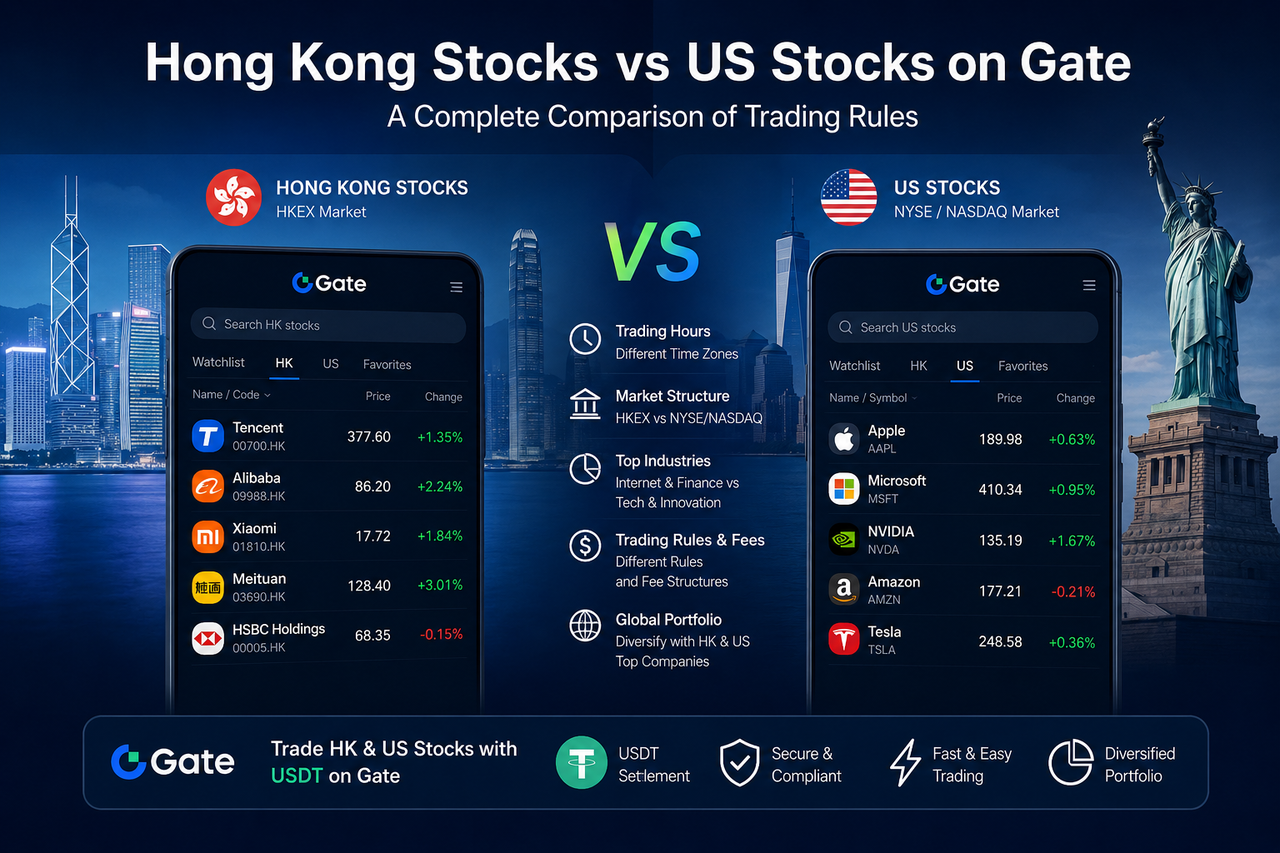
The Hong Kong stock market generally uses a "Board Lot" trading system, where different stocks trade in varying lot sizes.
The US stock market offers more flexibility, with some stocks allowing for smaller fractional trading units. Market liquidity and international participation tend to be higher in the US.
Additionally, the two markets differ in settlement procedures, market structure, and investor composition.
| Comparison Dimension |
Hong Kong Stocks |
US Stocks |
| Market Structure |
Asian Market |
Global Market |
| Representative Companies |
Tencent, Alibaba, Xiaomi |
Apple, Microsoft, Nvidia |
| International Fund Participation |
High |
Very High |
| Liquidity |
High |
Very High |
| Industry Characteristics |
China Economy-Related Assets |
Global Technology Innovation Assets |
What Are the Fee Differences Between Buying Hong Kong Stocks and US Stocks on Gate?
Gate Stocks applies the fee structure of each respective market for Hong Kong and US stocks.
Fees typically include trading commissions, platform fees, market fees, and regulatory charges. Because market rules differ, specific fee items and rates may vary.
Investors should always check the latest fee information on the official Gate Stocks page before trading.
How Can I Invest in Both Hong Kong Stocks and US Stocks Simultaneously Through Gate?
Once you open a Stocks account, you can manage both Hong Kong and US stock assets within the same account system.
The basic steps are:
-
Register for a Gate account;
-
Complete identity verification;
-
Transfer USDT from your Spot Account or Unified Account to your Stocks Account;
-
Search for your target stock in the Hong Kong stocks or US stocks section;
-
Place a trade order;
-
Review and manage your positions.
This setup makes global stock investing more streamlined and convenient.
Summary
Gate Stocks has built a comprehensive global stock trading system covering both Hong Kong and US stocks, offering users a new way to access international capital markets using USDT. The Hong Kong stock market captures opportunities tied to the Asian economy and Chinese enterprises, while the US stock market represents global tech innovation and mature capital markets. Together, they form a complementary pair for global asset allocation.
For investors, choosing between Hong Kong and US stocks is not about which is inherently better — it depends on your investment goals, industry preferences, and risk tolerance.
FAQs
Can I trade both Hong Kong stocks and US stocks using USDT?
Yes. You can use USDT as your funding source to trade on Gate Stocks and manage your assets within a unified account.
Which market is larger — Hong Kong stocks or US stocks?
The US stock market is the largest in the world, while the Hong Kong stock market is one of Asia's most important international financial hubs. Both play significant roles in the global capital market.
Are the trading hours for Hong Kong stocks and US stocks the same?
No. Hong Kong stocks follow the HKEX trading schedule, while US stocks follow the NYSE and Nasdaq schedules. There is a notable time difference between the two.
Which is better for long-term investing — Hong Kong stocks or US stocks?
It depends on your investment goals and industry preferences. Hong Kong stocks tilt toward the Asian economy and Chinese companies, whereas US stocks focus on global tech innovation and international market leaders.
Can I hold both Hong Kong stocks and US stocks at the same time?
Yes. Gate Stocks provides a unified stock account system that allows you to hold and manage Hong Kong stocks, US stocks, and other supported market assets simultaneously.