What Is the Gate Stock Token Zone?
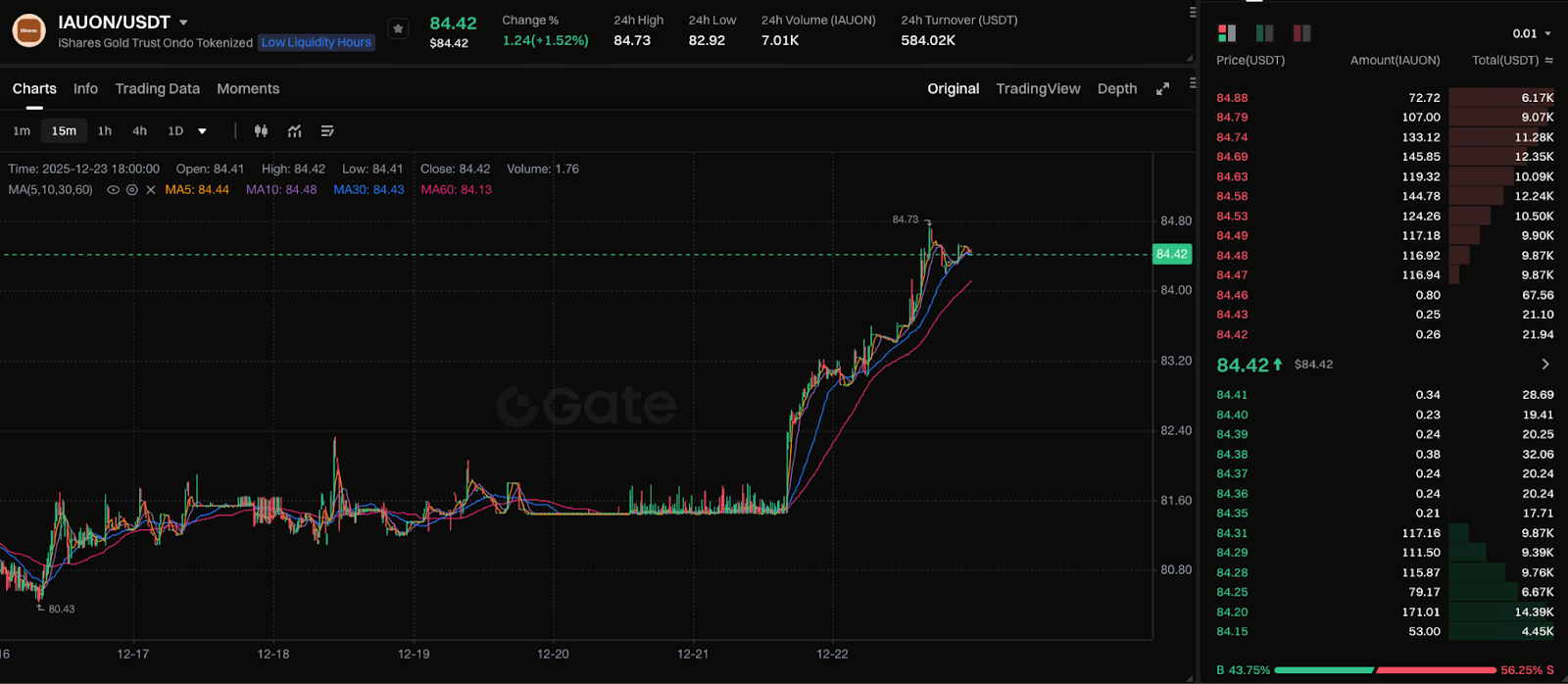
Image: https://www.gate.com/trade/IAUON_USDT
The Gate Stock Token Zone is a dedicated section on the Gate platform where users can trade tokenized representations of stock prices. With digital assets like USDT in their Gate accounts, users can trade stock tokens pegged to the prices of leading global public companies, gaining direct exposure to stock price movements.
It is important to emphasize that stock tokens are not traditional equities. They are on-chain trading instruments that tokenize and map real stock prices, designed primarily for price trading and risk exposure management.
Product Attributes and Positioning of Stock Tokens
From a product design standpoint, Gate stock tokens typically serve the following roles: They track or reflect the market price performance of specific stocks. Users trade the tokens themselves, not the underlying equities. The main function is to provide opportunities to trade on stock price volatility, not to confer company ownership or facilitate long-term equity investment.
Accordingly, stock tokens are best suited as tools for price exposure, trading, strategy execution, or portfolio diversification.
Clarification on Equity, Dividends, and Voting Rights
This is a critical consideration before using stock tokens. In most cases, stock tokens do not grant shareholders voting rights. Whether dividends or equivalent returns exist and how they are distributed depends on the specific product design and issuance rules for each stock token.
Common approaches include: Some stock tokens may reflect dividend impacts through pricing mechanisms or automatic reinvestment, while others only track the stock price itself and do not distribute cash dividends.
Therefore, before trading, users should review the official product documentation for each stock token and should not assume that holding a stock token is equivalent to owning the underlying stock.
Trading Modes Supported in the Gate Stock Token Zone
The Gate Stock Token Zone offers multiple trading modes to meet a range of trading needs:
Spot trading is ideal for users seeking direct exposure to stock price movements. The process is similar to digital asset spot trading and is straightforward to use.
Contract trading enables users to go long or short in both rising and falling markets. However, it involves margin requirements and risk controls, making it more appropriate for experienced traders.
The available trading modes and pairs are as displayed in the Stock Token Zone.
Pricing and Settlement Logic
Within the Gate Stock Token Zone, stock tokens are typically priced in stablecoins such as USDT. Profits and losses are settled in digital assets, and users do not need to interact with traditional securities accounts, clearing, or settlement processes.
This structure allows stock tokens to integrate seamlessly into the existing trading systems of crypto users.
Key Differences Between Stock Tokens and Traditional Stocks
Although stock token prices are closely linked to those of real stocks, there are fundamental differences between the two.
- Stock tokens generally do not represent company equity or confer voting rights;
- Dividend distribution depends on the token’s design and does not constitute traditional cash dividends;
- Trading takes place in digital asset accounts, not securities accounts;
- The main purpose is to provide exposure to price volatility, not long-term equity holding.
Understanding these distinctions helps users make informed decisions when using the Stock Token Zone.
Who Should Use the Stock Token Zone?
From a user scenario perspective, the Gate Stock Token Zone is best suited for the following groups:
- Users seeking to participate in stock price movements within their digital asset accounts;
- Traders familiar with crypto spot or contract trading who want to expand their trading options;
- Users who prefer medium- or short-term trading and strategy-driven activity, rather than long-term holding.
For those new to this product, it is recommended to start with small-scale spot trading to become familiar with price fluctuation characteristics.
Important Risk Notice Before Use
Before using the Gate Stock Token Zone, users should fully understand the following:
- Stock token prices are influenced by the performance of the underlying stocks, macroeconomic conditions, and market sentiment, among other factors;
- Contract trading involves leverage and higher risk, and may not be suitable for all users;
- Service availability may vary by region;
- The specific rights, mechanisms, and rules for stock tokens are governed by the product documentation for each token.
Rational participation and a thorough understanding of product attributes are essential prerequisites for using this zone.
Summary
The Gate Stock Token Zone gives digital asset users a way to access global stock price exposure within the crypto trading ecosystem. With a familiar trading interface and flexible mechanisms, users can participate in stock market price movements without the need for traditional securities accounts.
To reiterate, stock tokens are tools for price tracking and trading—not actual stocks. With a clear understanding of their product positioning and risks, the Stock Token Zone can be a valuable addition to your trading strategies.







