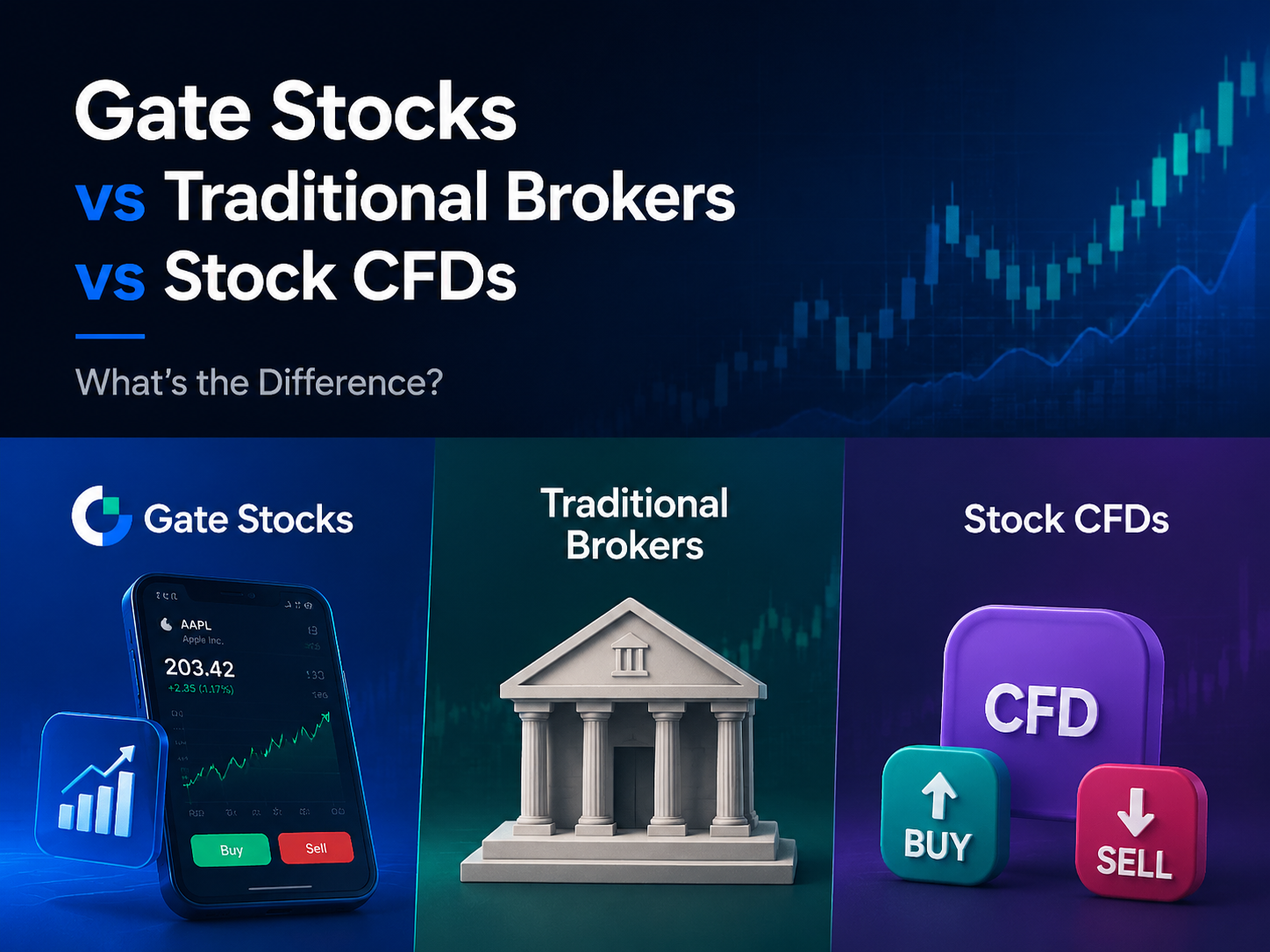
Although all three approaches provide exposure to the U.S. market, they differ significantly in asset ownership, economic rights, trading costs, and account structures. Understanding these differences can help investors choose the approach that best matches their goals and investment style.
What Are Gate Stocks, Traditional Brokers, and Stock CFDs?
Gate Stocks, traditional brokers, and stock CFDs represent three distinct ways to participate in the U.S. stock market.
Gate Stocks is a real stock trading service. According to Gate's official announcement, Gate Stocks connects users to U.S. securities markets through regulated brokerage infrastructure, allowing them to trade stocks and ETFs directly through their Gate account while using USDT as their primary settlement asset.
Traditional brokers provide the conventional route to stock investing. Investors open a brokerage account, deposit fiat currency, and buy stocks through established securities markets.
Stock CFDs (Contracts for Difference) are financial derivatives. Instead of owning shares, investors speculate on price movements and settle profits or losses based on the difference between entry and exit prices.
While all three methods offer exposure to U.S. equities, their underlying structures and investor rights differ considerably.
What Are the Main Ways to Buy Stocks with USDT?
For investors who primarily manage assets in digital currencies, USDT has become an increasingly important bridge between crypto markets and traditional financial markets.
Today, there are two primary ways to gain U.S. stock market exposure using USDT.
The first method is through Gate Stocks. Users can buy and sell stocks and ETFs directly with USDT while accessing real U.S. securities markets. Holdings may receive associated economic benefits, including cash dividends, stock dividends, stock splits, and reverse splits, according to platform rules.
The second method is through stock CFDs. Some CFD platforms allow investors to use USDT as collateral or settlement currency. In this model, investors do not own the underlying stock but instead gain exposure to price movements.
Although both methods involve USDT, they belong to different product categories and serve different investment objectives.
| Comparison |
Gate Stocks |
Stock CFDs |
| Real Stocks |
Yes |
No |
| Stock Ownership |
Yes |
No |
| Stock Dividends |
Supported |
Generally Not Applicable |
| Stock Splits |
Supported |
Adjustment Mechanism |
| Overnight Fees |
No |
Commonly Apply |
| Long-Term Holding |
Suitable |
Generally Less Suitable |
As a result, using USDT to access stocks does not necessarily mean using the same type of product.
How Do Traditional Brokers Provide Access to U.S. Stocks?
Traditional brokers remain the most established method of investing in U.S. equities.
Investors typically complete account registration, identity verification, and funding procedures before gaining access to stock markets. Funds are usually deposited through banking channels and converted into U.S. dollars when necessary.
One of the main advantages of traditional brokers is their comprehensive securities infrastructure. Investors generally participate through established shareholder registration systems and receive access to a broad range of brokerage services.
For long-term investors, traditional brokers provide mature portfolio management tools, extensive market access, and comprehensive shareholder services. However, the funding process often involves additional steps compared with digital asset-based trading systems.
How Do Stock CFDs Work?
A Contract for Difference is a derivative instrument designed around price speculation rather than asset ownership.
When trading a stock CFD, investors do not purchase actual shares. Instead, they open positions based on whether they expect a stock's price to rise or fall. Profit and loss are determined by the difference between the opening and closing prices.
CFDs are widely used because they support both long and short positions. Investors can potentially profit from rising markets or falling markets without owning the underlying asset.
Many CFD products also offer leverage, allowing traders to control larger positions with a smaller amount of capital. While leverage can increase potential returns, it also amplifies risk.
In addition, CFD trading may involve spreads, financing costs, overnight fees, and swap charges, making CFDs more suitable for short-term trading strategies than long-term investing.
What Is the Difference Between Real Stocks and CFDs?
The distinction between real stocks and CFDs goes beyond trading mechanics. It fundamentally affects ownership, economic rights, and investment objectives.
Real stock investing involves ownership exposure to the underlying stock asset. Whether accessed through Gate Stocks or traditional brokers, investors participate in actual securities markets.
CFDs, by contrast, are derivative contracts designed to track price movements without providing ownership of the underlying shares.
| Comparison |
Real Stocks |
CFDs |
| Stock Ownership |
Yes |
No |
| Economic Rights |
Yes |
No Direct Rights |
| Stock Dividends |
Supported |
Generally Not Applicable |
| Long-Term Holding |
Suitable |
Generally Less Suitable |
| Leverage |
Usually Limited |
Common |
| Short Selling |
Limited |
Widely Available |
For investors focused on long-term equity exposure, real stock investing and CFD trading represent fundamentally different approaches.
How Do Economic Rights Differ Between Gate Stocks, Traditional Brokers, and CFDs?
Economic rights are often one of the most important considerations for long-term investors.
According to information provided in Gate's Help Center, Gate Stocks support economic benefits such as cash dividends, stock dividends, stock splits, reverse splits, and certain corporate action adjustments. These events are processed according to platform rules and reflected within user accounts.
Traditional brokers generally support the same types of economic rights and often provide access through a more comprehensive shareholder framework.
CFDs operate differently. Since investors do not own the underlying stock, they do not directly receive stock-related economic rights. Some CFD providers may implement dividend-related cash adjustments, but these differ from actual shareholder distributions.
| Economic Benefit |
Gate Stocks |
Traditional Brokers |
Stock CFDs |
| Cash Dividends |
Supported |
Supported |
Adjustment Mechanism |
| Stock Dividends |
Supported |
Supported |
Generally Not Applicable |
| Stock Splits |
Supported |
Supported |
Position Adjustment |
| Reverse Splits |
Supported |
Supported |
Position Adjustment |
| Corporate Actions |
Supported |
Supported |
Limited Support |
For investors seeking stock-related economic benefits, real stock ownership generally offers broader participation than derivative-based products.
How Do Trading Costs and Account Structures Differ?
Each product category follows a different cost structure.
Gate Stocks operate as a stock trading service and do not involve funding rates or overnight holding fees. This structure can be attractive for investors seeking long-term stock exposure.
Traditional brokers may charge commissions, account maintenance fees, market data fees, or currency conversion costs, depending on the provider.
Stock CFDs typically include spreads, overnight financing charges, leverage-related costs, and other trading expenses. For long-term positions, these costs can accumulate over time.
Account structures also differ significantly.
| Feature |
Gate Stocks |
Traditional Brokers |
Stock CFDs |
| Primary Funding Asset |
USDT |
Fiat Currency |
Margin-Based |
| Currency Conversion Required |
No |
Usually Yes |
Platform Dependent |
| Unified Account Structure |
Supported |
Usually Separate |
Platform Dependent |
| Integration with Digital Assets |
Strong |
Limited |
Moderate |
For investors who already manage capital in digital assets, USDT-based stock access can simplify portfolio management across multiple asset classes.
Which Option Is Better for Different Investment Goals?
The best choice depends on the investor's objectives.
Investors seeking long-term stock ownership, ETF exposure, and stock-related economic rights may find real stock trading services more suitable. Both Gate Stocks and traditional brokers fall into this category.
For investors who already hold and manage assets in USDT, Gate Stocks can provide a more streamlined connection between digital assets and traditional securities markets.
Investors focused on short-term market movements, leveraged strategies, or directional trading may prefer stock CFDs because of their flexibility and trading-oriented structure.
Traditional brokers may remain attractive to investors who prefer established securities account systems and traditional fiat-based portfolio management.
There is no universally superior approach. Each method serves a different purpose and caters to different investor needs.
Summary
Gate Stocks, traditional brokers, and stock CFDs all provide access to the U.S. stock market, but they are built on fundamentally different frameworks.
Gate Stocks connect users to real stocks and ETFs through regulated brokerage infrastructure while supporting USDT-based trading and stock-related economic rights.
Traditional brokers provide mature securities account systems and comprehensive stock investing services.
Stock CFDs are derivative products designed primarily for price speculation, leverage, and short-term trading opportunities.
Understanding the differences in ownership, economic rights, trading costs, and account structures can help investors choose the approach that best aligns with their financial goals.
FAQ
Can I buy stocks directly with USDT?
Yes. Some platforms support stock trading using USDT. For example, Gate Stocks allows eligible users to buy and sell stocks and ETFs using USDT.
What is the difference between buying stocks with USDT and trading stock CFDs?
Buying stocks through Gate Stocks provides access to real stock trading services, while stock CFDs are derivative products based on price movements and do not involve stock ownership.
Are Gate Stocks real stocks?
According to Gate's official announcement, Gate Stocks provide access to real stock and ETF trading through regulated brokerage infrastructure.
Which is better for long-term investing: real stocks or CFDs?
Real stock investing is generally more suitable for long-term investors seeking stock ownership and economic rights, while CFDs are primarily designed for trading and short-term market exposure.
Do I need to convert currency when buying stocks with USDT?
With Gate Stocks, users can trade stocks and ETFs directly using USDT without converting funds into U.S. dollars beforehand.
Do stock CFDs pay dividends?
CFD traders generally do not receive actual stock dividends. Some CFD providers may implement dividend-related adjustments according to their own rules.
What markets are available through Gate Stocks?
According to Gate's official announcement, Gate Stocks currently support more than 10,000 stocks and ETFs across major U.S. markets and liquidity venues, including NYSE, Nasdaq, NYSE Arca, NYSE American, and BATS.