As one of the world’s leading medical device companies, BDX (Becton, Dickinson and Company) operates within this large and complex market. Understanding the development logic of the medical device industry not only helps explain Becton Dickinson’s business model, but also helps clarify the forces behind the long term growth of the healthcare industry.
Why the Global Medical Device Market Keeps Growing
The medical device market has been able to sustain long term growth, first and foremost, because global healthcare demand continues to expand. As populations grow, medical services become more widely available and healthcare spending per person rises, more countries are increasing investment in healthcare resources, which in turn continues to lift demand for medical devices.
Unlike some consumer industries, healthcare demand is generally highly resilient. Regardless of changes in the economic environment, the need for disease diagnosis, treatment and health management does not disappear. Hospitals need to keep purchasing medical equipment, laboratories need to continually update testing systems, and healthcare institutions must replenish large volumes of clinical consumables. These demand characteristics provide the industry with a stable foundation for long term development.
At the same time, the global disease profile is changing. The number of patients with chronic diseases, cardiovascular diseases, cancer and metabolic disorders continues to rise, driving sustained demand for testing equipment, treatment devices and long term management tools. As a result, the medical device industry benefits not only from population growth, but also from the increasing complexity of healthcare services.
From an industry perspective, medical devices have evolved from simple auxiliary medical tools into essential infrastructure for the modern healthcare system. Their market size continues to grow alongside the expansion of healthcare systems worldwide.
How Population Aging Drives Healthcare Demand
Population aging is widely seen as one of the long term trends driving the global healthcare industry. As life expectancy rises, older adults account for a growing share of the population, and this group typically requires more medical resources and health management services.
Aging is often accompanied by higher rates of chronic disease. Health issues such as hypertension, diabetes, bone and joint disorders and cardiovascular disease all require long term monitoring and ongoing treatment. Medical devices and diagnostic equipment play an important role throughout this process.
For hospitals, aging means more patients need imaging exams, blood tests, infusion therapy and rehabilitation care. For medical device companies, these needs eventually translate into continuous purchases of equipment and consumables.
In addition, the home healthcare and long term care markets are developing rapidly. More medical devices are entering home settings for chronic disease management and remote health monitoring. This means the medical device industry benefits not only from growing hospital demand, but also from the expansion of the home healthcare market.
Why Medical Technology Upgrades Create Industry Opportunities
The development of the medical device industry depends not only on demand growth, but also closely on technological progress. Over the past few decades, continued advances in medical technology have improved the ability to diagnose and treat disease while creating new market opportunities.
In diagnostics, automated testing systems, high throughput analysis platforms and molecular diagnostic technologies continue to improve testing efficiency and accuracy. For hospitals and laboratories, technology upgrades can help improve the quality of diagnosis and treatment, giving them strong incentives to purchase new systems.
In treatment, minimally invasive surgical devices, intelligent monitoring systems and precision treatment tools are gradually becoming more widely used. These technologies are pushing medical devices beyond basic tools and toward higher value solutions, while also raising the industry’s overall technical barriers.
For companies like BDX, technology upgrades create opportunities not only to launch new products, but also to enhance customer value through automation and digital solutions. As healthcare services become increasingly dependent on data and technology, innovation has become one of the key factors in industry competition.
Why Medical Consumables Have Continuous Demand
Medical consumables are one of the most stable segments of the medical device industry. Unlike large equipment, consumables are usually single use or short cycle products, which gives them the characteristics of continuous consumption and repeat purchasing.
In daily hospital operations, syringes, needles, infusion sets, blood collection tools and various laboratory consumables are used in large quantities every day. Because these products are directly related to patient safety and infection control, they usually cannot be reused and inventories must be replenished continuously.
This business model gives medical consumables characteristics similar to consumer goods. Although the price of each individual product is relatively low, high purchase frequency and stable demand can create a long term recurring revenue source. For many medical device companies, consumables are often an important pillar of cash flow.
In addition, the continued expansion of global healthcare service coverage is further increasing demand for consumables. In both developed and emerging markets, as investment in healthcare resources grows, the size of the consumables market usually expands as well.
How Emerging Markets Drive Industry Expansion
Beyond mature markets such as Europe and the United States, emerging markets have become an important source of growth for the global medical device industry. Many developing countries are increasing investment in healthcare system development, which is lifting demand for equipment and consumables.
As economies develop and household incomes rise, more countries are beginning to improve their healthcare service systems. Building new hospitals, upgrading laboratory facilities and expanding primary care coverage all require support from large amounts of medical equipment and related consumables.
At the same time, emerging markets often have large populations, while healthcare service penetration still has room to improve. As public health investment increases and medical insurance systems improve, medical device companies can gain new market opportunities.
For international companies, emerging markets represent not only additional sales potential, but also long term growth capacity. In recent years, many leading medical device companies have actively expanded into Asia, Latin America, the Middle East and Africa to share in the growth benefits brought by the expansion of global healthcare resources.
Why Healthcare Infrastructure Development Affects Industry Growth
The development of the medical device industry is closely tied to healthcare infrastructure construction. Hospitals, laboratories, diagnostic centers and public health institutions are the most important application settings for medical device products.
When a country or region increases investment in healthcare resources, it usually creates demand for hospital expansion, new medical institutions and equipment upgrades. This not only drives purchases of large equipment, but also increases later demand for consumables and maintenance services.
In recent years, many countries have begun to treat healthcare system development as an important strategic priority. Population growth, aging and public health challenges all require healthcare infrastructure to keep improving. In this process, medical device companies are often among the most direct beneficiaries.
In the long run, healthcare infrastructure development determines not only the size of the industry, but also the growth potential of the medical device market. As healthcare systems around the world continue to improve, the industry’s demand base remains strongly supported.
Conclusion
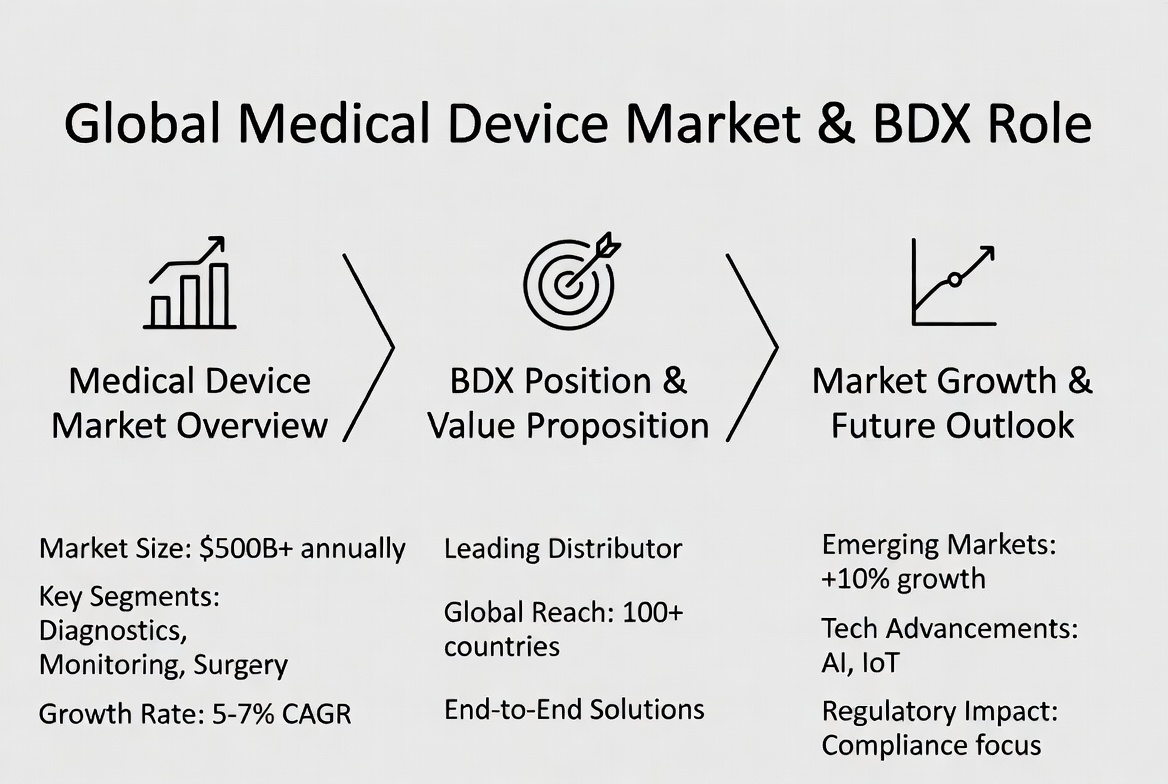
The long term growth of the global medical device market is driven by multiple factors working together, including population aging, rising healthcare demand, technology upgrades, continuous consumption of medical consumables and expansion in emerging markets. At the same time, healthcare infrastructure development and the modernization of medical services continue to create new industry opportunities. For global medical device companies such as BDX, business growth depends not only on innovation in individual products, but also on sustained demand growth brought by the long term expansion and upgrading of the overall healthcare system.
FAQs
Why Can the Medical Device Industry Grow Over the Long Term?
Healthcare demand is highly resilient. Population growth, aging and the expansion of healthcare resources all continue to increase demand for medical devices.
What Is the Difference Between Medical Devices and Pharmaceuticals?
Pharmaceuticals are mainly used to treat disease, while medical devices cover multiple healthcare stages, including diagnosis, treatment, monitoring and rehabilitation.
Why Does Population Aging Benefit the Medical Device Industry?
Older adults typically need more disease testing, treatment and long term health management services, which increases the use of medical devices.
Why Are Medical Consumables an Important Market?
Medical consumables are continuously used and repeatedly purchased, creating stable and predictable long term demand.
How Do Emerging Markets Drive Growth in the Medical Device Industry?
As healthcare infrastructure develops and healthcare spending increases, emerging markets are becoming an important source of growth for the global medical device industry.
What Is BDX’s Position in the Medical Device Industry?
BDX is one of the world’s leading medical device companies, with businesses covering medical consumables, diagnostic systems, life sciences tools and hospital solutions.