Tokenized stocks are emerging as a key pathway for Real World Assets (RWA) to enter the blockchain. As traditional finance infrastructure and the digital asset ecosystem converge, a growing number of stock assets are being brought on-chain through tokenization. Compared to traditional securities account systems, tokenized stocks enable on-chain transfers and digital settlement while offering greater composability, unlocking new asset sources for digital finance applications.
Within the tokenized stock ecosystem, xStocks as one of the key issuance frameworks connecting real stocks and blockchain networks. Its core mission is to establish a verifiable mapping between real stocks and on-chain tokens, enabling stocks to circulate as digital assets.
What Are Stock Tokens in xStocks?
Stock tokens in xStocks are on-chain digital assets mapped to real-world stocks. Each token typically represents a specific quantity of underlying shares, with the relationship maintained through custodians, issuers, and legal structures. To users, these tokens behave like standard crypto assets—storable in digital wallets and transferable on-chain. But at their core, their value derives from real-world stock holdings.
The essence of tokenized stocks lies in asset mapping. On-chain tokens are not created out of thin air; they are built upon existing stock assets. This makes stock tokens a vital bridge connecting traditional capital markets with the blockchain ecosystem.
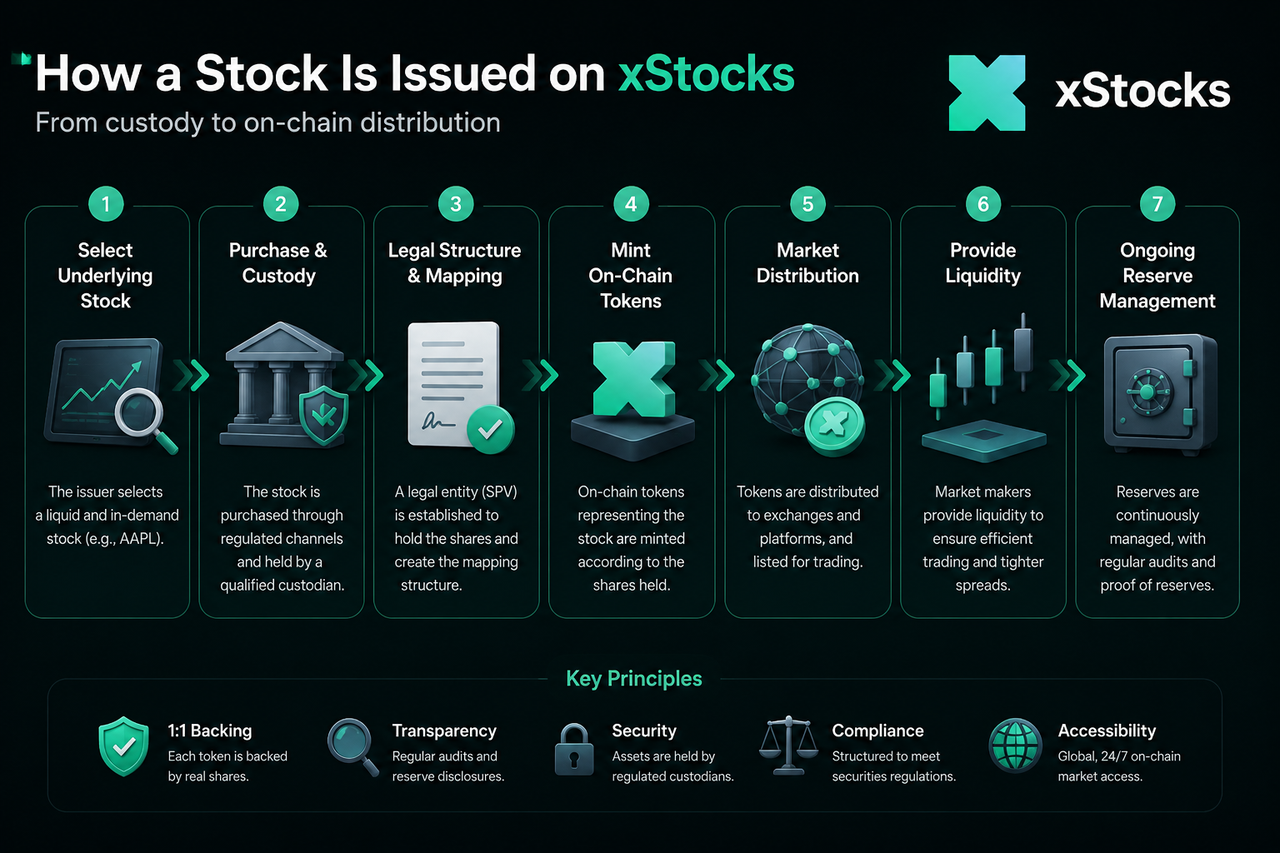
Step 1: The Issuer Selects the Target Stock Asset
The tokenized stock issuance process typically begins with target asset selection. Issuers choose suitable stocks for tokenization based on market demand, asset liquidity, and regulatory feasibility. Large-cap tech firms, index funds, and well-known blue-chip stocks are favored due to their stable market demand and robust trading infrastructure.
Beyond market appeal, issuers must evaluate custody costs, the complexity of managing corporate actions, and ongoing compliance requirements. Events like dividends, stock splits, and mergers can impact the operational management of tokenized products. Thus, asset selection is not just a market decision—it is a key element of risk management.
Step 2: Purchase and Custody Real Stocks
Once the target asset is identified, the issuer purchases the corresponding shares through compliant channels and places them with a designated custodian. At this stage, no tokens exist on-chain; all assets remain within the traditional securities system. The existence of real stocks is a prerequisite for the asset-backed relationship of tokenized stocks.
The custodian plays a pivotal role, holding the underlying shares, maintaining custody records, and supporting audits and disclosures. For investors, the transparency and reliability of the custody system directly impact the credibility of tokenized stocks. Therefore, custody is widely regarded as the foundation of the entire issuance process.
Step 3: Establish the Legal Entity and Asset Mapping Structure
After custody is in place, a legal mapping must be established to ensure a clear rights structure between on-chain tokens and underlying stocks. Most tokenized stock projects use a Special Purpose Vehicle (SPV) or similar legal framework to hold the shares, achieving asset segregation and risk mitigation.
The first function of the legal structure is asset segregation. By holding shares in an independent entity, the impact of the issuer's operational risks on the underlying assets is reduced. Even if the issuer faces financial trouble, the underlying stocks theoretically remain separate.
The second function is managing investor rights. Redemption arrangements, corporate action handling, and income distribution rules must be clearly defined in legal documents. Different products may offer varying designs for voting, dividend, and redemption rights, making the legal framework essential for investor understanding.
Additionally, the legal structure ensures regulatory compliance. Since stocks are regulated financial assets, tokenized products must operate within a legal framework to meet securities laws and investor protection requirements.
Step 4: Mint Stock Tokens on the Blockchain
Once the underlying stocks are in custody and the legal structure is established, the issuer can mint corresponding tokens on-chain based on the actual custody balance. If the custodian holds 1,000 shares of a listed company, the issuer can produce the equivalent number of on-chain tokens at a predetermined ratio. The mapping ratio varies by product: some projects use a 1:1 share-to-token model, while others allow fractionalization to accommodate small on-chain trades.
The minting process gives stock assets a true digital form. Users can now hold stock-linked digital assets via the blockchain without ever touching a traditional securities account. This is a defining feature that sets tokenized stocks apart from conventional securities recordkeeping.
Step 5: Tokens Enter Market Circulation
After minting, stock tokens enter circulation. Unlike traditional markets that depend on exchanges and central clearinghouses, on-chain stock token transfers and settlements occur entirely on the blockchain. Ownership changes are recorded in real time, reducing the intermediaries typical of legacy clearing.
Market participants can buy and sell tokens on supported platforms or transfer them to personal wallets for custody. Thanks to the blockchain's global reach, tokenized stocks can access a much broader digital asset audience, enhancing circulation efficiency.
Step 6: Market Makers Provide Liquidity Support
Issuance alone does not make a market—liquidity is the next critical step. Market makers continuously provide buy and sell quotes, enabling price discovery and reducing friction for counterparties. For tokenized stocks, liquidity directly drives market activity and user trading experience.
Market makers dynamically adjust their quote ranges to narrow bid-ask spreads and improve market depth. As participant numbers and trading volumes grow, the liquidity structure of the tokenized stock market naturally matures.
Step 7: Continuously Maintain Reserves and Token Supply
Post-issuance, the issuer must continuously align the underlying asset reserves with the on-chain token supply. When new stocks enter custody, new tokens can be minted accordingly; when tokens are redeemed or removed from circulation, the equivalent tokens are burned.
This mint-and-burn mechanism ensures the on-chain token count stays synchronized with real stock reserves, preserving the mapping relationship. For tokenized stocks, ongoing reserve management and transparent disclosure are vital for maintaining market trust.
What Is the Difference Between xStocks and Synthetic Asset Issuance?
Both tokenized stocks and synthetic assets offer price exposure to stocks, leading to frequent comparisons. However, their issuance logic is fundamentally different. xStocks is built on real stock custody—each token is backed by a specific quantity of underlying shares. Synthetic assets, by contrast, rely on collateral systems and price oracles to track stock prices without holding the actual shares.
This distinction leads to different risk structures and regulatory profiles. Tokenized stocks emphasize real asset backing and reserve management, while synthetic assets depend more on smart contracts and market incentives. So while both provide stock price exposure, their underlying mechanics differ significantly.
| Comparison Dimension |
xStocks |
Synthetic Assets |
| Underlying Asset |
Holds real stocks |
Does not hold real stocks |
| Issuance Basis |
Stock custody reserves |
Collateral system |
| Price Source |
Stock market price |
Oracle price |
| Proof of Reserves |
Typically required |
Typically not required |
| Asset Mapping |
Exists |
Does not exist |
| Legal Attribute |
Closer to securities mapping |
Closer to derivative structure |
Summary
Bringing a stock from traditional markets onto the blockchain via xStocks involves multiple steps: target asset selection, real stock custody, legal structure creation, on-chain token minting, market circulation, and ongoing reserve management. The entire process is designed to create a stable, verifiable asset mapping between real stocks and on-chain tokens.
Unlike synthetic assets that track prices, xStocks emphasizes real asset backing and legal protection. By coordinating custodians, issuers, and the blockchain network, traditional stocks gain the programmability and on-chain liquidity of digital assets, becoming a key building block of real-world asset tokenization.
FAQs
Do stock tokens in xStocks correspond to real stocks?
xStocks is designed to establish a mapping between on-chain tokens and real stocks. The exact correspondence, rights structure, and asset backing depend on the issuance framework and legal documentation, so you should refer to the relevant product disclosures.
Why do tokenized stocks need a custodian?
The custodian holds the underlying stock assets and provides real asset backing for on-chain tokens. Without a custody system, it would be impossible to prove the connection between tokenized stocks and real stocks.
Can stock tokens be minted indefinitely after issuance?
In theory, no. New tokens must be backed by an equivalent number of real stocks entering custody. Otherwise, the asset mapping is broken and market trust is undermined.
How does the token supply of xStocks change?
When new stocks enter the reserve pool, corresponding tokens can be minted according to the rules; when tokens are redeemed or leave circulation, the equivalent number is burned, maintaining balance between assets and tokens.
Is xStocks the same as a traditional stock IPO?
No. An IPO is a company's first public offering of shares to enter the capital market. xStocks issuance creates an on-chain mapping of existing stocks without altering the listed company's capital structure.