Cross-chain transactions have become an essential need in the multichain era. As networks such as Ethereum, Solana, Base, Arbitrum, and BNB Chain have developed their own ecosystems, user assets are no longer concentrated on a single blockchain. Instead, they are spread across multiple networks. Because different chains do not have native interoperability, asset transfers, trade execution, and access to liquidity have become increasingly complex.
Against this backdrop, Defi App has introduced a DeFi super app model centered on user experience. Compared with traditional cross-chain processes, which require users to manage wallets, gas tokens, and bridging tools themselves, Defi App uses account abstraction and an automated execution architecture to hide the underlying complexity in the background.

What Is Defi App’s Cross-Chain Transaction Mechanism?
Defi App’s cross-chain transaction mechanism is an automated asset exchange system that uses liquidity aggregation, smart routing, and cross-chain infrastructure to complete asset conversions across multiple blockchains.
Traditional cross-chain transactions usually require users to complete several steps themselves, including switching networks, connecting to a cross-chain bridge, confirming the bridging transaction, waiting for assets to arrive, and then making another swap. The entire process involves multiple protocols and several on-chain signatures.
Defi App combines these steps into a single transaction request. Users only need to choose the asset they want to sell and the asset they want to buy, and the backend system automatically handles the rest of the execution process.
How Does Defi App Use Account Abstraction to Simplify Operations?
Account abstraction is an important foundation of Defi App’s user experience.
Under the traditional wallet model, every on-chain action requires users to sign transactions and pay gas fees themselves. Account abstraction allows the system to execute complex operations on behalf of users through a smart account structure.
Users do not need to understand the gas mechanisms of different chains, nor do they need to frequently manage multiple wallet addresses. Account abstraction packages the complex underlying logic into a simpler experience, making transactions feel more like using a regular internet application.
For beginners, this design significantly lowers the technical barrier to entering DeFi.
How Does the Smart Routing System Find the Best Trading Path?
The smart routing system is responsible for finding the best execution plan for cross-chain transactions.
After a user submits a transaction request, the system analyzes multiple dimensions of data, including:
The system then generates the best trading path.
For example, when a user wants to convert ETH on Ethereum into USDC on Base, the system may call multiple liquidity pools and cross-chain protocols at the same time to achieve a better execution result.
This automated routing model reduces the need for users to manually compare different protocols.
How Is Gas-Free DeFi Implemented?
Gas-Free DeFi does not mean blockchain transactions have no cost at all. Rather, it means users do not need to actively manage the gas payment process.
In traditional DeFi, each chain requires its own gas token. For example:
| Network |
Gas Token |
| Ethereum |
ETH |
| Base |
ETH |
| Solana |
SOL |
| BNB Chain |
BNB |
| Avalanche |
AVAX |
When users do not have the required gas asset, they often cannot complete a transaction.
Defi App handles part of the gas payment process through its transaction execution layer and backend settlement mechanism. The system can automatically calculate and settle the related fees during the transaction process, so users do not need to prepare several different gas tokens in advance.
This design significantly improves the user experience in a multichain ecosystem.
What Is the Complete Process of a Defi App Cross-Chain Transaction?
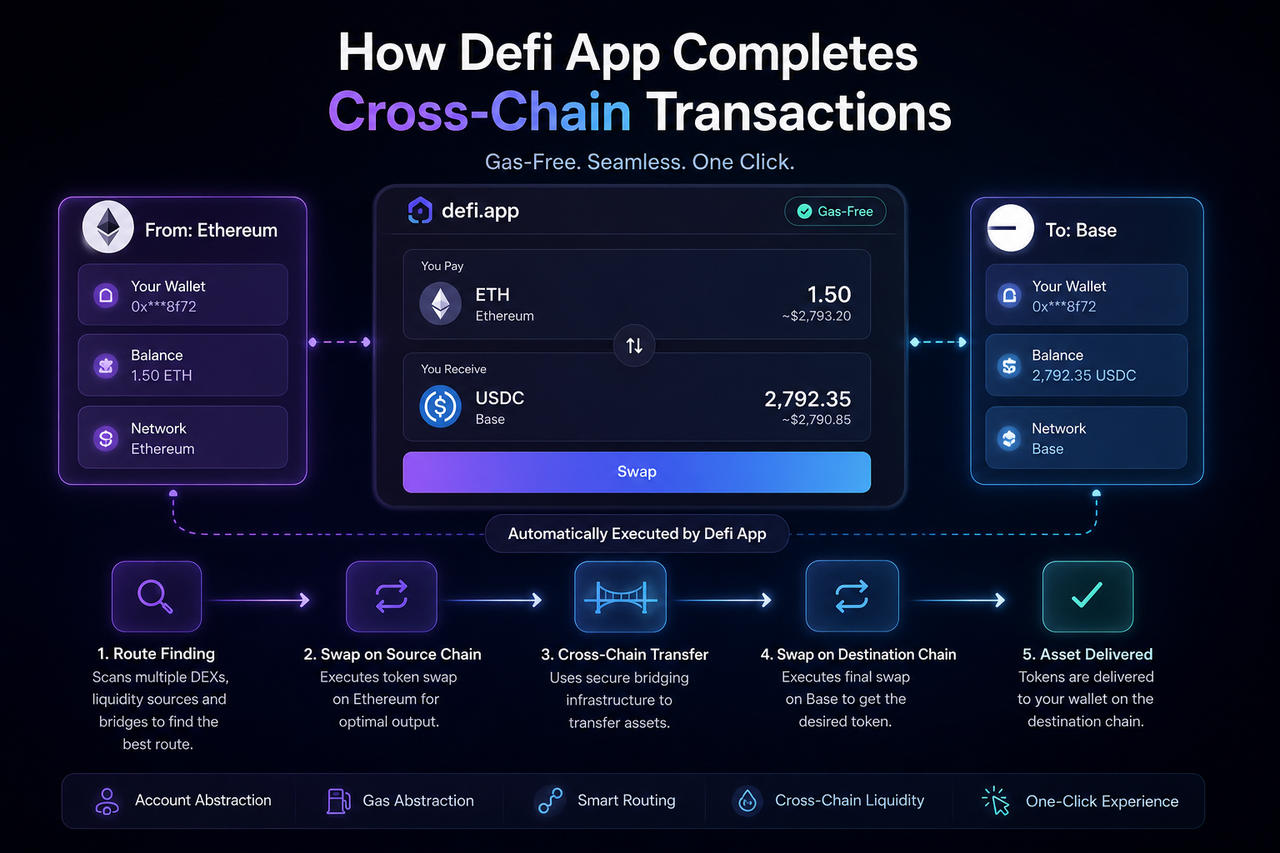
After a user initiates a cross-chain transaction, the system typically goes through the following steps:
Step 1: Submit a Transaction Request
The user selects the asset to sell, the target asset, and the destination chain.
Step 2: Path Analysis
The smart routing system scans multiple liquidity sources and cross-chain protocols.
Step 3: Transaction Simulation
The system evaluates the expected price, slippage, and execution costs.
Step 4: Signature Confirmation
The user authorizes the transaction execution.
Step 5: Automated Cross-Chain Execution
The system completes the asset swap, bridging process, and delivery on the destination chain.
Step 6: Asset Arrival
The target asset appears in the user’s account.
Throughout the process, many underlying operations are automatically coordinated by the system.
How Is Defi App Different from Traditional Cross-Chain Bridges?
Both Defi App and traditional cross-chain bridges can move assets across chains, but they are not positioned in the same way.
A cross-chain bridge is essentially infrastructure. It is responsible for transferring assets or messages between different chains.
Defi App, by contrast, is a user-facing application. It integrates multiple pieces of infrastructure and improves the overall experience.
| Comparison Dimension |
Defi App |
Traditional Cross-Chain Bridge |
| Product Positioning |
DeFi super app |
Cross-chain infrastructure |
| User Experience |
Unified interface |
Requires manual execution |
| Gas Management |
Automatically optimized |
Handled by users themselves |
| Route Selection |
Automatically finds the best path |
Usually fixed bridging |
| Functional Scope |
Trading, asset management, yield, and more |
Asset transfer |
For this reason, Defi App is closer to an on-chain financial gateway, while cross-chain bridges are one of its underlying components.
What Risks Do Defi App Cross-Chain Transactions Face?
Automated execution can simplify operations, but it cannot eliminate risk entirely.
Cross-chain transactions still involve several key risk areas, including:
-
Smart contract risk
-
Cross-chain bridge risk
-
Liquidity risk
-
Routing execution risk
-
Network congestion risk
In addition, finality times vary across blockchains, and some transactions may be affected by changes in on-chain conditions.
Conclusion
Defi App’s cross-chain transaction mechanism uses account abstraction, smart routing, and an automated execution system to turn what used to be a complex multichain process into a single user interaction. The core value of Gas-Free DeFi is not that it removes transaction costs, but that it hides the complexity of gas management and cross-chain workflows, allowing users to access liquidity and financial services across different blockchain networks more easily.
FAQs
Does Gas-Free DeFi Mean It Is Completely Free?
Gas-Free DeFi does not mean blockchain transactions have no cost. Gas fees still exist, but the system calculates and processes them in the background, so users do not need to manage gas tokens across different chains themselves.
How Does Defi App Find the Best Trading Path?
Defi App analyzes factors such as liquidity, slippage, cross-chain costs, and network conditions, then uses smart routing algorithms to find a more efficient execution plan.
What Is Account Abstraction in Defi App?
Account abstraction is a smart account architecture that packages complex on-chain operations into a simpler experience, allowing users to complete transactions and manage assets without needing to understand the underlying technical details.
What Is the Biggest Difference Between Defi App and a Regular Cross-Chain Bridge?
A regular cross-chain bridge mainly handles cross-chain asset transfers, while Defi App provides a complete user experience layer that integrates trading, bridging, asset management, gas optimization, and other functions.
Are There Risks in Defi App’s Cross-Chain Transactions?
Defi App’s cross-chain transactions still face risks related to smart contracts, cross-chain bridges, liquidity, and network congestion. Automated execution can simplify the process, but it cannot completely remove the inherent risks of blockchain systems.







