As the multi-chain ecosystem continues to expand, users often find themselves managing assets across multiple blockchains, switching wallets, and preparing different Gas tokens for each chain. This fragmented experience not only raises the barrier to entry but also hinders the mass adoption of Web3 applications. Heima aims to eliminate this complexity through a chain abstraction architecture, allowing users to focus on their end goals rather than the underlying execution process.
Within the chain abstraction landscape, Heima’s core value proposition is not to build a new application chain, but to act as a unified coordination layer connecting disparate blockchain and application ecosystems. By integrating Omni Account, Omni Executor, Agent Hub, and Heima Layer 1, Heima fuses cross-chain transactions, asset management, and application interactions into a single, seamless experience, making the multi-chain world operate as effortlessly as a single-chain system.
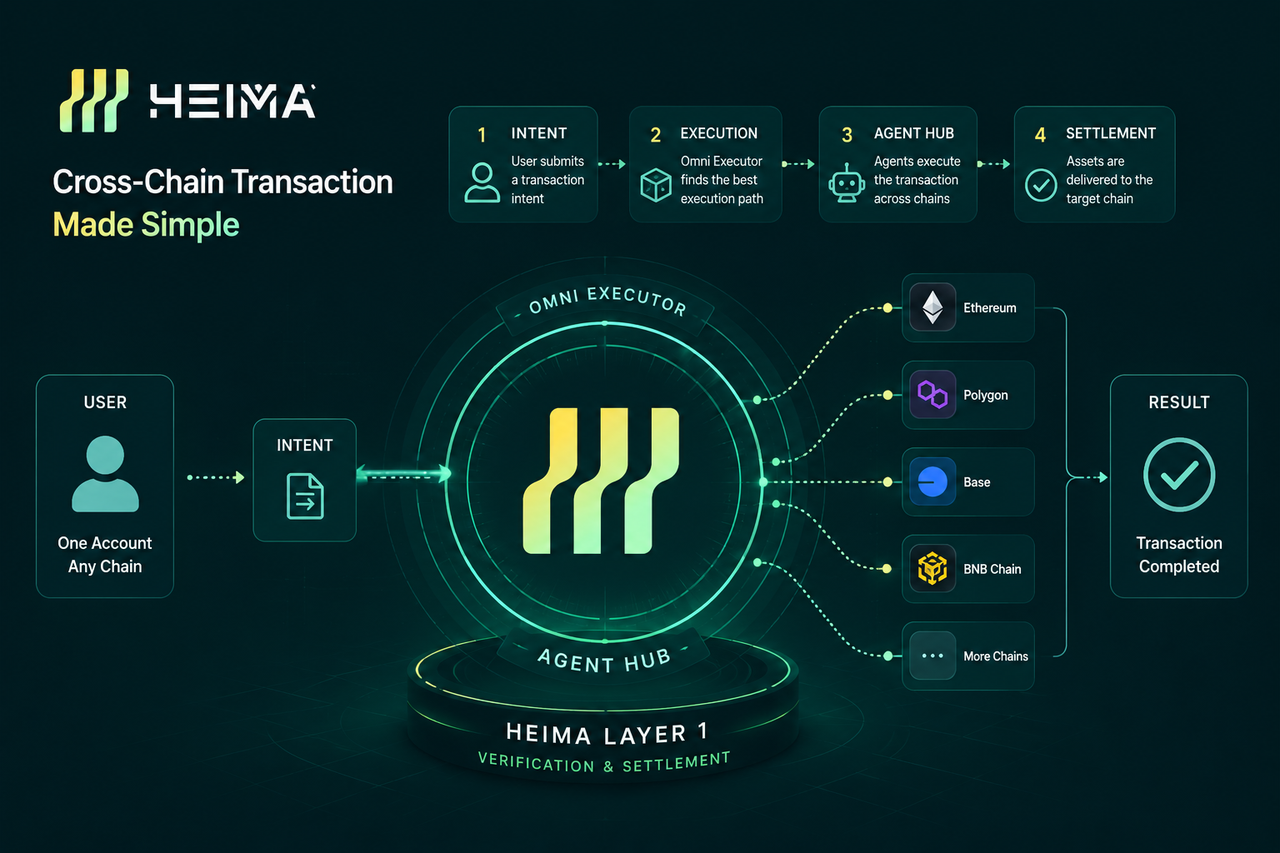
What Core Components Power a Heima Cross-Chain Transaction?
A complete Heima cross-chain transaction involves four core modules that together form the chain abstraction infrastructure.
| Module |
Primary Function |
| Omni Account |
Manage unified identity and multi-chain assets |
| Omni Executor |
Parse Intents and generate execution paths |
| Agent Hub |
Coordinate agent nodes to execute tasks |
| Heima Layer 1 |
Verify, record, and audit transactions |
Omni Account gives users a single entry point for managing assets and identities across multiple chains from one interface. Omni Executor interprets user needs and crafts execution plans, while Agent Hub orchestrates actual executors to complete the work. Finally, Heima Layer 1 validates and stores all execution records.
Step 1: User Submits a Transaction Intent
The cross-chain process begins when a user submits an Intent.
An Intent is essentially a description of the desired outcome. Unlike traditional transactions that specify every action, an Intent captures only the final state the user wants to achieve. For example, a user can request “swap USDT on BNB Chain for ETH on Base” without detailing how to get there.
After the user signs the Intent, it is sent to the Heima network. The system then analyzes the requirements and prepares for the next execution phase.
How Is an Intent Different from a Traditional Transaction?
Traditional transactions focus on the execution path—users must explicitly define every step. Intents, by contrast, focus on the end goal, with the system automatically mapping out the best execution route.
This fundamental difference lets Heima hide complex cross-chain logic, delivering a far simpler user experience.
Step 2: Omni Executor Parses the Transaction Requirements
Once the Intent is submitted, the Omni Executor takes over.
The Omni Executor is Heima’s core execution engine, running within a Trusted Execution Environment (TEE)-supported architecture. Its main job is to parse user requirements and break down an abstract goal into discrete, executable steps.
For instance, a simple cross-chain swap request might be split into asset locking, liquidity acquisition, cross-chain transfer, swap on the destination chain, and final delivery. Although the user sees only a single request, the system coordinates multiple underlying operations behind the scenes.
This design keeps the user experience clean while accommodating the complexity of a multi-chain environment.
Step 3: Finding the Optimal Cross-Chain Execution Path
After parsing the requirements, the Omni Executor searches for the best execution route.
Cross-chain transactions typically have multiple feasible paths, each with different costs, speeds, and liquidity conditions. The system must compare and filter among these options.
Route calculation considers factors such as liquidity depth, transaction fees, slippage, network congestion, and execution time. The system then selects the plan with the best overall efficiency.
Why Not Use a Fixed Bridge Route?
Traditional bridge protocols usually rely on a single cross-chain path, making them vulnerable to insufficient liquidity or network congestion.
Heima’s dynamic routing mechanism allows real-time selection of different liquidity sources and execution methods, improving efficiency and reducing complexity for users.
Step 4: Gas Abstraction Automatically Handles Fees
Gas management is a common pain point in cross-chain interactions.
In the traditional model, users must hold the native token of the destination chain to pay for Gas. For example, after moving assets to Arbitrum, they still need ETH to proceed.
With Heima’s Gas Abstraction mechanism, users no longer need to prepare destination-chain Gas in advance. The system automatically handles fee payments, keeping complex Gas management hidden in the background.
During execution, the Intent Filler network pays the Gas on behalf of the user and recovers the cost through a settlement mechanism later. For users, the entire experience feels more like a Web2 application.
Step 5: Agent Hub Coordinates Execution Nodes to Complete the Transaction
Once the execution path is determined, the transaction is distributed to the Agent Hub network.
The Agent Hub acts as an open execution marketplace, hosting agent nodes and automated service providers. These participants execute specific operations per system instructions and drive the transaction forward.
Execution nodes handle asset scheduling, protocol calls, liquidity acquisition, and delivery on the destination chain. To maintain network security, participants must meet verification and staking requirements.
What Role Does Intent Filler Play?
Intent Fillers are key participants in the Agent Hub. They respond to user Intents and perform the actual execution.
These nodes provide liquidity, advance execution costs, and coordinate cross-chain settlement. In return, they receive network incentives.
Intent Fillers allow Heima to completely isolate the complex cross-chain execution process from the user interface.
Step 6: Cross-Chain Settlement and Final Delivery
Once all execution steps are complete, the system enters the settlement phase.
The target assets arrive in the user’s designated account, and the cross-chain transaction is finalized. For the user, the entire process appears as a single simple request, not a series of independent operations.
In the traditional model, users may need to sign multiple times, switch between several applications, and wait for confirmations from various protocols. Under Heima’s architecture, all these steps are automatically coordinated by the underlying system.
This design embodies the core goal of chain abstraction: making cross-chain operations as simple as single-chain transactions.
Step 7: Heima Layer 1 Completes Verification and Audit
After the transaction is complete, Heima Layer 1 records the entire execution lifecycle.
The record includes the time the Intent was submitted, the execution path generated, the operation logs of the execution nodes, and the final settlement result. All data is stored in one place for later verification.
Because cross-chain transactions involve multiple blockchains and participants, a unified audit layer is essential for transparency and verifiability.
Why Is Layer 1 Recording Necessary?
Without a unified recording layer, cross-chain execution would be scattered across different networks, making it impossible to form a complete audit trail.
Heima Layer 1 uses a single ledger to record all key events, making the entire Intent lifecycle traceable, verifiable, and auditable.
Summary
Heima’s cross-chain transaction is essentially an intent-driven, automated execution flow. The user submits an Intent, the Omni Executor parses the requirements and plans the path, the Agent Hub coordinates execution nodes, Gas abstraction handles fees automatically, and Heima Layer 1 records and verifies everything.
By integrating account abstraction, cross-chain liquidity, automated execution, and unified settlement into one system, Heima simplifies complex multi-chain interactions into a single goal-driven request—lowering the barrier to entering the Web3 multi-chain ecosystem.
FAQs
Do I need to manually bridge assets for a Heima cross-chain transaction?
No. Simply submit a transaction Intent, and Heima automatically selects liquidity sources and execution paths, completing cross-chain settlement in the background.
What is Heima’s Intent?
An Intent describes the final result you want to achieve. You express your goal without specifying the steps; the system handles the rest.
How does Heima offer a Gas-free experience?
Heima uses Gas Abstraction and the Intent Filler network to handle fee payment. You don’t need to hold the destination chain’s native token to complete a cross-chain transaction.
What does Omni Executor do?
Omni Executor is Heima’s core execution engine. It parses Intents, generates execution plans, calculates cross-chain paths, and coordinates the transaction process.
How is Heima different from traditional cross-chain bridges?
Traditional bridges require you to manually bridge assets and manage Gas. Heima uses chain abstraction and intent-driven architecture to hide complex operations in the underlying system.
How does Heima ensure cross-chain transactions are verifiable?
Heima Layer 1 records the entire Intent lifecycle—including execution paths, settlement results, and verification data—forming a complete audit trail.







