What Problem Does Prophet Aim to Solve?
The core logic of traditional prediction markets is to form judgments about the probability of future events through transactions between market participants—such as election results, whether an ETF will be approved, or whether the price of a cryptocurrency will break through a specific range. Changes in market prices are often also interpreted as the market's expectation of the event outcome.
However, traditional prediction markets rely heavily on trading participants and liquidity. Without enough buyers and sellers, the market is prone to insufficient liquidity, price distortion, or even an inability to function effectively. This problem becomes especially pronounced for niche or less popular topics.
Prophet attempts to change this model. Its core concept is to have AI act directly as a counterparty in the market, meaning that even without other traders, the market can still maintain basic liquidity and trading functions. This design also allows the prediction market to move away from the traditional matching model toward a more automated and intelligent direction.
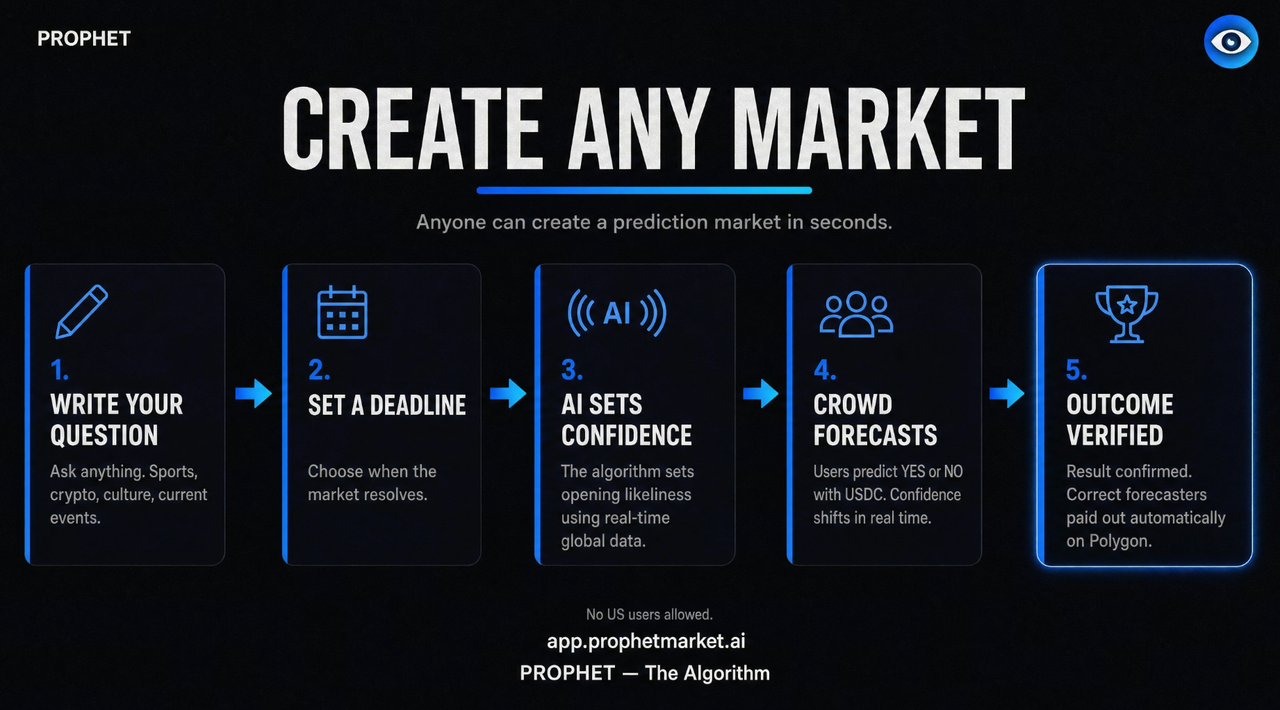 (Image source: prophetmarketai)
In Prophet's design, AI is not just an auxiliary analysis tool but a core role in the market. When a user creates a prediction market—for example, whether BTC will break through a specific price, whether the US will cut interest rates, or whether a product will be officially launched—the system begins analyzing the probability of the event.
Prophet's AI calculates the likelihood of an event based on historical data, real-time information, model inference, and market behavior, and converts this probability into a market price. For example, if the AI determines an event has a 70% probability of occurring, the system may assign a price close to 0.7, which essentially represents the market's estimated probability of the event outcome.
Unlike traditional prediction markets, Prophet does not need to wait for other traders to place orders. The AI directly provides bid and ask prices and assumes part of the trading risk, allowing the market to form almost instantly. This is one of Prophet's most fundamental distinctions.
Why Doesn't Prophet Need Traditional Matching?
General prediction markets rely heavily on buyers, sellers, and liquidity. If market participants are insufficient, problems such as failed trades, price distortion, or insufficient liquidity can easily arise, particularly for niche topics. Prophet's approach is to have AI act as a "continuously existing counterparty," meaning the market does not need to wait for liquidity to enter. Even long-tail or niche markets can be quickly established and operated, while reducing the cost of market formation. Thus, Prophet's core concept is not just AI prediction capability, but creating a new liquidity model through AI, enabling prediction markets to operate with higher efficiency.
Multi-Model Mechanism: How Are Prices Generated?
Prophet does not rely on a single AI model for price prediction but uses a multi-model integration mechanism to reduce the risk of bias and misjudgment. Since different AI models may vary in data understanding, inference methods, and training directions, relying on a single model can be influenced by specific biases or erroneous signals. To improve stability and credibility, Prophet integrates multiple large AI models, different data sources, and various inference results to build a more comprehensive judgment basis.
In the overall process, the system first synchronously collects each model's predictions for the same event, incorporating market data, external information, and other analysis sources. It then cross-references results between models. Since different models may produce probability judgment differences, conclusion conflicts, or inconsistent analysis directions, Prophet uses a weighting mechanism and cross-validation to filter out more credible results.
After integration, the system outputs the event probability and converts it into a corresponding market price. For example, if the AI comprehensively determines that the probability of an event occurring is 65%, the market price may correspond to approximately 0.65. The core of this design is to reduce the risk of inaccuracy from a single model through multi-model collaboration, while improving the rationality and stability of market pricing.
How Is Automated Settlement Completed?
Beyond the AI pricing mechanism, another important feature of Prophet is the automated settlement capability of the prediction market. Traditional prediction markets, after an event ends, often rely on manual arbitration, community voting, or third-party institutions to confirm the result—a process that is not only slow but also prone to disputes due to human factors.
Prophet attempts to directly complete event determination through AI and systematic processes. When a market event ends, the system automatically collects external data sources, such as exchange data, on-chain information, or other public data, and then feeds them into the AI model for analysis and comparison to confirm whether the event occurred. After determination, the market can automatically execute the settlement process, reducing manual intervention.
Taking whether BTC breaks through a certain price as an example, the system may directly reference real-time price data from a cryptocurrency exchange or verify the market result through on-chain information to further confirm whether the event occurred. Through this approach, Prophet aims to establish a more efficient, lower-friction prediction market model, while reducing the time costs and dispute risks associated with traditional arbitration processes.
Tranche Testing Mechanism: Why Is It Rolled Out in Phases?
Currently, Prophet adopts a Tranche phased testing model. The core purpose is to gradually verify whether the overall market mechanism can operate stably, while reducing risks the system may face in the early stages. Since Prophet combines new mechanisms such as AI pricing, liquidity provision, and automated settlement, the platform needs to first observe actual operation through small-scale testing before formally expanding the market.
In this process, Prophet not only needs to verify the rationality of the AI model's pricing capability but also must test the performance of the market liquidity model in a real trading environment. Additionally, the platform aims to collect more real market data through early user participation, further optimizing model judgment and risk control capabilities.
Currently, Phase 1—Tranche 1—mainly conducts market verification on a smaller scale, including an initial liquidity pool of approximately 10,000 USDC, a limited market size, and a trading design focused on short-cycle markets. At the same time, participation is only open to a subset of users. These arrangements indicate that Prophet is still in the early testing and verification stage, with a focus not on large-scale expansion but on confirming whether the AI-driven market can operate stably.
Prophet's Core Change: From Market-Driven to Model-Driven
Price formation in traditional prediction markets is essentially built on consensus among human traders. Market participants continuously adjust prices through buying and selling behavior, ultimately forming the overall market judgment on the probability of an event. Therefore, traditional prediction markets usually rely heavily on participant numbers, liquidity depth, and market sentiment.
However, the direction proposed by Prophet introduces a distinctly different market logic. The core concept is that market prices no longer rely entirely on matching between human traders but are directly generated by AI models as event probabilities and market prices. In other words, AI is not just an auxiliary analysis tool but gradually becomes a core pricing role in the market.
This also implies that the development direction of prediction markets may shift from human-matching and liquidity-driven markets to model-driven and AI-liquidity markets. This transformation is not only a technical architecture upgrade but may also change how financial markets form prices in the future, allowing AI's role in the market to evolve from an analyst to a direct participant.
Summary
Prophet proposes an operating architecture completely different from traditional prediction markets, attempting to redefine the processes of market creation, pricing, and settlement through AI technology. Its core features include AI as counterparty, multi-model probability pricing, automated market settlement, and instant liquidity provision, all aimed at lowering the barrier to entry for prediction markets while improving the efficiency of market creation and operation.
Although Prophet is still in the early testing stage, this AI-driven market model has already begun to demonstrate a new type of financial prototype resulting from the deep integration of Web3 and AI. In the future, if the accuracy of AI models, risk control capabilities, and market trust mechanisms continue to improve, such AI prediction markets could become a new direction for on-chain financial development.







