Real World Assets (RWA) has become one of the fastest-growing sectors in crypto in recent years. As the stablecoin market expands and institutional capital increasingly flows into blockchain, more traditional financial assets—including Treasuries, corporate bonds, private credit, fund shares, and other fixed-income products—are entering the on-chain ecosystem through tokenization.
Against this backdrop, Grove Finance is emerging as a vital infrastructure connecting on-chain liquidity with real-world credit markets. Unlike traditional DeFi protocols that focus on lending or trading, Grove Finance prioritizes capital allocation and credit market building, reflecting the broader trend of DeFi converging with real-world finance.
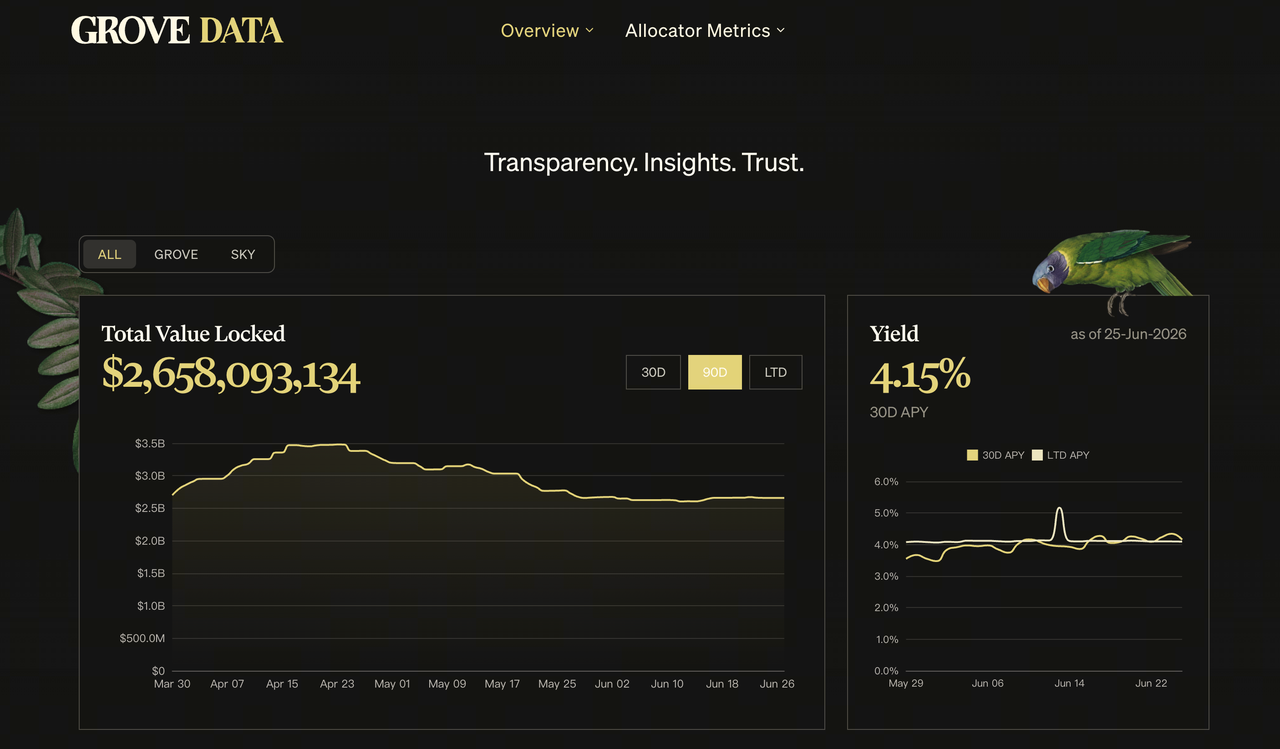 As of June 26, Grove TVL stood at $2.658B. Source: Grove Data
Grove Finance's Role in the RWA Ecosystem
While Grove Finance is often categorized as an RWA project, it is fundamentally not an asset issuance platform but an institutional-grade capital allocation protocol.
From a value-chain perspective, Grove Finance sits between capital providers and asset issuers, routing stablecoin liquidity into various credit assets and managing portfolios on an ongoing basis.
| Participant |
Primary Role |
| Stablecoin holders |
Provide liquidity |
| Grove Finance |
Asset allocation & risk management |
| RWA issuers |
Supply tokenized assets |
| Credit markets |
Generate yield & cash flow |
Thus, Grove Finance functions more like an asset manager in traditional finance than an asset issuance platform.
How Grove Finance Bridges Real World Assets
Grove Finance's core mechanism is built on a capital allocation framework. When capital enters the protocol, it is not channeled into a single market. Instead, the Grove Allocator evaluates and deploys it according to a predetermined risk management framework.
These funds can be allocated across multiple credit asset classes, including tokenized U.S. Treasuries, corporate bonds, private credit products, and institutional financing instruments. This enables on-chain stablecoins to access traditional financial markets and earn returns, while real-world assets gain a new source of capital.
In essence, Grove Finance transforms on-chain capital into productive capital in the real economy and channels the returns back into the on-chain ecosystem.
How the Grove Allocator Drives RWA Market Growth
The Grove Allocator is one of Grove Finance's most critical infrastructure components, akin to a portfolio management system in traditional finance.
In practice, the Allocator performs credit analysis, risk assessment, and yield forecasting on different assets, constructs a diversified portfolio based on investment strategy, and continuously monitors market conditions.
The process typically follows these steps:
-
Screen eligible credit assets;
-
Analyze asset risk and return profiles;
-
Build a diversified investment portfolio;
-
Monitor asset performance continuously;
-
Adjust allocation ratios in response to market changes.
This design allows Grove Finance to avoid dependency on a single yield source and instead participate in a broader credit market, enhancing capital efficiency and system stability.

Which RWA Assets Does Grove Finance Target?
While RWA covers a wide spectrum, Grove Finance currently prioritizes credit assets because they typically feature clear cash flow structures and well-established risk assessment frameworks.
Common allocation targets include:
| Asset Class |
Characteristics |
Relationship with Grove |
| U.S. Treasuries |
High liquidity, low risk |
Core allocation |
| Corporate bonds |
Fixed-income stream |
Long-term return component |
| Private credit |
Higher yield |
Credit market allocation target |
| Institutional financing products |
Serve the real economy |
Capital flow channel |
| Structured credit assets |
Risk tranching |
Potential expansion area |
Compared to other RWA types like real estate tokenization, credit assets generally offer more stable returns, making them Grove's strategic focus.
Grove Finance vs. Traditional DeFi Protocols
Traditional DeFi protocols revolve around crypto-native assets. For instance, Aave and Compound generate yield primarily from lending interest, with demand arising mainly within the crypto market.
Grove Finance, by contrast, routes capital into real-world credit markets, resulting in fundamentally different use of funds, yield sources, and risk structures.
| Dimension |
Grove Finance |
Traditional DeFi |
| Yield source |
RWA & credit assets |
Crypto lending market |
| Capital use |
Asset allocation |
Collateralized lending |
| Risk structure |
Credit risk |
Collateral risk |
| User base |
Institutional capital markets |
Crypto-native users |
| Development direction |
On-chain capital markets |
Crypto financial services |
This distinction positions Grove Finance as a key representative of DeFi's convergence with traditional finance.
How Grove Finance Fosters On-Chain Credit Markets
On-chain credit markets are the foundation for large-scale RWA adoption. Without a mature capital allocation system, even tokenized assets struggle to attract sustained funding.
This is where Grove Finance adds value. Through the Grove Allocator, the protocol provides a steady source of capital for credit assets and establishes a unified risk management framework. At the same time, stablecoin holders gain access to more diversified yield streams.
In this process, Grove Finance not only improves capital efficiency but also facilitates the entry of institutional capital into blockchain, accelerating the maturation of on-chain credit markets.
Key Challenges for Grove Finance
Despite the rapid growth of RWA, Grove Finance faces challenges including credit risk, liquidity risk, and regulatory risk.
Real-world assets are not risk-free. Corporate defaults, economic cycles, and interest rate fluctuations can all impact asset performance. Moreover, some credit assets have longer maturities and limited liquidity, requiring additional mechanisms to accommodate on-chain redemption demands.
Furthermore, the global regulatory landscape is still evolving. Future rules governing security tokenization and on-chain credit markets may significantly affect the industry's development.
Conclusion
Grove Finance serves as a critical infrastructure bridging stablecoin liquidity with real-world asset markets. Through capital allocation modules like the Grove Allocator, the protocol channels funds into tokenized Treasuries, corporate bonds, private credit, and other credit assets, driving the growth of on-chain credit markets.
Compared to traditional DeFi lending protocols, Grove Finance is closer to an institutional-grade asset management platform, with its core value rooted in capital allocation, risk management, and yield optimization.
FAQs
Is Grove Finance an RWA project?
Grove Finance is typically classified as an RWA infrastructure project. While it does not issue assets itself, it connects stablecoin liquidity with real-world asset markets through its capital allocation mechanism.
How does Grove Finance participate in the RWA market?
Grove Finance uses the Grove Allocator to allocate capital into tokenized Treasuries, corporate bonds, private credit, and other credit assets, generating returns from real-world economic activity.
How is Grove Finance different from traditional RWA platforms?
Traditional RWA platforms focus on asset issuance and tokenization, whereas Grove Finance is centered on capital allocation, risk management, and portfolio construction.
Why is the Grove Allocator important?
The Grove Allocator is Grove Finance's core module, responsible for asset screening, risk assessment, and capital deployment. It acts as the primary link between stablecoin liquidity and real-world assets.
What is the difference between Grove Finance and Aave?
Aave primarily serves the crypto lending market, while Grove Finance allocates capital to real-world credit markets. Their yield sources and risk structures differ fundamentally.