As the Real World Asset (RWA) and tokenized bond markets expand, a growing amount of on-chain capital seeks yield sources beyond traditional DeFi lending. Grove Finance was built as an institutional-grade credit infrastructure in this context.
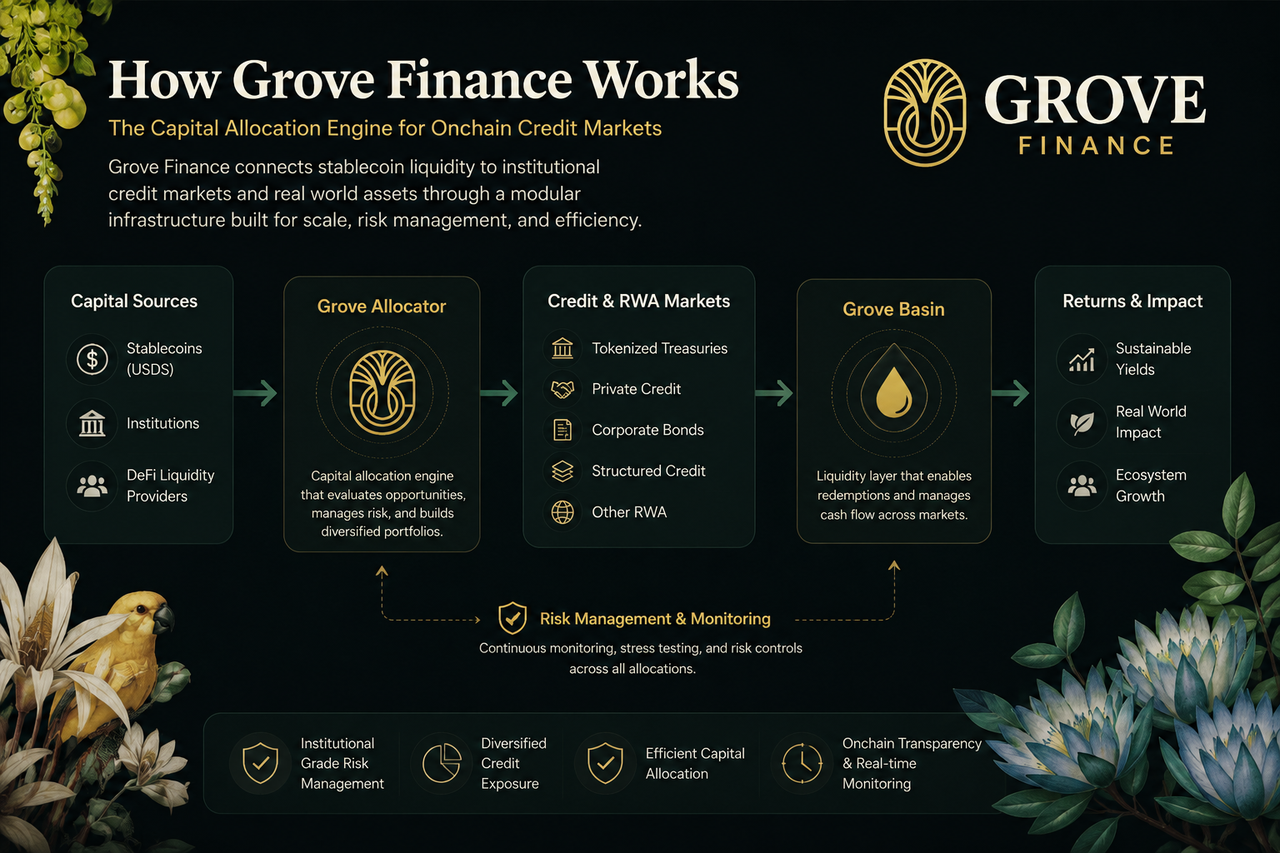
Within Grove Finance's overall architecture, Grove Allocator sits at the core of capital flow. It evaluates the risk-return profile of different credit assets and determines how funds are allocated across various markets. You can think of Grove Allocator as Grove Finance's "asset management hub," whose operational efficiency directly impacts the ecosystem's capital utilization, yield levels, and risk control capabilities.
What Is Grove Allocator?
Grove Allocator serves as Grove Finance's capital allocation module, managing the flow of funds within the protocol. Unlike traditional DeFi protocols that deploy capital directly into lending markets, Grove Allocator first screens investable assets and then allocates them according to a risk management framework.
From a functional perspective, Grove Allocator closely resembles an asset allocation platform in traditional finance. Its goal is not to chase returns from a single market, but to build a diversified portfolio across different credit assets.
This design allows Grove Finance to participate in both on-chain financial markets and real-world credit markets, thereby expanding the use cases for stablecoin capital.
Grove Allocator's Position in the Grove Finance Architecture
Grove Finance's operation relies on the collaboration of multiple infrastructure modules, with Grove Allocator serving as the capital allocation layer.
Funds first enter Grove Finance's liquidity system. Then, Grove Allocator evaluates investment opportunities and decides the direction of capital allocation. After assets generate returns, they flow back into the ecosystem for distribution and reinvestment.
The entire process can be simplified into the following structure:
| Stage |
Core Module |
Primary Task |
| Liquidity Entry |
Grove Finance |
Receive funds |
| Asset Evaluation |
Grove Allocator |
Risk analysis and screening |
| Capital Allocation |
Grove Allocator |
Portfolio construction |
| Yield Generation |
Credit asset market |
Generate cash flows |
| Yield Reflow |
Grove Finance |
Distribute returns |
This structure positions Grove Allocator as the capital dispatch center within the Grove Finance ecosystem.
What Happens When User Funds Enter Grove Finance?
When funds enter Grove Finance, they are not immediately deployed into a single lending market.
First, the system pools the funds into a unified liquidity pool. Then, Grove Allocator evaluates the current market environment and asset allocation requirements based on preset rules.
After completing asset analysis, capital is allocated to credit markets that meet risk standards — for example, tokenized treasuries, institutional credit markets, or other yield-bearing asset pools.
The entire process emphasizes a balance between capital efficiency and risk control, rather than simply chasing the highest yield.
How Does Grove Allocator Screen Credit Assets?
Asset screening is one of Grove Allocator's most important functions.
Different credit assets have different risk profiles. For example, treasury bonds typically offer higher liquidity and lower default risk, while private credit may provide higher yields but comes with greater risk.
During the screening process, Grove Allocator typically focuses on the following factors:
| Evaluation Dimension |
Focus Area |
Mitigation Approach |
| Credit quality |
Borrower's repayment ability |
Strict asset screening |
| Liquidity |
Ease of exiting the asset |
Liquidity reserves |
| Yield stability |
Predictability of cash flows |
Dynamic allocation adjustments |
| Risk concentration |
Single asset exposure |
Diversified portfolio |
| Compliance |
Regulatory and legal requirements |
Compliance review mechanisms |
Through multi-dimensional evaluation, Grove Allocator strives to build a more robust credit asset portfolio.
How Does Grove Allocator Allocate Capital?
Capital allocation is not a one-time event, but a continuous, dynamic adjustment process.
When market conditions change, Grove Allocator can reassess the asset portfolio and adjust the weight of funds across different markets. For example, if yields on low-risk assets decline, the system may increase the allocation to other credit assets.
This allocation logic is similar to the portfolio management principles found in traditional asset management.
Its core objectives include:
-
Improving capital utilization efficiency
-
Diversifying credit risk
-
Maintaining adequate liquidity
-
Optimizing long-term yield structure
Therefore, Grove Allocator functions more like a continuously operating asset allocation system rather than a static pool of funds.
How Does Grove Allocator Manage Risk?
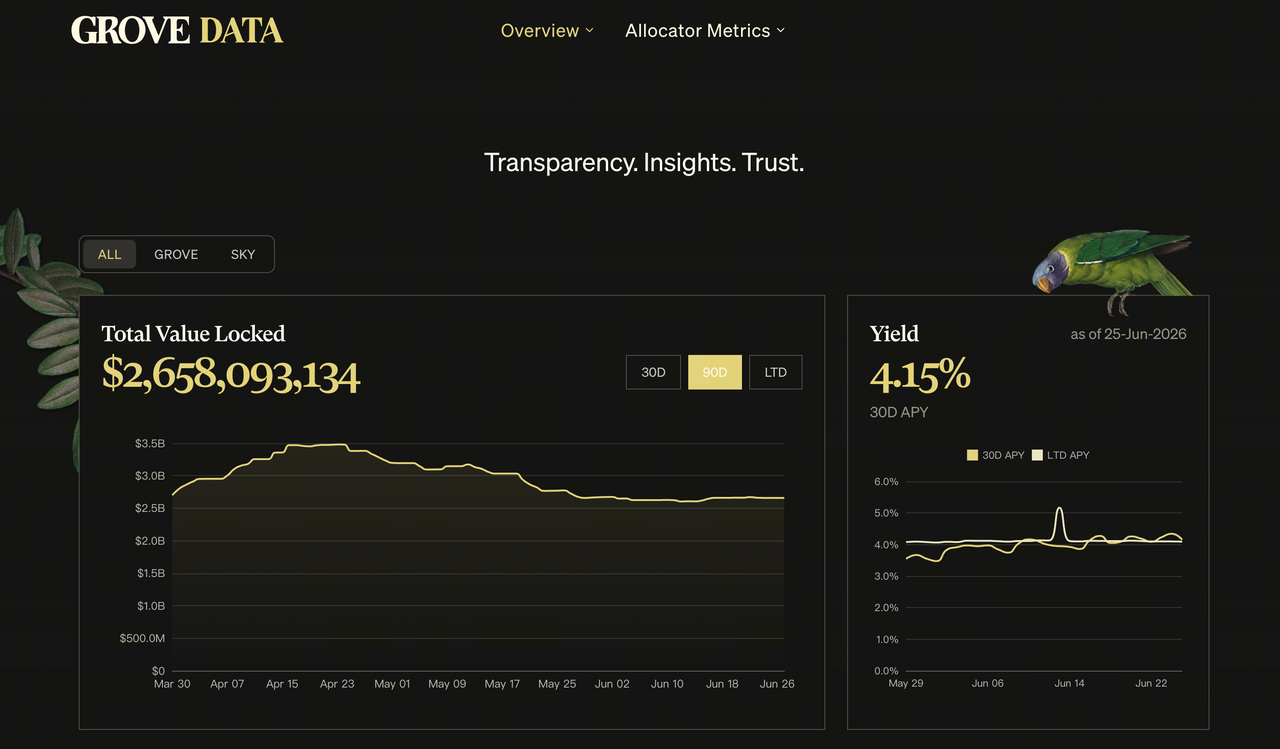
The biggest challenges in credit markets are default risk and liquidity risk.
To reduce risk exposure, Grove Allocator employs a diversification strategy. Combining different asset classes, borrowers, and maturity structures helps mitigate the impact of any single risk event.
Additionally, the risk management framework typically sets investment caps, liquidity buffers, and continuous monitoring mechanisms.
The table below shows the key risk types Grove Allocator focuses on:
| Risk Category |
Description |
Mitigation Approach |
| Credit risk |
Borrower default |
Strict asset screening |
| Liquidity risk |
Difficulty liquidating assets |
Liquidity reserves |
| Market risk |
Interest rate changes |
Dynamic allocation adjustments |
| Concentration risk |
Overconcentration in assets |
Diversified portfolio |
| Compliance risk |
Regulatory changes |
Compliance review mechanisms |
Risk management capability is also a key feature that distinguishes Grove Finance from traditional yield aggregation protocols.
How Is Grove Allocator Different From Traditional DeFi Lending Protocols?
The biggest difference between Grove Allocator and traditional lending protocols like Aave lies in the use of funds.
Traditional DeFi lending markets primarily rely on crypto asset collateral, with yields typically coming from lending interest. Grove Allocator, however, allocates capital to a broader range of credit markets.
The core differences between the two models are as follows:
| Comparison Dimension |
Grove Allocator |
Traditional DeFi Lending |
| Use of funds |
Credit asset allocation |
Lending market |
| Yield source |
RWAs and credit assets |
Lending interest rates |
| Risk structure |
Credit risk |
Collateral risk |
| User focus |
Institutional capital markets |
Crypto asset users |
| Allocation method |
Portfolio management |
Liquidity pool matching |
Therefore, Grove Allocator is closer to an on-chain asset management platform than a traditional lending protocol.
Summary
As Grove Finance's core capital allocation engine, Grove Allocator is responsible for connecting stablecoin liquidity to real-world assets and institutional credit markets. Through asset screening, risk assessment, portfolio management, and dynamic adjustment mechanisms, Grove Allocator enables efficient on-chain capital flow into credit asset markets.
Compared to traditional DeFi lending protocols, Grove Allocator places greater emphasis on institutional-grade asset management logic and credit market allocation capabilities. Its existence not only improves capital utilization efficiency but also drives deeper integration between the stablecoin ecosystem and real-world financial markets.
FAQs
What is Grove Allocator?
Grove Allocator is Grove Finance's capital allocation module, responsible for distributing stablecoin funds across different credit assets and real-world asset markets. Its core responsibilities include asset screening, risk management, and portfolio construction.
How does Grove Allocator generate yield?
Grove Allocator does not directly create yield. Instead, it generates returns by allocating capital to tokenized treasuries, private credit, and other credit asset markets. The yield ultimately flows back into the Grove Finance ecosystem.
Is Grove Allocator a lending protocol?
Grove Allocator is not a traditional lending protocol. It is closer to an on-chain asset allocation platform, focusing on managing capital flows and optimizing asset portfolios rather than matching lenders and borrowers.
What is the difference between Grove Allocator and Grove Basin?
Grove Allocator is responsible for capital allocation and asset management, while Grove Basin primarily handles liquidity management and redemption support. Together, they form the core infrastructure of Grove Finance.
Does Grove Allocator participate in the RWA market?
One of Grove Allocator's key functions is to connect with the RWA market. Real-world assets such as tokenized treasuries, corporate bonds, and private credit can all become allocation targets for Grove Allocator.