As the DeFi ecosystem expands into a multi-chain, multi-protocol environment with complex yield structures, the learning curve and execution difficulty of traditional methods continue to rise. The emergence of Prompt-to-DeFi is widely regarded as one of the key attempts in the Agentic Finance direction.
Unlike traditional DeFi aggregators, which simply integrate protocol entry points, INFINIT places greater emphasis on the role of AI Agent in strategy design, reasoning, and execution.
What Is INFINIT’s Prompt-to-DeFi?
As an AI-powered interaction mechanism that generates on-chain DeFi strategies through natural language, INFINIT’s Prompt-to-DeFi enables users to skip manual, complex protocol operations. Simply input a goal or requirement, and the system automatically analyzes it and generates the corresponding on-chain execution flow.
The core objective of Prompt-to-DeFi is to shift users’ focus from specific operational steps to directly articulating their goals, allowing the AI Agent to handle all underlying logic autonomously.
What Is the Core Logic Behind Prompt-to-DeFi?
The fundamental logic of Prompt-to-DeFi is transforming natural language requirements into executable on-chain actions.
For example, when a user enters:
“Find a low-risk, stable yield strategy for ETH”
The system does not simply return a list of protocols. Instead, it performs a deeper analysis covering:
- User risk tolerance
- Current on-chain yield rates
- Available liquidity
- Protocol security
- Execution costs
- Asset compatibility
The AI Agent then generates a complete strategic path, such as:
- Convert ETH to LST
- Deposit into a lending protocol
- Participate in a stable yield pool
- Auto-optimize the yield route
This entire process is akin to the AI “translating” the user’s objective into DeFi execution language.
How INFINIT Understands User Prompts
INFINIT’s first step is semantic comprehension of the user’s prompt. Using a large language model (LLM), the system analyzes risk preference, yield target, time horizon, asset type, and acceptable operational scope.
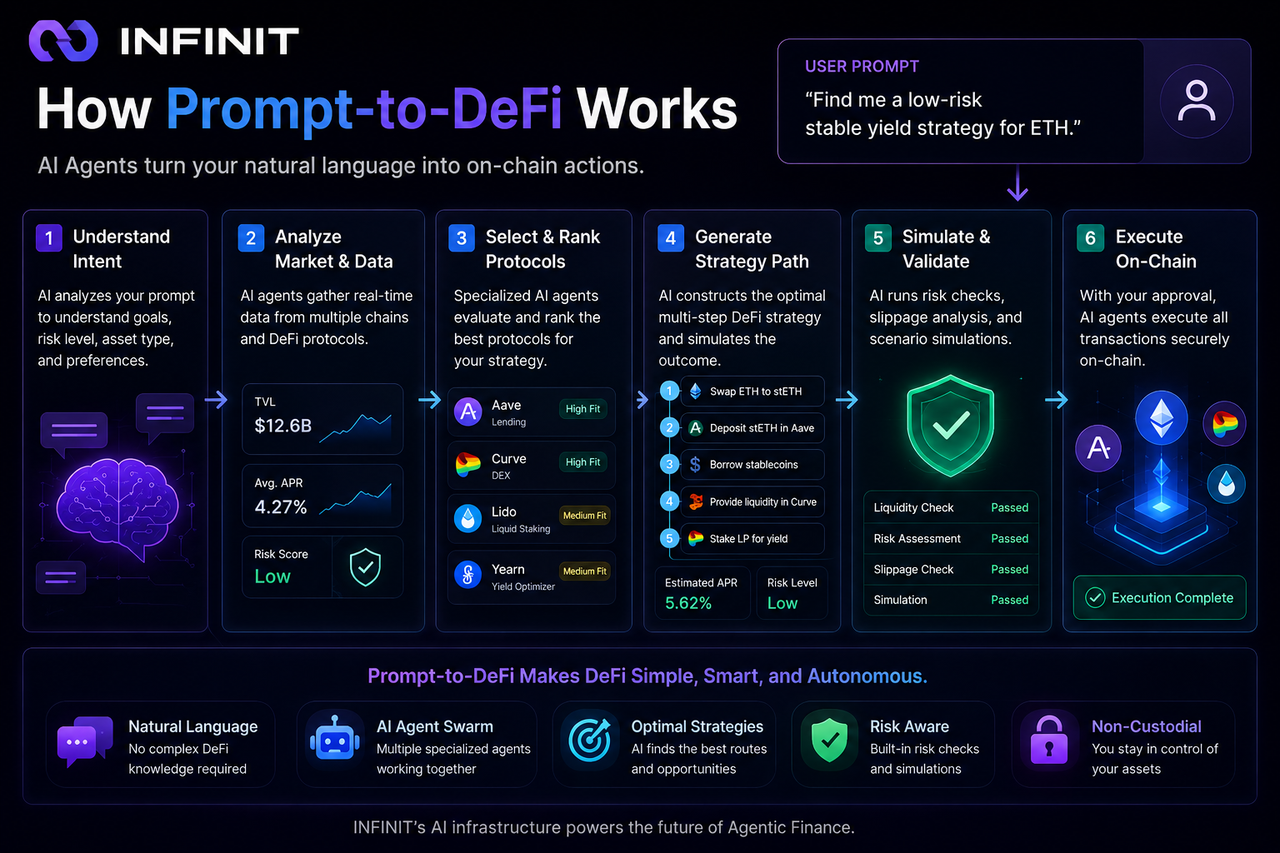
Unlike traditional keyword matching, the AI Agent prioritizes “intent recognition.” For instance, “stable yield” and “high yield” trigger fundamentally different strategy structures.
The system also conducts dynamic contextual analysis using real-time on-chain data. When market volatility spikes, the Agent may reduce leverage usage; if a protocol’s yield declines, the system can automatically adjust the strategy path.
This dynamic reasoning mechanism is what truly sets Prompt-to-DeFi apart from conventional template-based strategy systems.
How the AI Agent Selects DeFi Protocols
After understanding the prompt, INFINIT moves into the protocol selection phase.
The platform hosts multiple specialized Agents, each responsible for a distinct protocol type — lending protocols, DEXs, cross-chain bridges, restaking protocols, and yield aggregators. These Agents continuously monitor TVL, yield rates, liquidity depth, risk parameters, smart contract status, and on-chain activity. Based on the user’s goal, the system automatically filters and combines the most suitable protocols.
For example, when generating a leveraged looping strategy, the system doesn’t just pick a lending protocol; it also evaluates interest rate stability, liquidation risk, borrowing capacity, and asset volatility. Compared to manual research across multiple protocols, the AI Agent can perform dynamic filtering and path optimization far more efficiently.
How Prompt-to-DeFi Generates On-Chain Execution Paths
Once protocols are selected, the system begins constructing the execution path.
This stage involves:
- Decomposing the operation sequence
- Estimating gas costs
- Designing asset conversion routes
- Coordinating cross-chain interactions
- Controlling slippage
- Simulating risks
For instance, a cross-chain yield strategy might include:
- Bridging from Ethereum to Arbitrum
- Converting ETH to a stablecoin
- Depositing into a lending protocol
- Auto-configuring yield farming
These steps are automatically linked by the AI Agent into a unified workflow.
The system also simulates trade outcomes in advance, checking for insufficient liquidity, excessive slippage, liquidation risk, path failures, and protocol anomalies. Only after passing verification does the strategy proceed to execution.
How INFINIT Executes Multi-Step On-Chain Actions
In traditional DeFi, users must manually click through multiple protocol pages step by step. With Prompt-to-DeFi, the AI Agent orchestrates all steps automatically.
Through a unified execution layer, the system handles:
- Wallet authorization
- Contract calls
- Swap
- Bridge
- Deposit
- Borrowing
- Yield configuration
The user sees only the final confirmation screen, while all complex on-chain logic is executed behind the scenes by the Agent.
INFINIT operates on a non-custodial model — the platform never directly holds user assets. The AI Agent’s execution authority is strictly limited to the scope authorized by the user, reducing centralization risk.
This “AI auto-coordination + user final confirmation” model represents a key design direction in today’s Agentic Finance landscape.
How Prompt-to-DeFi Differs from Traditional DeFi Aggregators
Traditional DeFi aggregators primarily consolidate protocol entry points, making it easier for users to access different platforms. However, users are still responsible for designing their own strategies.
Prompt-to-DeFi takes this a step further by introducing an AI Agent that enables the system to:
- Understand user goals
- Automatically generate strategies
- Dynamically adjust paths
- Automate execution coordination
The fundamental difference lies in the presence of an “AI strategy layer.”
| Comparison Dimension |
Prompt-to-DeFi |
Traditional DeFi Aggregator |
| User Input Method |
Natural language prompt |
Manual operations |
| Strategy Generation |
AI auto-generated |
User self-designed |
| Multi-Step Coordination |
Automatic |
Step-by-step user execution |
| Real-Time Reasoning |
Supported |
Limited |
| Risk Analysis |
Dynamic analysis |
Typically minimal |
| Automation Level |
Relatively High |
Medium |
Summary
INFINIT’s Prompt-to-DeFi is a significant practical implementation of combining AI Agents with DeFi. Its core mission is to reduce on-chain financial complexity through natural language interaction.
Compared to traditional DeFi aggregators, Prompt-to-DeFi not only integrates protocol entry points but also leverages AI to autonomously handle strategy reasoning, protocol selection, and on-chain execution. Users can complete complex multi-step DeFi operations without needing deep knowledge of intricate financial structures.
FAQs
How Does INFINIT’s Prompt-to-DeFi Understand User Needs?
The system uses a large language model to analyze user risk preferences, yield targets, asset types, and operational requirements, combined with real-time on-chain data for dynamic reasoning.
Can Prompt-to-DeFi Automatically Execute Complex Strategies?
Yes. The system can autonomously coordinate multiple steps — including Swap, Bridge, lending, and yield farming — and generate a unified execution path.
What Is the Difference Between Prompt-to-DeFi and Traditional DeFi Aggregators?
Traditional aggregators mainly integrate protocol entry points, whereas Prompt-to-DeFi emphasizes AI-driven automatic strategy generation and execution.
Does INFINIT Take Custody of User Assets?
No. INFINIT follows a non-custodial model — user assets always remain in their own wallets.