In this process, natural gas must not only be extracted and processed but also transported through a vast infrastructure network to coastal liquefaction terminals. As one of the largest natural gas infrastructure operators in the United States, WMB (Williams Companies) plays a critical role in this industry chain. Understanding how the LNG export chain operates is key to recognizing Williams' strategic value in the U.S. energy market.
How the LNG Industry Chain Works
LNG stands for Liquefied Natural Gas. The core principle is cooling natural gas to approximately -162°C, converting it into a liquid to drastically reduce its volume for long-distance maritime transport.
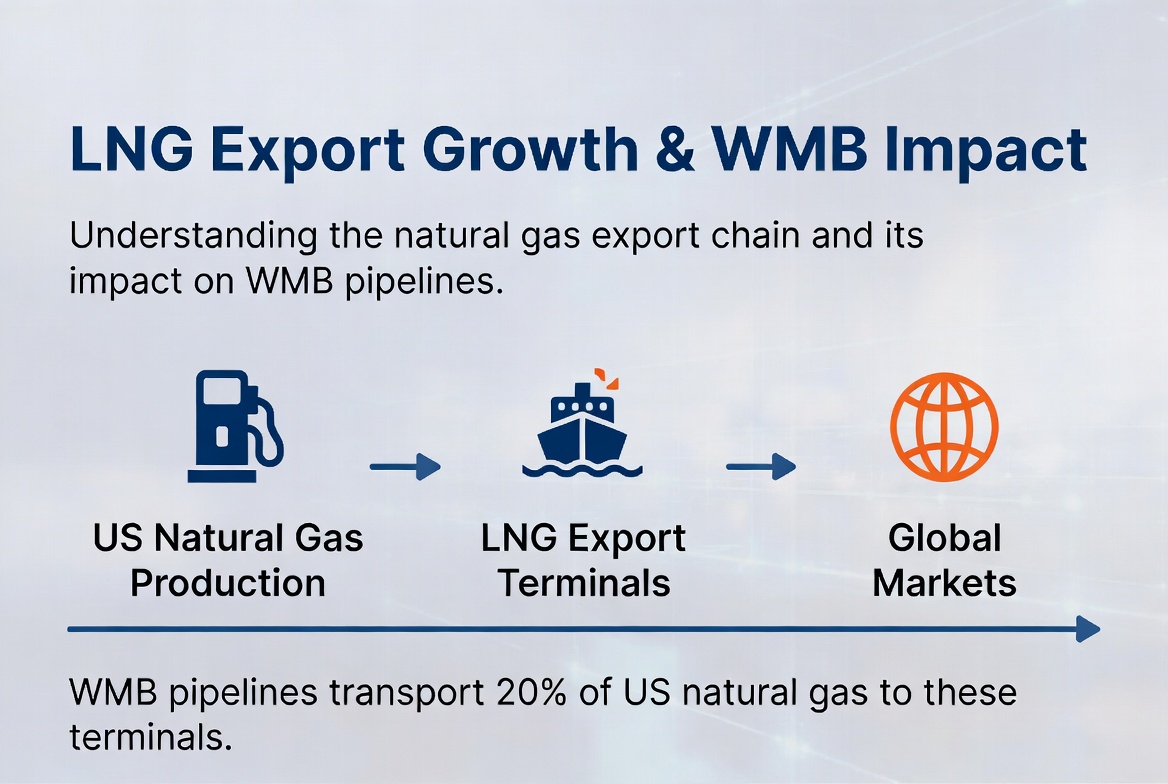
The complete LNG industry chain typically includes natural gas production, gathering and transportation, liquefaction processing, maritime shipping, receiving terminals, and final consumption. Natural gas is first extracted at production sites, then transported via pipeline systems to liquefaction plants. After liquefaction, LNG is loaded onto specialized carriers and shipped through international routes to global markets.
Once LNG arrives at an importing country, it must be regasified at receiving terminals and connected to the local natural gas pipeline network, ultimately reaching power plants, industrial users, and residential homes. Since the industry chain involves multiple infrastructure nodes, expansion at any single node can drive development across the entire sector.
For energy companies, the LNG industry chain is not just an international trade model but a crucial mechanism connecting global natural gas supply and demand. As the global energy structure continues to evolve, LNG is becoming one of the fastest-growing segments in the international energy market.
Why the U.S. Has Become a Major Global LNG Exporter
Over the past decade, the U.S. energy industry has undergone profound changes. One of the most important turning points was the shale gas revolution. The large-scale application of technologies such as horizontal drilling and hydraulic fracturing has rapidly increased U.S. natural gas production, establishing a globally leading resource advantage.
As domestic natural gas supply continued to rise, the U.S. market saw significant surplus production capacity. At the same time, growing natural gas demand in Europe and Asia prompted U.S. companies to actively build LNG export facilities. Through LNG exports, the U.S. can deliver its abundant natural gas resources to international markets.
The U.S. natural gas market also benefits from a mature infrastructure system. A well-developed pipeline network, storage facilities, and large-scale liquefaction terminals along the Gulf Coast form the essential foundation for export growth. These facilities enable the U.S. to efficiently connect inland gas fields with global energy markets.
Today, the U.S. has become a key player in global LNG trade. The increase in export volumes has not only reshaped the U.S. energy landscape but also created new growth opportunities for natural gas infrastructure operators.
The Role of Natural Gas Pipelines in LNG Exports
Although LNG ultimately reaches international markets by ship, natural gas pipelines are the starting point of the entire export system.
Natural gas resources are typically located in inland production areas such as the Appalachian Basin, the Haynesville Shale, and the Permian Basin. Liquefaction terminals, however, are mainly concentrated along the Gulf Coast and select coastal regions. Natural gas must rely on long-distance pipeline transport to connect production areas with export terminals.
Without a pipeline network, even abundant natural gas resources cannot effectively support LNG export growth. Therefore, the pipeline system functions as an energy logistics network, its importance comparable to railways and ports in international trade.
As LNG export capacity expands, the demand for natural gas supply from liquefaction terminals also increases. This typically leads to higher utilization rates of pipelines connecting production areas to terminals, driving business growth for infrastructure operators.
How WMB Connects Production Areas to Export Terminals
Williams is a key player in the U.S. natural gas transportation system, and one of its core values lies in connecting natural gas production areas with consumer markets.
The company operates the Transco natural gas pipeline system, which spans multiple states in the eastern U.S. and is one of the largest and highest-volume natural gas pipeline networks in the country. This system can transport natural gas from major production areas such as the Appalachian region to markets on the East Coast and Gulf Coast.
With the development of the LNG industry, large volumes of natural gas need to reach coastal liquefaction facilities. Williams' pipeline network precisely undertakes this transportation task, providing a stable gas supply to liquefaction terminals. While the company does not directly engage in LNG production or export trade, it participates deeply in the entire industry chain through transportation services.
From an industry chain perspective, Williams acts as a bridge connecting natural gas resources to international markets. Whether the final natural gas flows to power plants, industrial users, or overseas markets, the pipeline network is indispensable critical infrastructure.
How Global Energy Demand Affects Natural Gas Exports
LNG export growth fundamentally stems from changes in global energy demand. With economic development and the ongoing energy transition, more and more countries are increasing the share of natural gas in their energy mix.
In the European market, natural gas has long been a key energy source. In recent years, energy security concerns have driven European countries to further increase LNG import capacity to diversify their energy supply. At the same time, Asia continues to expand its natural gas consumption.
Countries such as China, Japan, South Korea, and Southeast Asian nations generally view natural gas as an important fuel for power generation and industrial energy. With economic growth and rising energy consumption, demand for LNG in these regions has remained consistently high over the long term.
As a result, global natural gas demand growth affects not only export companies but also flows through the industry chain to infrastructure operators. For Williams, expansion in international market demand ultimately translates into higher natural gas transportation volumes and increased pipeline utilization rates.
Why LNG Growth Is an Important Opportunity for WMB
For Williams, LNG export growth does not mean directly selling natural gas, but rather a sustained increase in natural gas throughput.
As natural gas flows from production areas to liquefaction terminals, substantial pipeline infrastructure is required. With ongoing expansion of export terminals, the demand for natural gas supply capacity also rises. As a major pipeline operator, Williams benefits from this growth in transportation demand.
Additionally, LNG projects typically have long construction cycles and long-term operational characteristics. Once a liquefaction terminal is commissioned, it often requires a continuous and stable supply of natural gas. This long-term demand enhances the utilization rate of natural gas infrastructure and increases the strategic value of related assets.
From a long-term perspective, the global energy transition, growth in natural gas consumption, and expansion of international trade are jointly driving the development of the LNG industry. With its extensive pipeline network and the Transco system, Williams occupies an important position in the U.S. natural gas export industry chain and is therefore considered by many investors as a representative company in the natural gas infrastructure sector.
Summary
LNG exports have become a major growth driver for the U.S. natural gas industry. From natural gas extraction to liquefied exports, the entire industry chain heavily relies on support from infrastructure networks. As a leading U.S. natural gas infrastructure operator, WMB (Williams Companies) connects natural gas production areas with export terminals through major pipeline systems such as Transco, playing a key role in the LNG industry chain. With growing global natural gas demand and expanding U.S. LNG export volumes, the importance of the natural gas transportation network is expected to increase further, and Williams will continue to benefit from this long-term industry trend.
FAQ
What is LNG?
LNG stands for Liquefied Natural Gas. It is natural gas that has been cooled to an ultra-low temperature to become a liquid, enabling long-distance maritime transportation.
Why has the U.S. become a major LNG exporter?
The main reasons include the surge in natural gas production from the shale gas revolution, a well-established infrastructure system, and growing international market demand.
What role do natural gas pipelines play in LNG exports?
Natural gas pipelines transport natural gas from inland production areas to coastal liquefaction terminals and are an essential component of the LNG industry chain.
Does WMB directly export LNG?
No. Williams primarily operates in natural gas transportation and infrastructure services, serving the LNG industry chain through its pipeline network.
Why is Transco important to Williams?
Transco is one of the largest natural gas pipeline systems in the U.S. and one of Williams' most core infrastructure assets.
Why is LNG export growth beneficial for WMB?
Growth in export volumes means more natural gas must be transported through pipelines to liquefaction terminals, thereby increasing the utilization rate of Williams' pipeline network and boosting business demand.