For Meta, advertising is not only a source of revenue. It is also a key foundation that keeps the entire social ecosystem running. Free social services attract users to the platform. Large volumes of user behavior data help the advertising system improve delivery performance. Advertising revenue, in turn, supports the platform’s continued expansion and technology investment. This cycle forms the core logic of Meta’s business model.
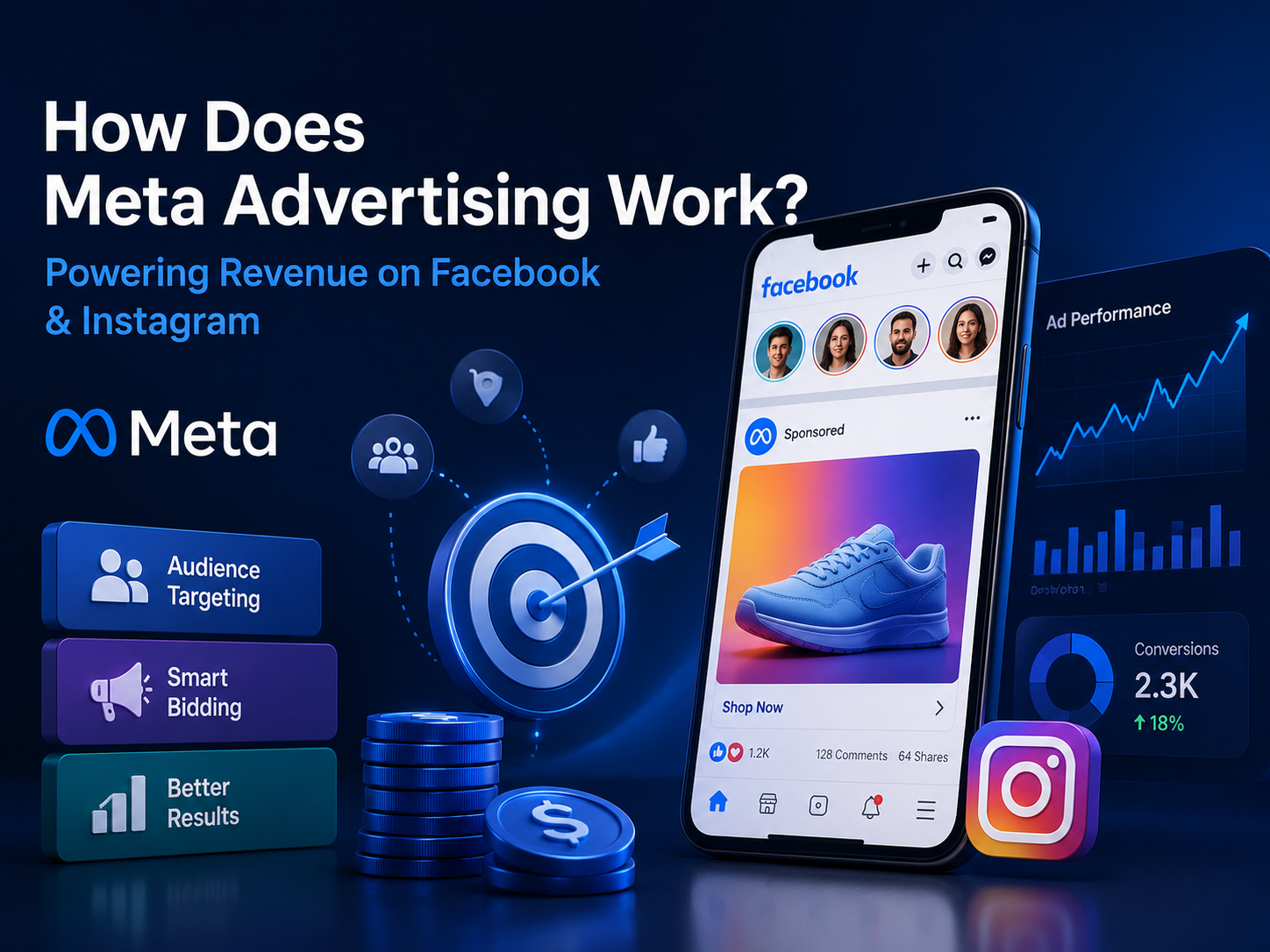
Meta’s advertising business is a digital advertising ecosystem built around Facebook, Instagram, Messenger, and certain third party channels. Advertisers create campaigns through Meta’s ad management platform and run them based on their marketing goals, budgets, and target audiences.
Compared with traditional television ads or outdoor advertising, the biggest feature of Meta advertising is its ability to support precise targeting. Advertisers can select target users based on factors such as age, location, interests, behavior patterns, and purchasing tendencies, improving the efficiency of their ad spending.
Today, Meta ads are mainly used for brand marketing, e commerce promotion, app downloads, content distribution, and local business promotion. With its massive user base and mature data analytics capabilities, Meta has become one of the major players in the global digital advertising market.
How Does the Ad Auction System Work?
Meta does not sell ad placements at fixed prices. Instead, it uses a real time auction model to determine which ads are shown. When multiple advertisers want to reach similar groups of users, the system automatically evaluates the competing ads through an auction process.
Meta’s ad auction does not simply compare bid amounts. It considers several factors together:
| Factor |
Role |
| Ad bid |
The amount the advertiser is willing to pay |
| Estimated action rate |
The likelihood that a user will interact or convert |
| Ad quality |
A score based on ad content and user experience |
| Ad relevance |
How well the ad matches the target audience |
The system ultimately calculates overall value rather than simply selecting the ad with the highest bid. This mechanism balances user experience, advertising performance, and platform revenue, creating a more sustainable advertising ecosystem.
For advertisers, the auction mechanism means high quality content can often achieve better exposure at a lower cost, rather than relying solely on the size of the budget.
How User Data Improves Ad Precision
A major advantage of Meta’s advertising system comes from its ability to accumulate user data. Over years of operating Facebook and Instagram, Meta has developed a large pool of behavioral data, which helps the system better understand user interests and needs.
Users’ browsing, likes, comments, shares, follows, and viewing behavior on the platform all become important signals for recommendations and ad optimization. By analyzing these behavioral patterns through machine learning models, Meta can predict which types of content and products users are more likely to care about.
It is important to note that Meta does not directly sell individual user data to advertisers. Advertisers can usually only choose target audience characteristics, while the ad delivery process is handled automatically by the system. What advertisers see are statistical results and conversion data, not specific user information.
This model allows Meta to improve advertising performance while maintaining the data security and privacy management mechanisms needed to operate the platform.
How Facebook and Instagram Generate Advertising Revenue
Although Facebook and Instagram both belong to Meta’s ecosystem, their advertising scenarios differ in certain ways.
Facebook ads rely more on communities, interest groups, feed content, and business pages for distribution. They are well suited to brand building, local business promotion, and longer cycle marketing campaigns. Instagram, by contrast, places more emphasis on visual content, making it especially suitable for fashion, beauty, consumer brands, and creator marketing.
The main ad formats currently include:
| Ad Format |
Main Platforms |
| Feed ads |
Facebook, Instagram |
| Reels ads |
Instagram, Facebook |
| Stories ads |
Instagram, Facebook |
| Video ads |
Facebook, Instagram |
| Explore ads |
Instagram |
| Shop ads |
Facebook, Instagram |
Advertising revenue mainly comes from ad impressions, clicks, and conversion actions. As short video content has grown rapidly, Reels ads have become an important part of Meta’s advertising system and are gradually becoming a new source of growth.
Meta continues to attract advertisers mainly because its platforms have a massive user base and mature advertising infrastructure.
For advertisers, ad spending is not only about the scale of traffic. Return on investment matters even more. Meta’s advertising system uses data analysis and automated optimization to help advertisers improve conversion efficiency and overall marketing results.
Meta’s platform advantages are mainly reflected in the following areas:
-
Access to a large number of active users worldwide
-
Support for multiple advertising objectives
-
Precise audience targeting capabilities
-
Mature data analytics tools
-
Automated ad optimization support
These capabilities make Meta an important part of many companies’ digital marketing strategies. Both large brands and small and medium sized businesses can use the platform to run marketing campaigns.
The greatest competitive advantages of Meta’s advertising ecosystem come from network effects and data scale.
Facebook, Instagram, and WhatsApp together form a vast user network. Users continuously generate content and interactions, allowing Meta to keep improving its recommendation algorithms and advertising system. This ability to accumulate data cannot be replicated in the short term.
In addition, Meta has a complete advertising toolchain. From ad creation and creative testing to data analysis and conversion tracking, advertisers can complete almost the entire marketing process within the same platform.
Compared with traditional advertising platforms, Meta also has a clear advantage in social relationships. Users do not merely consume content. They also interact with friends, brands, and creators, and this relationship network can further strengthen ad distribution and impact.
As artificial intelligence continues to develop, Meta has also begun using AI to automatically optimize ad creative, audience matching, and budget allocation, improving the overall efficiency of its advertising system.
Although advertising remains Meta’s core source of revenue, this model also faces challenges on several fronts.
First, privacy regulation is becoming stricter worldwide. Data protection policies introduced in some regions limit how platforms collect and use user data, which may affect ad targeting capabilities.
Second, competition in the digital advertising market continues to intensify. Short video platforms, search advertising platforms, and emerging content platforms are all competing for advertising budgets, placing Meta under increasing market pressure.
In addition, the development of artificial intelligence is changing the structure of the advertising industry. Future advertising systems will need not only more precise targeting capabilities, but also stronger content generation, automated optimization, and intelligent analytics. Meta needs to keep investing in technology research and development to maintain the competitiveness of its advertising business.
As a result, although Meta’s advertising business has a mature ecosystem and advantages of scale, it still needs to keep adapting to changes in regulation, technology, and market competition.
Conclusion
Meta’s advertising business is built on a vast social ecosystem. Through its ad auction system, data analytics capabilities, and precise targeting mechanisms, it connects advertisers with users. Facebook and Instagram provide a wide range of advertising scenarios, while advertising revenue has become Meta’s most important commercial source.
From a business model perspective, user scale, data accumulation, and advertising technology together form Meta’s competitive moat. As AI technology continues to develop, Meta is also further strengthening its advertising ecosystem through intelligent recommendations and automated ad optimization, helping it maintain an important position in the digital advertising market.
FAQs
What Is Meta’s Main Source of Revenue?
Meta’s main source of revenue is digital advertising. Platforms such as Facebook and Instagram generate revenue by selling ad display opportunities to advertisers.
Meta’s ad auction system considers factors such as ad bids, ad quality, user conversion probability, and relevance to determine which ads are ultimately shown, rather than relying only on bid amount.
What Is the Difference Between Facebook Ads and Instagram Ads?
Facebook ads are better suited to community interaction and brand promotion, while Instagram ads place more emphasis on visual content and are often used for fashion, consumer products, and creator marketing.
Meta does not directly sell users’ personal data to advertisers. Advertisers can only select target audience characteristics, and ad delivery is handled automatically by the system.
Meta has a massive user base, mature data analytics tools, and precise targeting capabilities, which help advertisers improve marketing efficiency and conversion performance.
AI is helping Meta improve ad recommendations, ad creative generation, budget optimization, and audience matching, further strengthening the performance of its advertising system.