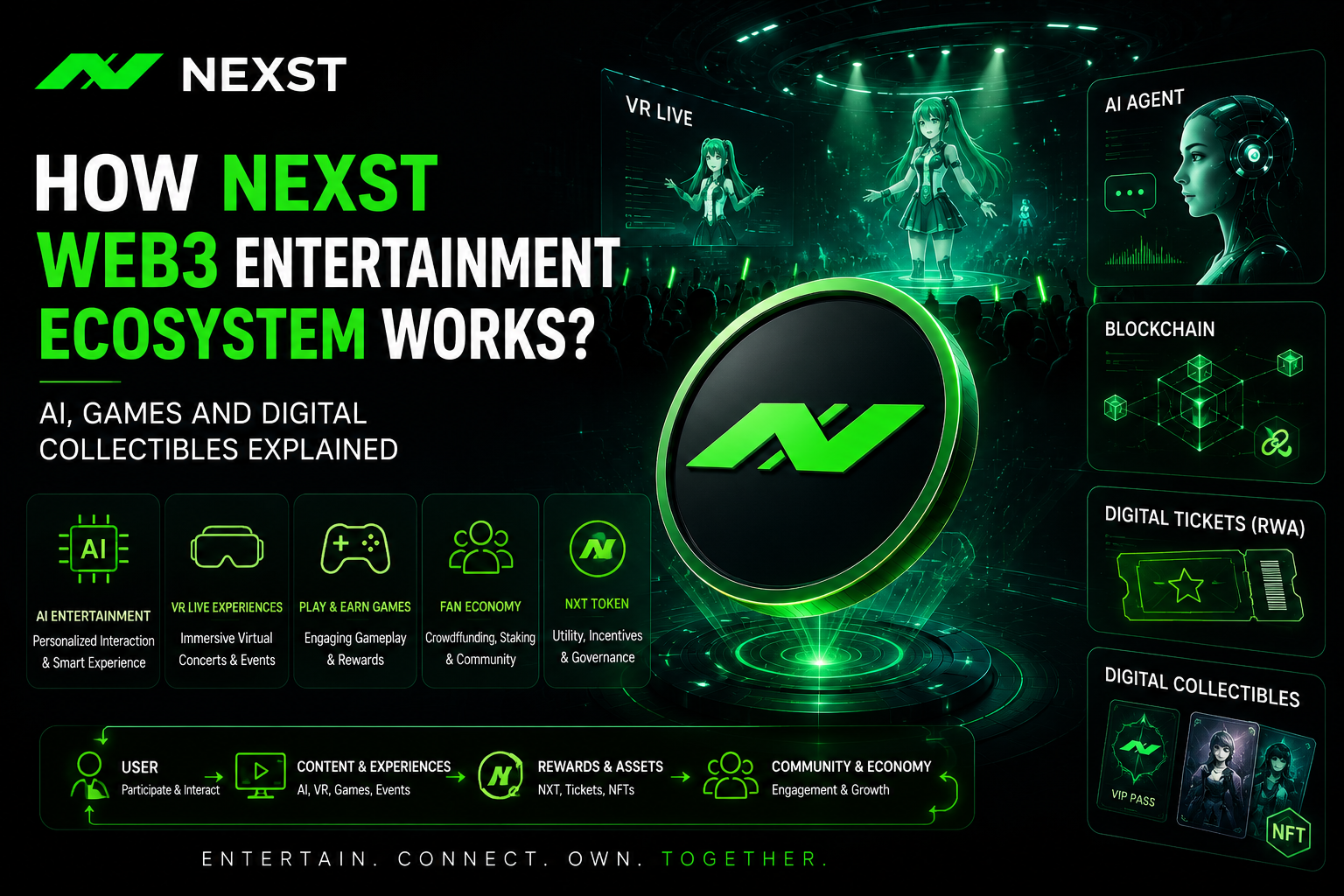
Users searching for NEXST’s Web3 entertainment ecosystem usually want to understand how it differs from traditional entertainment platforms, and how AI Agents, games, digital collectibles, and on-chain rights work together to create interactive scenarios. To understand NEXST’s project positioning, the ecosystem structure matters more than any single product function.
This topic usually involves several layers, including platform architecture, AI entertainment mechanisms, gaming interaction, digital collectibles, user relationships, and the ecosystem loop.
What Is a Web3 Entertainment Ecosystem
A Web3 entertainment ecosystem can be understood as an entertainment platform structure that brings content consumption, user identity, digital assets, and community interaction together. Its core purpose is not only to let users watch content, but to allow them to participate in entertainment activities through on-chain identities, tokens, and digital collectibles.
First, users enter entertainment applications through a wallet, account, or platform gateway. The system then identifies the user’s identity, participation behavior, and digital asset status. Next, users can take part in virtual performances, gaming interactions, digital collectible access, or community activities. In the end, these behaviors are recorded as identity, rights, or interaction records within the platform.
Structurally, NEXST’s Web3 entertainment ecosystem is not a single livestreaming product. It is a combination built around AI, VR, games, and digital assets. Its impact lies in shifting the entertainment relationship from “platforms distribute content and users watch it” to “users participate in content, assets, and communities as they operate together.”
How NEXST Connects AI, VR, and Blockchain
NEXST connects AI, VR, and blockchain by placing entertainment content, immersive experiences, and on-chain rights within the same user journey. AI is responsible for interaction and content assistance, VR handles immersive scenarios, and blockchain records assets and rights.
First, users enter NEXST’s entertainment gateway. AI Agents can then provide content recommendations, interactive responses, or virtual character services. Next, users enter VR LIVE, games, or digital activity scenarios, while the system records related rights based on user behavior. Finally, the blockchain module is used to carry digital ticketing, digital collectibles, token circulation, and some identity credentials.
| Module |
Core Role |
User Experience |
| AI Agent |
Personalized interaction and content assistance |
Stronger sense of interaction |
| VR LIVE |
Virtual performances and immersive scenes |
Participatory entertainment |
| Blockchain |
Records assets and rights |
Verifiable digital identity |
| NXT token |
Connects functions and incentives |
Gateway to ecosystem participation |
| Digital collectibles |
Carry identity and commemorative value |
Long-term interaction records |
The focus of this structure is coordination across different modules. AI improves interaction efficiency, VR expands the entertainment experience, and blockchain makes user behavior and digital assets verifiable.
How NEXST’s Gaming System Creates User Interaction
NEXST’s gaming system mainly supports user interaction and participation retention. Through tasks, activities, rewards, and digital assets, it turns entertainment content into an experience that encourages ongoing participation.
First, users enter games or interactive activities within the platform. The system then records user behavior according to activity rules, such as participation frequency, task completion, or interaction results. Next, users may receive points, digital collectibles, activity rights, or other in-platform rewards. Finally, these interaction results connect with user identity, community relationships, and entertainment content.
The core point is that the gaming system is not an isolated entertainment module. It is an interaction layer within NEXST’s Web3 entertainment ecosystem. It allows users to go beyond watching content and take part in activities, support artists, or obtain digital assets.
This mechanism is important because it strengthens the ongoing relationship between users and the platform. Traditional entertainment platforms rely more on content updates to attract users, while gamified mechanisms can bring users into a deeper fan economy structure through participation behavior.
What Role Do Digital Collectibles Play in NEXST
Digital collectibles in NEXST serve as identity records, activity memories, and links to fan benefits. They can be understood as on-chain or digital credentials formed after users participate in entertainment activities.
First, users take part in performances, games, community activities, or specific content interactions. The system then issues digital collectibles or allows users to obtain them based on activity conditions. Next, digital collectibles can be used as commemorative assets, identity markers, or rights credentials. Finally, they become part of the long-term relationship between users, artists, the platform, and the community.
Structurally, digital collectibles are not just pictures or virtual items. They are relationship carriers in a Web3 entertainment ecosystem. They can record which activities users have joined, which content they have supported, and what kind of identity they hold within the community.
This mechanism means fan behavior can move from one-time consumption to a long-term digital record. For NEXST, digital collectibles help connect content, activities, user identity, and community operations.
How NEXST Builds Long-Term Relationships Between Users and Artists
NEXST builds long-term relationships between users and artists by combining interaction, rights, and digital assets. Users do not only watch artist content. They can also participate in artist-related activities through AI Agents, crowdfunding, digital ticketing, and collectible systems.
First, users discover artist content or virtual activities through the platform. AI Agents and interaction systems then provide more personalized forms of communication. Next, users can participate in a deeper fan economy through NXT, digital ticketing, gaming activities, or digital collectibles. Finally, the platform turns user behavior into identity, rights, and community relationships.
From a mechanism perspective, NEXST attempts to reduce the distance between artists and fans in traditional entertainment models. Traditional platforms are mainly driven by content distribution, while NEXST places more emphasis on interaction records and digital rights.
The impact of this mechanism is that fan relationships can shift from short-term viewing to long-term participation. Artists can gain clearer data on user support, while users can build a more continuous participation experience through digital assets and platform rights.
The key to forming a loop for Web3 entertainment platforms is allowing content, interaction, assets, and incentives to circulate continuously. NEXST’s ecosystem structure revolves around AI entertainment, VR LIVE, gaming activities, digital collectibles, and the NXT token.
First, artists or the platform provide content and activities. Users then interact through AI, VR, or gaming systems. Next, the system records user behavior through digital collectibles, points, or NXT-related mechanisms. Finally, user rights, community participation, and platform incentives feed back into the creation of more content and activities.
Structurally, an ecosystem loop is not the result of a single completed function. It is a cycle created by multiple modules working together. AI provides the interaction gateway, games increase participation frequency, digital collectibles preserve user relationships, and the token mechanism connects rights with incentives.
The significance of this loop is that the platform no longer relies only on one-time content consumption. Instead, it uses continuous interaction to increase user stickiness and give entertainment activities stronger community attributes.
What Limitations Does NEXST’s Ecosystem Mechanism Have
Although NEXST’s ecosystem mechanism covers AI, VR, games, and digital collectibles, it also faces limitations related to user barriers, content supply, and technical experience. Whether a Web3 entertainment ecosystem can operate steadily depends on the appeal of its content, the quality of the user experience, and the coordination of its on-chain mechanisms.
First, users need to understand concepts such as wallets, digital assets, the NXT token, and platform rights. The system then needs to ensure that AI interactions, VR scenes, and gaming experiences are stable enough. Next, the platform must continue to provide artist content, activities, and community operations. Ultimately, the ecosystem can remain active only when content, technology, and asset mechanisms are well matched.
At its core, this depends on the balance between entertainment content and Web3 mechanisms. If on-chain functions are too complex, ordinary users may find it difficult to participate. If the content supply is insufficient, digital assets and incentive mechanisms will struggle to create lasting value.
Therefore, NEXST’s limitations do not come only from technology. They also come from user education, content operations, and ecosystem coordination.
Conclusion
NEXST’s Web3 entertainment ecosystem uses AI, VR, games, digital collectibles, and the NXT token mechanism to build a platform structure centered on user participation and digital rights. Its core path is that users enter entertainment content, the system records interaction behavior, digital assets carry identity and rights, and platform incentives encourage continued participation.
Looking at the overall mechanism, NEXST is not a single entertainment platform. It is trying to connect AI entertainment, virtual interaction, on-chain assets, and the fan economy. Its ecosystem value depends on whether content, technical experience, user participation, and digital asset applications can form a stable loop.
FAQs
What does NEXST’s Web3 entertainment ecosystem mainly include?
NEXST’s Web3 entertainment ecosystem mainly includes AI Agents, VR LIVE, gaming interaction, digital collectibles, RWA ticketing, and the NXT token mechanism.
How does NEXST use AI to improve the entertainment experience?
NEXST uses AI Agents to provide content recommendations, virtual interaction, user responses, and activity support, creating more personalized interaction between users and artists or platform content.
What are digital collectibles used for in NEXST?
Digital collectibles can serve as activity memories, identity credentials, and carriers of fan benefits. They are used to record users’ participation in entertainment activities and community interactions.
What is the relationship between NEXST’s gaming system and Web3?
The gaming system supports user interaction and participation retention. User behavior can be connected with points, digital collectibles, activity rights, and platform identity.
Traditional entertainment platforms mainly rely on content distribution, while NEXST places greater emphasis on AI interaction, on-chain rights, digital assets, and records of user participation.