As global coffee consumption continues to rise, the supply chain has become a vital competitive foundation for coffee companies. From climate change in coffee-growing regions and international coffee price fluctuations to logistics costs and sustainability demands, coffee brands must strengthen their supply chain management to maintain product quality and profitability.
Looking at trends in the consumer goods sector, Starbucks' supply chain strategy exemplifies the shift of global brands from rapid expansion to refined operations. By leveraging data analytics, sustainable sourcing, and supply chain digitization, Starbucks is continually enhancing the efficiency of connections from raw material acquisition to consumer experience.
How Starbucks' Coffee Supply Chain Works
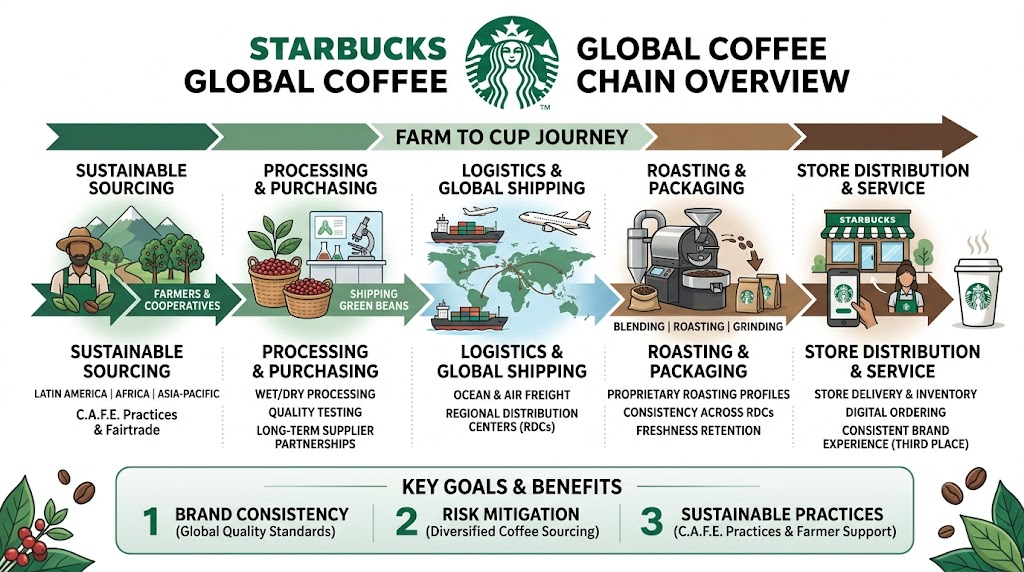
Starbucks operates a sophisticated global supply chain that spans coffee-producing regions, procurement systems, manufacturing, logistics, and retail sales. As a world-leading coffee chain, Starbucks sources large volumes of Arabica coffee beans from multiple countries and regions each year to supply its tens of thousands of stores worldwide.
The supply chain begins at the cultivation stage. Starbucks primarily sources its coffee beans from key producing regions in Latin America, Africa, and Asia—including Brazil, Colombia, Guatemala, Ethiopia, and Indonesia. Beans from different regions offer unique flavor profiles: Latin American coffees often feature nutty and cocoa notes, while African coffees tend to have more pronounced fruity and floral characteristics.
In procurement, Starbucks moves beyond simple market purchases by building long-term supplier partnerships. The company evaluates coffee cultivation, production quality, environmental practices, and farmers' rights through its Coffee and Farmer Equity (C.A.F.E. Practices) standards.
After procurement, the beans are transported, roasted, and distributed. Starbucks has established roasting facilities and supply chain centers worldwide, ensuring consistent product flavor through centralized processing. Professionally roasted beans are then shipped to stores across various countries and regions.
This model is designed to maintain brand consistency amid global expansion. Whether customers buy Starbucks coffee in the US, Europe, or Asia, they can expect a consistent product experience.
Compared to companies that rely on a single regional supply chain, Starbucks' global system offers greater risk diversification. If a coffee-producing region is affected by weather, policy, or transportation issues, Starbucks can adjust its sourcing strategy to minimize supply disruptions.
How Starbucks Ensures Coffee Bean Quality
Coffee quality is central to Starbucks' brand value, making supply chain management critical to ensuring beans meet standards from cultivation through retail.
Starbucks enforces strict requirements for coffee bean varieties, primarily sourcing high-quality Arabica beans rather than the lower-cost, less consistent Robusta variety.
Arabica beans are prized for their rich aroma and flavor, making them popular in the specialty coffee market. However, Arabica is more sensitive to climate, altitude, and growing conditions, making stable supply more challenging.
To ensure procurement quality, Starbucks established the C.A.F.E. Practices certification system, which addresses multiple aspects of coffee production—including bean quality, farm environmental management, worker welfare, and economic transparency.
Through this system, Starbucks not only filters suppliers but also helps farmers improve their cultivation skills. The company partners with certain coffee-growing regions to provide agricultural technical support, boosting both yield and quality.
Starbucks also operates Farmer Support Centers, which offer technical guidance on soil management, pest and disease control, and climate adaptation.
For Starbucks, supply chain quality management is about more than just flavor—it's fundamental to protecting the global brand. For large chains, significant product quality differences across regions can directly impact consumer trust.
As a result, Starbucks extends quality control to the front end of the supply chain through standardized procurement, supplier management, and technical support.
Why Global Coffee Prices Impact Starbucks' Costs
Fluctuating coffee prices are a key factor influencing Starbucks' operating costs. Global prices are shaped by supply and demand, climate change, international trade policies, and currency exchange rates. Production changes in major coffee-producing countries like Brazil significantly affect global prices.
For example, severe drought, frost, or abnormal weather can reduce coffee output, driving up international prices. As coffee beans are Starbucks' core raw material, rising procurement costs directly impact profit margins.
In recent years, climate change has emerged as a major risk to the global coffee supply chain. Coffee cultivation depends on specific temperature and rainfall conditions, and environmental shifts in traditional regions may shrink areas suitable for coffee farming.
Beyond raw material costs, transportation expenses also play a crucial role. Global logistics costs, port congestion, and rising energy prices can all increase the cost of importing and distributing coffee.
To manage cost pressures, Starbucks avoids relying solely on short-term market purchases. Instead, it uses long-term supply agreements, supply chain optimization, and pricing strategies to mitigate risk.
Scale is another key competitive advantage. With its massive purchasing power, Starbucks has stronger bargaining leverage with suppliers and can improve cost efficiency through its global sourcing network. Still, rising coffee prices affect the entire industry. Whether Starbucks, Luckin Coffee, or other brands, all must contend with raw material price volatility. In the future, supply chain management will be critical for coffee companies seeking to control costs.
Sustainability is now a cornerstone of Starbucks' supply chain strategy. The coffee industry faces long-standing environmental and social challenges, including deforestation, unstable smallholder incomes, and climate change. Leading coffee brands must focus not only on procurement prices but also on long-term supply chain stability.
Starbucks advances sustainable sourcing through C.A.F.E. Practices, encouraging suppliers to adopt eco-friendly farming methods, improve resource efficiency, and raise farmers' incomes. The company also prioritizes climate-resilient agriculture by promoting drought-resistant coffee varieties, enhancing soil management, and providing agricultural training to help farmers adapt to climate change. Sustainable sourcing brings Starbucks dual benefits.
On one hand, it strengthens the brand’s reputation for social responsibility and meets consumer expectations for environmental stewardship and fair trade.
On the other, it enhances supply chain stability. By supporting the long-term development of coffee farmers, Starbucks builds more reliable supply sources and reduces future supply risks.
In recent years, more consumer brands have integrated ESG (Environmental, Social, and Governance) strategies into supply chain management. For global enterprises like Starbucks, a sustainable supply chain has become a core element of long-term competitiveness.