In-depth analysis of Samsung C&T's investment logic and Gate's Korean stock Operar purchase process, covering corporate structure, business layout, Operar mechanisms, and risk management—ideal for global investors to refer to.
Samsung C&T Corporation is one of the most “comprehensive” core enterprises within South Korea’s Samsung Group chaebol system, spanning construction engineering, international trade, fashion retail, and strategic investment. As one of Korea’s earliest general trading companies (sōgō shōsha), Samsung C&T plays a key role in connecting industrial capital, global supply chains, and infrastructure development within the group.
Unlike typical tech manufacturing firms, Samsung C&T operates more as a “diversified business platform,” with revenue streams from large-scale global engineering projects, resource trading, and long-term investment portfolios. This structure provides a degree of resilience during cyclical fluctuations while maintaining a strong correlation with the global macroeconomic cycle.
From a capital market perspective, Samsung C&T is a quintessential “conglomerate core asset” on the Korea Exchange (KRX). Its stock performance reflects not only its own fundamentals but also Korea’s chaebol structure, the global infrastructure cycle, and commodity trading trends.
Samsung C&T Positioning and Business Structure Analysis
Samsung C&T’s core business is organized into four segments:
Construction & Engineering. Handles global mega-infrastructure projects such as skyscrapers, industrial facilities, and energy plants. This segment is one of the company’s most stable cash flow generators.
Trading. Facilitates global commodity flows in energy, chemicals, metals, and agricultural products, holding a prominent position in Korea’s general trading company ecosystem.
Fashion & Lifestyle. Manages high-end apparel brands and retail operations. This segment is relatively stable but contributes a smaller revenue share.
Investment & Strategic Holdings. Oversees capital allocation and long-term investment deployments within the group, significantly influencing overall valuation.
This diversification gives Samsung C&T stronger anti-cyclical resilience compared to single-industry peers, though it also adds complexity to valuation analysis.
The Korean Chaebol Model and Samsung C&T’s Distinctiveness
The “chaebol system” is essential to understanding Samsung C&T in the Korean capital market. In this system, large groups form stable industrial networks through cross-shareholding and holding structures, with Samsung C&T acting as a key hub for capital and business integration within the Samsung Group.
This structure yields two characteristics:
On one hand, the company’s operations are highly synergistic, linking with Samsung Electronics, Samsung Heavy Industries, and other affiliates.
On the other hand, its stock price is influenced not only by its own performance but also by the group’s overall strategic moves.
Consequently, Samsung C&T’s investment profile resembles that of a “comprehensive macro asset” rather than a single-industry stock.
How Gate’s Korean Stock Trading System Integrates Samsung C&T Stock
With Gate’s launch of its Korean stock trading service, users can directly trade KRX-listed stocks, including Samsung C&T.
Key features of this trading system:
Direct trading of KRX stocks (KOSPI and KOSDAQ)
Coverage of Samsung Group core companies and major blue-chip assets
USDT as the unified pricing and settlement currency
Shared unified account system with US and Hong Kong stocks
Includes position management, PnL statistics, and fund records
The major shift: Korean stocks are now part of a unified global asset account, enabling investors to access the Korean market without traditional cross-border brokerage accounts.
Step-by-Step Guide to Buy Samsung C&T Stock on Gate
The process is straightforward within Gate’s stock trading framework:
Step 1: Account Registration & KYC Verification
Register an account and complete identity verification to unlock stock trading permissions.
Step 2: Transfer Funds to the Stock Account
Transfer USDT from your spot account to the stock account to fund Korean stock trading.
Step 3: Navigate to the Korean Stock Market Module
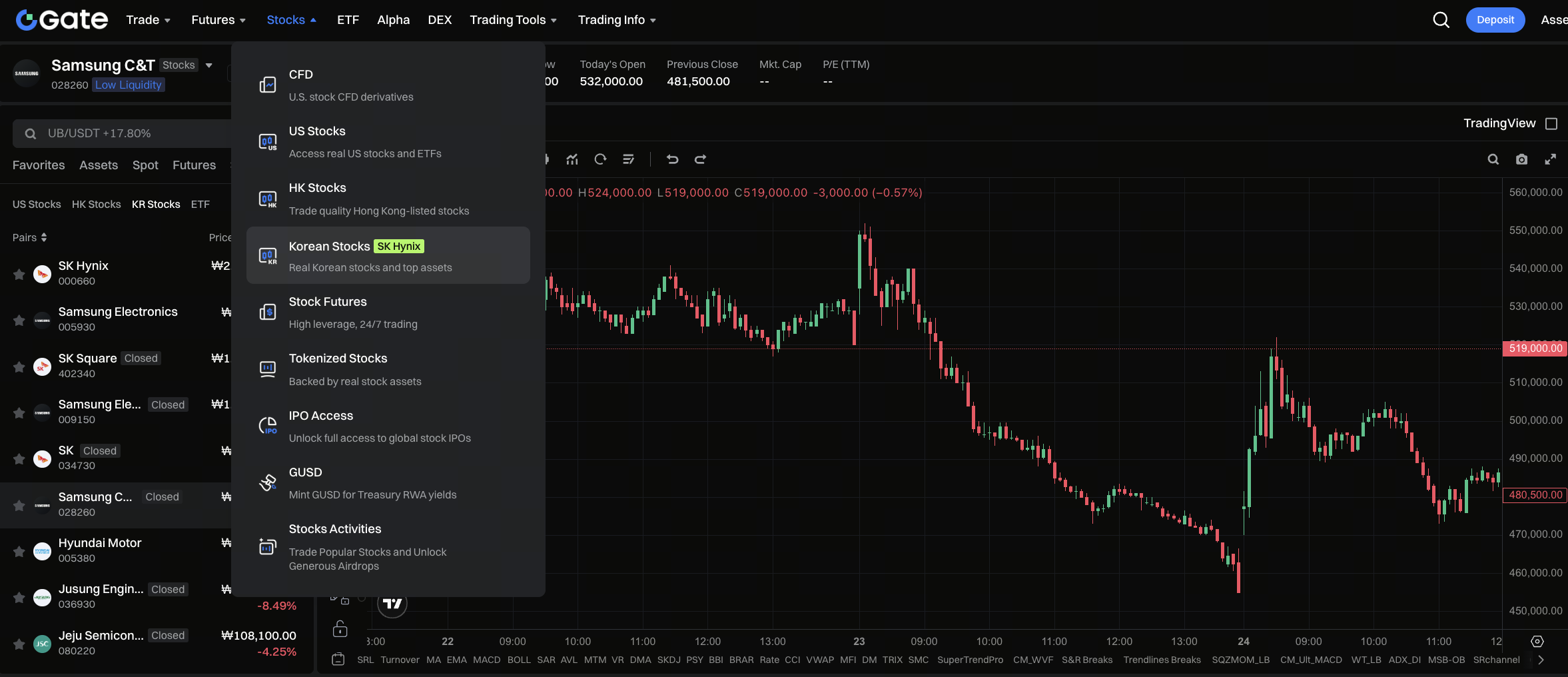
Select Korean Stocks in the stock trading interface, then search for Samsung C&T or ticker 028260.
Step 4: Place and Execute a Trade
Choose between market orders or limit orders. Once matched, the system generates a position record.
Step 5: Manage Assets in the Unified Account
Samsung C&T positions appear alongside US and Hong Kong stock holdings for seamless cross-market portfolio management.
Growth Drivers: Construction, Trade, and New Ventures
Samsung C&T’s growth is driven by three structural factors:
1. Global Infrastructure Cycle. Urbanization in emerging markets fuels demand for large-scale construction projects, providing long-term support for the engineering segment.
2. Commodities and Trade Flows. Cyclical movements in energy and raw materials trading directly impact the trading segment’s revenue.
3. Group Synergies and Strategic Investments. As a key capital node within Samsung, the company benefits from intra-group synergies and strategic holdings that support long-term value creation.
This mix of cyclical, investment, and structural businesses gives Samsung C&T a complex yet resilient profit model.
Investment Risks and Macroeconomic Exposure
Key risk factors to consider when investing in Samsung C&T:
Volatility in the global construction and infrastructure cycle
Potential restructuring within the Korean chaebol system
Exchange rate risk and USDT-denominated pricing
Global economic slowdown impacting overseas projects
Compared to tech growth stocks, Samsung C&T behaves more like a macro-cyclical asset, with broader but more dispersed risk sources heavily tied to the global economy.
Samsung C&T in a Global Asset Allocation Context
In a global portfolio, Samsung C&T is typically classified as a “diversified cyclical asset” whose value derives not from a single industry but from multi-business synergies.
Through Gate’s Korean stock trading channel, investors can add Samsung C&T to a cross-market portfolio, complementing US tech stocks and Hong Kong dividend assets.
From a long-term allocation standpoint, such assets help dampen the volatility of growth-oriented holdings and enhance overall portfolio stability.
FAQs
Q1: Is Samsung C&T a technology company?
No. It is a diversified conglomerate covering construction, trading, retail, and investment.
Q2: Do I need a Korean brokerage account to buy Samsung C&T on Gate?
No. You can trade directly on Gate’s Korean stock module.
Q3: How does Samsung C&T relate to Samsung Electronics?
Both are part of the Samsung Group but operate in different sectors: Samsung C&T focuses on engineering and trading, while Samsung Electronics specializes in semiconductors and consumer electronics.
Q4: What currency is used for settlement in Gate’s Korean stock trading?
All pricing and settlement are done in USDT.
Q5: What are the main investment risks for Samsung C&T?
Key risks include global economic cycles, commodity price volatility, and uncertainty in overseas construction projects.
Q6: Is Samsung C&T suitable for long-term investment?
It is best suited as a cyclical and diversified asset within a portfolio rather than as a standalone high-growth pick.
Author: Max
Disclaimer
* The information is not intended to be and does not constitute financial advice or any other recommendation of any sort offered or endorsed by Gate.
* This article may not be reproduced, transmitted or copied without referencing Gate. Contravention is an infringement of Copyright Act and may be subject to legal action.
Solana faces both opportunities and challenges in its development. Recently, severe network congestion has led to a high transaction failure rate and increased fees. Consequently, some have suggested using Layer 2 and appchain technologies to address this issue. This article explores the feasibility of this strategy.
Sui is a PoS L1 blockchain with a novel architecture whose object-centric model enables parallelization of transactions through verifier level scaling. In this research paper the unique features of the Sui blockchain will be introduced, the economic prospects of SUI tokens will be presented, and it will be explained how investors can learn about which dApps are driving the use of the chain through the Sui application campaign.
This article introduces the technical principles, framework, and applications of Zero-Knowledge (ZK) technology, covering aspects from privacy, identity (ID), decentralized exchanges (DEX), to oracles.
Tronscan is a blockchain explorer that goes beyond the basics, offering wallet management, token tracking, smart contract insights, and governance participation. By 2025, it has evolved with enhanced security features, expanded analytics, cross-chain integration, and improved mobile experience. The platform now includes advanced biometric authentication, real-time transaction monitoring, and a comprehensive DeFi dashboard. Developers benefit from AI-powered smart contract analysis and improved testing environments, while users enjoy a unified multi-chain portfolio view and gesture-based navigation on mobile devices.