ORCL is the stock ticker for Oracle Corporation. Oracle’s business covers databases, Oracle Cloud Infrastructure, enterprise applications, and AI infrastructure. The stock price is influenced by factors such as cloud revenue, AI data center contracts, capital expenditures, profits, and market expectations.
Gate has launched a dedicated stock page for ORCL, where users can view real-time prices, charts, and market performance, and access trading features directly from that page. When trading, make sure you are on the Gate Stocks ORCL page, not on a page for ORCL-related CFDs, perpetual contracts, tokenized stocks, or other derivatives.
What to Prepare Before Trading ORCL Stock on Gate
Before trading ORCL stock on Gate, users must have an active Gate account, complete the required identity verification, and confirm that Gate Stocks is available in their country or region. Stock services are only available to qualified users, so even if you already have access to Gate’s crypto features, your account may not automatically have stock trading privileges.
You’ll also need to have enough USDT and transfer funds to your stock trading account. Gate Stocks allows you to trade stocks and ETFs directly with USDT—there’s no need to convert to USD first. However, always refer to the current page for the correct account, transfer entry, and settlement records.
Before trading, check the following:
- Is the search result for Oracle Corporation, and is the ticker ORCL?
- Is the page labeled as Gate Stocks, not CFD, contract, or tokenized stock?
- Is it currently within the trading session, and does the order support market or limit types?
- Available USDT, estimated trade amount, minimum trade size, and related fees.
Gate Stocks supports trading by share quantity or amount, and allows fractional shares as low as 0.01. Trading hours and order types may vary between stocks, so always refer to the ORCL page for specifics.
How to Find the Oracle (ORCL) Stock Trading Page
After logging in to Gate, go to the stock trading section and enter “ORCL” or “Oracle” in the search bar. Once results appear, verify the company name, ticker, and product type before entering the Oracle stock quote and trading page.
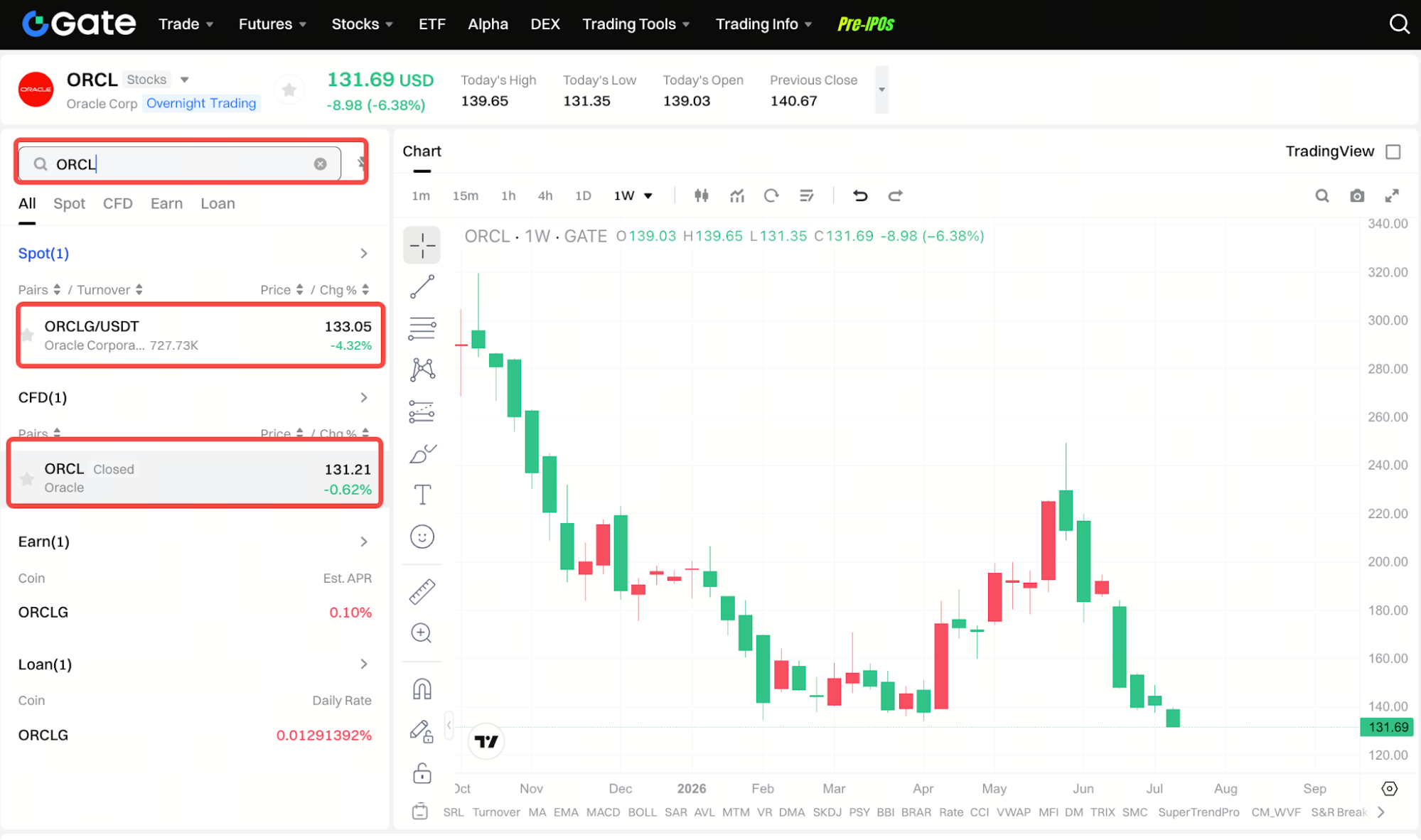
The Gate ORCL stock page displays real-time prices, charts, and performance data. Since the platform may offer real stocks, CFDs, perpetual contracts, or tokenized securities, do not rely solely on the “Oracle” name to identify the product.
| Checklist |
Gate Stocks ORCL Stock |
Other ORCL-Related Products |
| Product Type |
Traditional stock trading |
CFD, contract, or tokenized security |
| Trading Asset |
Oracle Corporation stock |
Stock derivatives or on-chain tokens |
| Funding Method |
Buy/sell directly with USDT |
May use margin or specific pairs |
| Holding Nature |
Stock rights held via platform and broker infrastructure |
Depends on derivative or token structure |
| Key Rules |
Buy, hold, sell, and corporate actions |
May involve leverage, funding rates, or on-chain rules |
Gate Stocks currently supports buying and selling only—no margin buying or direct short selling. CFDs or perpetual contracts may involve leverage, margin, forced liquidation, and overnight costs. Always confirm the product page before placing an order.
How to Buy ORCL Stock with USDT
To buy ORCL stock with USDT, go to the ORCL stock page, select “Buy,” and enter either the number of shares or the trade amount as supported. Confirm the order price, estimated USDT to be used, share quantity, and fees before submitting.
If market orders are supported, the trade will typically execute at the available market price, offering faster execution but possibly at a price different from what you see at order placement. With limit orders, you can set your maximum buy price, but the trade will only execute if the market hits that price and there’s sufficient liquidity.
Gate Stocks supports fractional shares with a minimum of 0.01, so you don’t need to buy a whole share. Fractional trading lowers the required funds per trade, but the final amount you can buy depends on the current ORCL price, minimum amount, order rules, and your account balance.
| Step |
Required Action |
Key Checkpoints |
| Fund Preparation |
Transfer USDT to stock account |
Sufficient available balance |
| Search Stock |
Enter ORCL or Oracle |
Company name and ticker |
| Choose Order |
Place by amount or shares |
Market or limit order |
| Confirm Details |
Check estimated amount and fees |
Price, quantity, total cost |
| Submit Order |
Confirm purchase |
Immediate or partial fill status |
| View Results |
Check holdings and order records |
Average fill price and actual shares |
Submitting an order does not mean your purchase is complete. Check your order status to confirm whether it’s filled, partially filled, pending, or canceled. Only filled shares will be added to your ORCL holding.
How to View ORCL Stock Holdings and Order Records
After buying, go to the Gate Stocks assets or holdings page to view your ORCL stock. Holdings records typically show the ticker, shares held, cost, current price, and value—specific fields and calculations are based on the platform.
The orders page lets you track open and historical trades. Limit orders may remain open until the set price is reached; if liquidity is low, orders may be partially filled, so your holdings may not exactly match your original order.
Key record types:
- Current Orders: Orders not yet fully filled or canceled.
- Order History: Completed, canceled, or expired trades.
- Trade Records: Actual fill price, share amount, time, and fees.
- Holdings Record: Current number and value of ORCL shares held.
- Funds Record: USDT transfers, trade settlements, and asset changes from corporate actions.
Gate Stocks supports position management and trade history queries. Corporate actions like cash dividends, stock splits, and reverse splits are reflected in your account and records according to platform rules.
How to Sell ORCL Stock and Settle in USDT
To sell ORCL stock, select ORCL from your holdings or re-enter the stock trading page and choose “Sell.” Enter the number of shares to sell, select the order type, and confirm the price, quantity, and expected USDT before submitting.
Sell orders may fill immediately, partially, or remain open. Market orders focus on execution speed; limit orders let you set a minimum price. If the market doesn’t reach your price, the limit sell order may remain unfilled.
Once filled, sale proceeds are credited as USDT per Gate Stocks’ settlement rules. Always check your trade records and fund details for the actual shares sold, average price, fees, and amount received—don’t rely solely on the estimated value shown at order placement. Gate Stocks enables direct USDT stock trading, with no need to convert to USD.
Before selling, check for pending corporate actions—cash dividends, stock splits, or reverse splits may affect your holdings or account records. The platform will process these based on your holdings and applicable rules on relevant dates.
How Does Trading ORCL Stock with USDT on Gate Differ from Using a Traditional Broker?
Both Gate Stocks and traditional brokers enable you to buy, hold, and sell stocks, and you’ll benefit or lose from ORCL price changes. The main differences are in funding, account setup, registration, shareholder rights, and trading hours—not in the Oracle stock itself.
Gate lets qualified users trade stocks directly with USDT, without the fiat deposit process required by traditional brokers. The platform accesses real securities markets through regulated brokerage infrastructure and supports fractional shares. Traditional brokers typically require bank accounts, USD, or other fiat for deposits and settlements.
| Comparison |
Gate USDT Trading for ORCL Stock |
Traditional Broker ORCL Trading |
| Funding |
Direct USDT use |
Usually USD or local fiat |
| Account Structure |
Gate stock account |
Independent brokerage account |
| Minimum Size |
As low as 0.01 shares |
Depends on broker’s fractional share policy |
| Stock Nature |
Real stocks via broker infrastructure |
Real stocks via broker |
| Registration |
Not registered in user’s name |
Depends on broker’s model |
| Voting Rights |
Usually no traditional voting rights |
May offer voting/shareholder services |
| Corporate Actions |
Processed per platform rules |
Per broker and market rules |
| Trading Hours |
Some stocks may have extended/all-day trading |
Usually exchange hours only |
| Margin/Shorting |
Only buy/sell supported |
Some brokers offer margin and short selling |
| Asset Management |
Manage with digital assets on one platform |
Usually separate from crypto accounts |
Important: According to the Gate Stocks Help Center, stocks are not registered in your personal name in the issuer’s shareholder register, and users generally do not have traditional voting rights. Economic entitlements like dividends and splits will be handled and reflected in your account per platform rules.
Summary
To trade Oracle (ORCL) stock with USDT on Gate, first confirm account eligibility and region availability, transfer USDT to your stock account, search for ORCL via Gate Stocks, and complete your buy or sell order as supported.
Key steps include verifying the product type, understanding market vs. limit orders, checking order execution status, and confirming settlement via holdings and fund records. Gate Stocks connects to real securities markets and supports USDT and fractional trading, but differs from traditional brokers in registration, voting rights, trading hours, and account structure.
FAQ
Can I buy ORCL stock directly with USDT on Gate?
Qualified users can buy and sell ORCL stock directly with USDT on Gate Stocks, with no need to convert to USD, but identity verification and regional support are required.
Is ORCL on Gate a real stock?
ORCL on Gate Stocks is linked to the real securities market through brokerage infrastructure and is not a typical crypto token, but the stock will not be registered in your personal name.
What is the minimum amount to purchase ORCL stock?
Gate Stocks supports fractional shares with a minimum of 0.01. The actual minimum depends on ORCL’s price, page rules, fees, and your available USDT.
Why don’t I see a position after submitting an ORCL buy order?
Submitting an order does not guarantee execution. If the limit price isn’t met, liquidity is insufficient, or only a partial fill occurs, check order status in open orders and trade records.
Will I receive USDT after selling ORCL stock?
After a sale is filled, proceeds are credited as USDT per Gate Stocks settlement rules. The actual amount is based on fill price and fee records.
Do I have voting rights when buying ORCL stock on Gate?
Gate Stocks users generally do not have traditional shareholder voting rights, as stocks are not registered in your name. Dividends and splits are processed per platform rules.