As the tokenization of real world assets, or RWA, continues to develop, more traditional financial assets are entering the digital asset ecosystem in on-chain form.
In the tokenized stock market, crypto trading platforms play an important role in connecting investors, liquidity, and underlying assets. Platforms such as Gate TradFi use digital asset accounts, stablecoin settlement, and on-chain infrastructure to provide a new way for traditional stock assets to be traded and circulated, making them one of the key gateways between traditional finance and digital finance.
What Are Gate TradFi and Tokenized Stock Trading?
Gate TradFi is a trading infrastructure module that connects traditional financial assets with the digital asset market. It allows users to participate in trading products related to traditional financial assets such as stocks, ETFs, and indices through digital asset accounts.
Unlike traditional securities markets, which require brokerage accounts, bank accounts, and securities custody systems, digital asset platforms usually combine account management, fund management, and trading functions within one unified environment. Users can transfer funds, manage assets, and trade in the market through a digital asset account.
For tokenized stocks, investors trade digital assets linked to the price or rights of real stocks, while the underlying shares are managed and maintained by issuers and custodians.
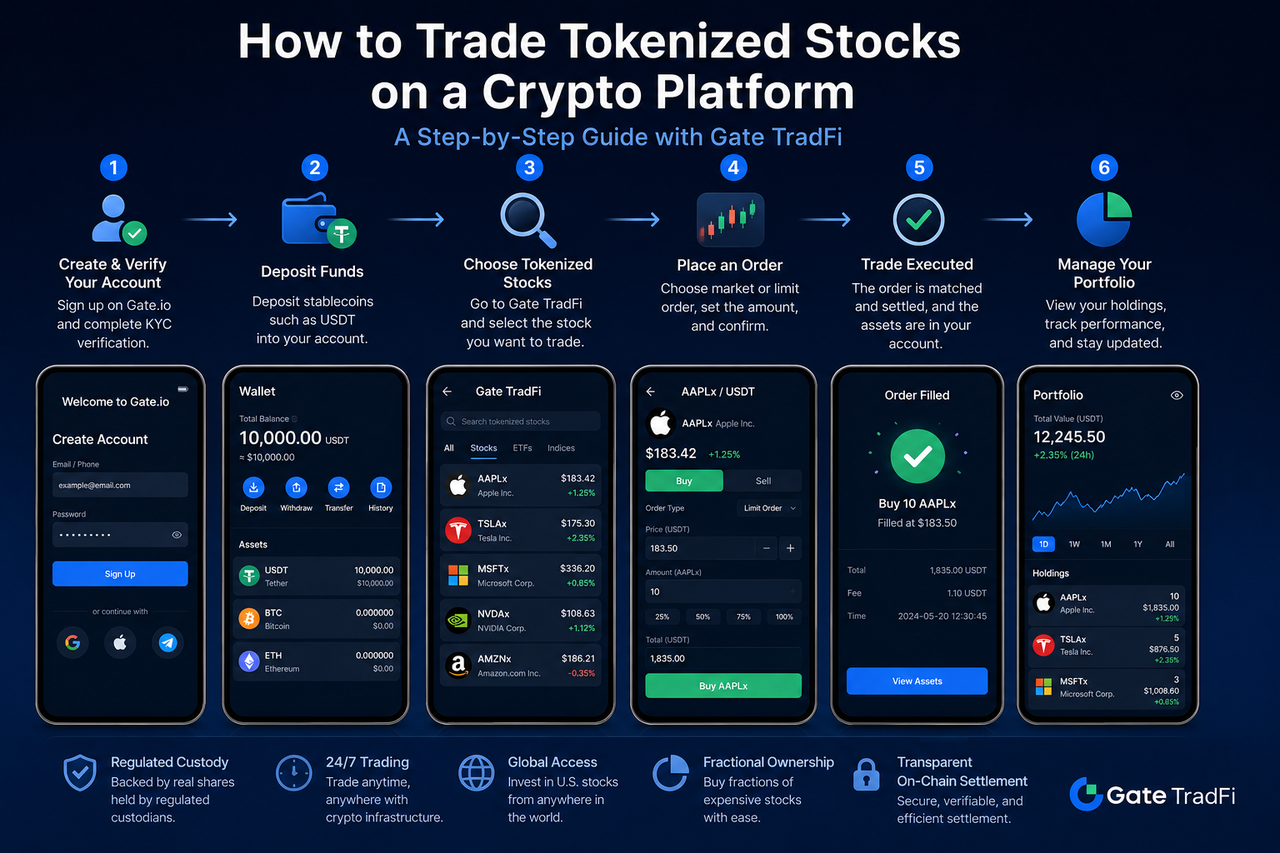
What Preparations Are Needed Before Trading?
Before tokenized stock trading begins, users need to complete account verification and prepare funds. Most platforms that support tokenized stocks require users to complete KYC, or Know Your Customer, procedures to meet regulatory and compliance requirements. Identity verification usually involves checking identity documents, facial recognition, and confirming residence information.
After account verification is complete, users need to prepare trading funds. Unlike traditional securities markets, which mainly settle in fiat currency, tokenized stock markets usually use stablecoins such as USDT and USDC as their main settlement assets. Once funds enter the trading account, they can be used for subsequent buying and selling of stock tokens.
Different platforms may vary in supported regions, account levels, and trading permissions, so users need to confirm whether they meet the relevant conditions based on the platform’s rules.
How to Choose Tokenized Stock Products
The range of tokenized stocks supported by different platforms is not exactly the same. Some platforms mainly cover shares of large listed US companies, such as globally known companies including Apple, Microsoft, Nvidia, and Tesla. Others may expand further into ETFs, index products, or other categories of real world assets.
When choosing a specific product, users should pay attention to its asset backing method, issuer, settlement rules, and the rights structure available to investors. Different products may handle dividend distribution, redemption mechanisms, and corporate actions differently. These factors all affect how closely the tokenized stock is linked to the underlying asset.
How Are Tokenized Stock Orders Submitted?
After selecting a trading asset, users can enter the trading interface and submit buy or sell instructions. The trading methods are relatively similar to those in traditional stock markets, mainly including market orders and limit orders.
A market order is executed immediately at the best available market price, making it more suitable when users want fast execution. A limit order allows users to set a buy or sell price in advance. The order is only filled when the market price reaches the preset condition, giving users stronger control over the execution price.
After an order is submitted, it enters the platform’s matching system. When the price and quantity from buyers and sellers match, the trade can be completed. The execution result is then updated on the account position page.
What Happens After a Tokenized Stock Trade Is Completed?
After a tokenized stock trade is executed, the buyer’s account receives the corresponding number of stock tokens, while the seller’s account receives the corresponding settlement funds. The digital asset platform updates the asset records and transaction history of both accounts accordingly.
Unlike traditional securities markets, which rely on brokers, clearing houses, and central securities depository systems, digital asset platforms usually record asset changes through on-chain or digital ledgers. After a trade is completed, position changes can be reflected in the user’s account more quickly.
From the user’s perspective, a tokenized stock trade feels similar to a digital asset spot trade, but the underlying asset corresponds to real world stock rights or price exposure.
How to View and Manage Positions
After a trade is completed, tokenized stocks appear on the account asset page. Users can view their current position size, market price changes, and historical transaction records. Some platforms also provide auxiliary tools such as price alerts, asset analysis, and risk management to support day to day position management.
Because tokenized stocks are securities mapping products in digital asset form, their position management experience is usually closer to that of a crypto asset trading platform than a traditional securities account system. Users can manage cryptocurrencies, stablecoins, and stock token assets through the same interface.
As platform features continue to develop, some trading platforms also support asset category management, return statistics, and unified multi market views to improve asset management efficiency.
How Are Dividends and Corporate Actions Reflected in Accounts?
Tokenized stocks do more than simply track stock prices. When the underlying listed company carries out corporate actions such as dividend payments, stock splits, mergers, or delistings, the relevant changes also need to be reflected in the token system.
When the underlying company pays a cash dividend, the issuer distributes the corresponding proceeds to token holders according to the product rules. The distribution may take the form of stablecoin payments, account balance adjustments, or other rights mapping methods. The specific rules are usually determined by the issuance documents or platform instructions.
When a stock split occurs, the number of tokens is adjusted by the same ratio, while the total asset value usually remains unchanged. If the company undergoes a major event such as a merger, privatization, or delisting, the issuer needs to readjust the token structure and investor rights arrangements based on changes in the underlying asset.
Gate TradFi vs Traditional Brokerage Trading Process
| Comparison Item |
Gate TradFi |
Traditional Brokerage |
| Account System |
Digital asset account |
Securities account |
| Fund Type |
Stablecoins |
Fiat currency |
| Deposit Method |
Digital asset transfer |
Bank transfer |
| Trading Entry Point |
Crypto platform |
Securities trading software |
| Asset Type |
Tokenized stocks |
Traditional stocks |
| Settlement System |
on-chain or digital settlement |
Central clearing system |
| Market Connection |
Digital asset ecosystem |
Traditional capital market |
| Technical Architecture |
Blockchain infrastructure |
Traditional financial infrastructure |
What Risks Should Be Considered When Trading Tokenized Stocks?
Tokenized stocks improve the efficiency of global asset circulation, but they still face multiple risks. Regulatory frameworks differ across jurisdictions, and relevant rules may change as the digital securities market develops.
Investors also need to consider whether issuers and custodians can fulfill their obligations. Whether tokenized stocks can maintain a corresponding relationship with real stocks largely depends on the transparency of asset custody and issuance mechanisms. At the same time, insufficient market liquidity may widen bid ask spreads and affect the trading experience.
In addition, operational risks, technical risks, and cross border compliance risks related to digital asset platforms are also important factors that the tokenized stock market needs to monitor continuously.
Conclusion
Trading tokenized stocks through a crypto platform essentially means participating in asset trading linked to the value of real stocks within digital asset infrastructure. The full process usually includes account verification, fund preparation, asset selection, order submission, trade matching, position management, and corporate action handling.
Platforms represented by Gate TradFi are pushing forward the integration of traditional financial assets and blockchain networks. Tokenized stocks not only expand the range of assets available in the digital asset market, but also explore new ways to issue, circulate, and settle stock based assets.
FAQs
Do You Need a Securities Account to Trade Tokenized Stocks?
Tokenized stock trading is usually completed through a digital asset platform. Whether a traditional securities account is required depends on the platform design and regulatory requirements. Most tokenized stock products allow users to participate through a digital asset account without separately opening a traditional brokerage account.
What Funds Are Used for Settlement When Trading Stocks on Gate TradFi?
Platforms like Gate TradFi usually use stablecoins such as USDT as the main settlement assets. Users manage funds, trade, and hold positions through a digital asset account.
Are Tokenized Stock Prices the Same as Real Stock Prices?
Tokenized stocks are usually linked to the value of the underlying shares, but factors such as market supply and demand, liquidity, and platform mechanisms may cause short term price deviations. Therefore, the token price and the underlying stock price may not always be exactly the same.
Do Tokenized Stocks Support Fractional Investment?
Most tokenized stocks support small value trades and fractional holdings. Investors can gain partial asset exposure without buying a full share, which is one of the important features of tokenized stocks.
Are Tokenized Stock Trading Hours the Same as Traditional Stock Market Hours?
Some tokenized stock platforms support longer trading hours or even round the clock trading. The specific opening hours depend on platform rules and the operating arrangements of the market linked to the underlying asset.
Are Tokenized Stocks RWA Assets?
Tokenized stocks are an important part of real world asset, or RWA, tokenization. Their core feature is mapping traditional stock assets onto blockchain networks for digital circulation, with trading and settlement carried out through on-chain infrastructure.