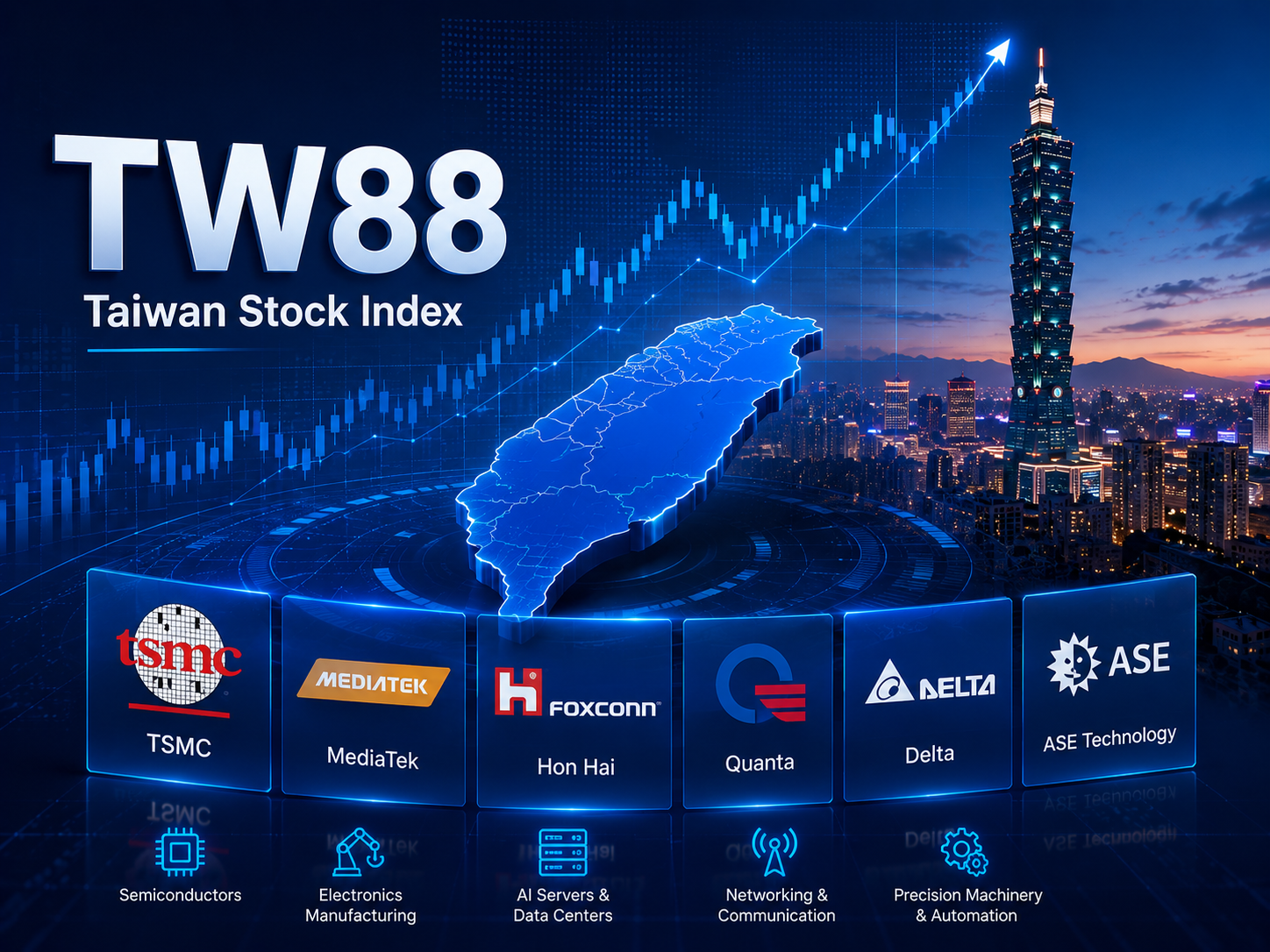
Unlike markets led mainly by financial or energy companies, Taiwan's market is deeply connected to the global electronics supply chain. From wafer fabrication to the server supply chain, and from consumer electronics to artificial intelligence infrastructure, many critical links in the global technology industry are closely tied to Taiwanese companies. Therefore, understanding how TW88 works is, in essence, understanding the connection between Taiwan's technology sector and global capital markets.
How TW88 Works
TW88 is an index product built around major listed companies in Taiwan's stock market. Its purpose is to reflect the overall performance of Taiwan's equity market. The index is weighted by the market capitalization of its constituents, so large companies usually have a much greater influence on index movements than small and mid-sized companies.
When companies with larger market capitalizations rise, TW88 may still move higher even if most small and mid-sized stocks perform only modestly. Likewise, when major weighted stocks undergo a clear correction, the index may come under significant pressure.
In terms of how it operates, TW88 is better understood as a concentrated reflection of Taiwan's core industrial competitiveness, rather than a simple average of all listed companies.
Why Semiconductor Leaders Dominate TW88 Movements
The semiconductor industry is one of the most important core sectors in Taiwan's capital market.
A large share of the world's advanced chip manufacturing capacity is concentrated in Taiwan, so the development of semiconductor companies often has a direct impact on the overall performance of TW88. Among them, TSMC, as a global leader in wafer foundry services, has an exceptionally strong influence in Taiwan's capital market.
When global demand rises for artificial intelligence, high performance computing, data centers, and advanced process chips, the semiconductor supply chain usually benefits first, helping lift the valuations of related companies.
Conversely, when demand for consumer electronics slows, corporate capital expenditure declines, or the semiconductor industry enters an inventory adjustment cycle, TW88 may face greater volatility.
Over the long term, TW88 has a strong connection with the global semiconductor business cycle.
How the Global Technology Cycle Affects Taiwan's Stock Market
Taiwan's industry structure makes its market highly sensitive to changes in the technology cycle.
In recent years, artificial intelligence has become a major growth theme in the global technology industry. As large technology companies continue to increase investment in AI infrastructure, demand has grown rapidly for servers, GPUs, network equipment, and advanced chips. Taiwanese supply chain companies have benefited as a result.
Beyond the AI industry, smartphones, personal computers, and consumer electronics markets also affect the order outlook for Taiwanese companies.
When the global technology sector enters an expansion phase, Taiwanese companies usually receive more orders and attract more capital attention. When the industry moves into an adjustment phase, corporate earnings expectations and market valuations may be affected.
For this reason, TW88 reflects not only Taiwan's domestic economic conditions, but also the broader development trend of the global technology industry.
How International Capital Determines the Short Term Direction of TW88
International capital is one of the key forces influencing Taiwan's market.
Because Taiwan's market is relatively open to foreign investors, international institutional investors have long held a large amount of Taiwanese equity assets. As a result, changes in global capital flows can often have a direct effect on market performance.
When global liquidity conditions are loose and investor risk appetite improves, international capital is usually more willing to allocate to growth oriented technology assets, which often benefits Taiwan's market.
By contrast, when the US dollar strengthens, the Federal Reserve keeps interest rates high, or global risk appetite weakens, some international capital may move toward safer assets, leading to greater market volatility.
Exchange rate movements are also worth watching. Fluctuations in the New Taiwan dollar often affect the export competitiveness of companies and, in turn, market sentiment.
Taiwan's Industry Chain Position in the Global Supply Chain
The defining feature of Taiwan's market is the high share of technology companies.
The semiconductor industry is Taiwan's most important growth engine and a key part of the global technology value chain. In addition, electronics manufacturing, consumer electronics, server equipment, network communications, and precision manufacturing also play important roles.
From an industry structure perspective, Taiwan's market is mainly driven by the following sectors:
| Industry Area |
Representative Companies |
| Wafer fabrication |
TSMC |
| Chip design |
MediaTek |
| Electronics manufacturing services |
Hon Hai |
| AI servers and data centers |
Quanta, Wistron |
| Semiconductor packaging and testing |
ASE Technology |
The development of the global artificial intelligence industry is driving data center construction, cloud computing expansion, and growing demand for high performance computing. Because Taiwanese companies are deeply involved in the global AI hardware supply chain, the strength of these related industries can often have a direct impact on TW88 performance.
Compared with resource-based or finance-led markets, TW88 is more easily influenced by the global technology cycle and the trend of industrial upgrading.
Why TW88 and NAS100 Often Move Together
TW88 and NAS100 often move in a similar direction. The main reason is that both are closely linked to the technology industry.
When global markets are optimistic about artificial intelligence, cloud computing, data centers, and digital transformation, both indices often benefit at the same time. When market liquidity improves, growth oriented technology companies are usually more likely to attract capital.
However, the two still have clear differences.
| Comparison Dimension |
TW88 |
NAS100 |
| Core Industries |
Semiconductors and hardware manufacturing |
Software and internet services |
| Leading Companies |
Manufacturing companies such as TSMC |
Technology companies such as Microsoft and Nvidia |
| Main Advantages |
Manufacturing capability and supply chain position |
Platform ecosystems and innovation capacity |
| AI Exposure |
Chip and server supply chain |
AI models and application ecosystem |
Put simply, TW88 is more exposed to the manufacturing side of the global technology industry, while NAS100 is more exposed to technology research, development, and applications.
Key Indicators Investors Should Watch
When tracking TW88, looking only at the index level is often not enough.
Important indicators that affect TW88 include:
-
Changes in TSMC revenue and capital expenditure
-
Global AI data center investment scale
-
Growth in AI server shipments
-
Overall performance of US technology stocks
-
NAS100 index trends
-
New Taiwan dollar exchange rate movements
-
International capital flows
-
Global semiconductor business cycle
These indicators can help investors understand the forces behind the market more comprehensively, rather than focusing only on short term price fluctuations.
Conclusion
TW88 is an important index product that reflects the overall performance of Taiwan's stock market, and its operating logic is closely tied to Taiwan's technology industry structure. The semiconductor industry, global technology cycle, international capital flows, and supply chain changes together shape the long term performance of TW88.
Because Taiwan holds an important position in the global semiconductor and electronics supply chain, TW88 is not only a key indicator for observing Taiwan's market, but is also regarded as one of the important reference windows for the global technology industry cycle.
FAQs
How Is TW88 Calculated?
TW88 is calculated using a market capitalization weighted approach. Companies with larger market capitalizations have greater influence over index movements, so large technology companies can often dominate index performance.
Why Does TSMC Affect TW88?
TSMC is a global leader in wafer foundry services and an important weighted stock in Taiwan's capital market. Changes in TSMC's share price often have a significant impact on TW88.
How Is TW88 Different from NAS100?
TW88 mainly reflects the development of the semiconductor and hardware manufacturing industries, while NAS100 is more concentrated in software, internet, and technology platform companies. Their industry structures are clearly different.
Why Does AI Industry Development Affect TW88?
The AI industry requires substantial support from chips, servers, and data center equipment. Since Taiwanese companies are deeply involved in the global AI hardware supply chain, growth in AI investment is usually positive for the development of related companies.
Why Does International Capital Affect Taiwan's Market?
International institutional investors hold a relatively high share of Taiwan's market. Capital inflows and outflows directly affect market liquidity and investor sentiment, making them one of the key factors influencing TW88.
How Can Crypto Users Participate in TW88 Market Movements?
Some multi asset trading platforms offer CFD products or index trading tools related to Taiwan stock market indices. Users can participate in market movements through these products, but product rules and risk management mechanisms may vary across platforms.