As the decentralized finance ecosystem continues to expand, users face an increasingly complex on-chain environment. A simple asset swap often involves multiple liquidity pools, numerous protocols, and interactions across different blockchains. For the average user, understanding this underlying logic and finding the optimal execution path is no easy task.
As a key component of the DeFAI infrastructure, Velvet adopts Intent-Based Trading as its core product architecture. This mechanism transforms the traditional on-chain trading model, allowing users to manage assets and execute trades without needing a deep understanding of the complex execution processes involved.
What Is Intent-Based Trading?
Intent-Based Trading is a trading model centered on "intent" rather than "instruction." Traditional DeFi trading typically requires users to explicitly specify execution steps, such as choosing a trading platform, setting slippage parameters, determining the trading route, and confirming Gas costs. Intent-Based Trading, on the other hand, focuses on the final outcome the user wishes to achieve.
For example, a user may want to convert ETH into a stablecoin, rebalance an investment portfolio, gain exposure to a specific asset, or execute a particular yield strategy. In this model, users do not need to draft a detailed execution plan—they simply state their goal, and the system automatically finds the best way to achieve it.
What Components Make up Velvet's Intent-Based Trading Architecture?
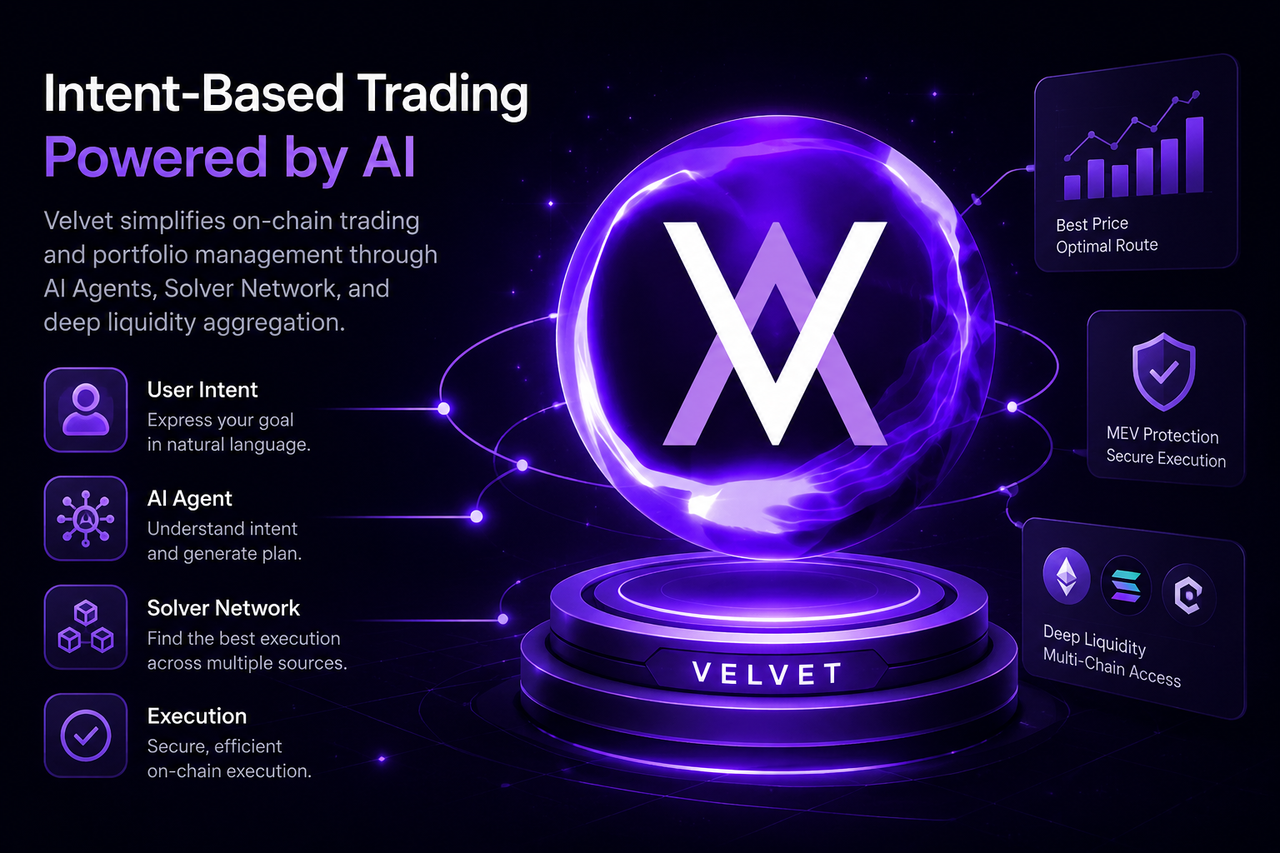
Velvet's Intent-Based Trading architecture consists of four main layers: the User Layer, the AI Agent Layer, the Solver Network, and the Execution Layer. Each module handles distinct responsibilities, working together to complete the full process from user request to on-chain execution.
The User Layer is responsible for receiving user goals rather than specific trading instructions. For instance, a user can directly state a desire to build a particular asset portfolio or gain exposure to a specific market. The system then converts these requests into standardized trading intents.
The AI Agent Layer interprets user needs and transforms natural language or simple operational requests into executable on-chain tasks. The AI Agent also analyzes potential execution strategies by incorporating market data, asset status, and liquidity conditions.
The Solver Network is tasked with finding the optimal execution path. Multiple Solvers simultaneously evaluate different protocols and liquidity sources, comparing prices, transaction costs, and execution efficiency, then generate competing solutions.
The Execution Layer submits the final solution to the blockchain to complete the transaction and returns the result to the user. The entire process runs automatically in the background, requiring no user involvement in complex technical details.
What Happens after a User Submits an Intent?
When a user submits a trading goal in Velvet, the system first generates a standardized trading intent. For example, if a user wants to convert a portion of their stablecoins into an AI-themed asset portfolio, the system identifies this goal without requiring the user to specify which exact assets to buy.
Next, the AI Agent parses the user's request and, considering asset size, market conditions, and potential risk parameters, generates a preliminary execution plan. The system analyzes the relationship between the user's goal and current market conditions to find the most suitable execution strategy.
After analysis, the intent is broadcast to the Solver Network. Multiple Solvers simultaneously attempt to find the best execution path, evaluating liquidity sources, transaction costs, and expected slippage.
Once verified, the optimal solution proceeds to the on-chain execution phase. When the transaction completes, the result is returned to the user interface, updating the relevant asset status and portfolio allocation. To the user, the entire process appears as a simple goal input, while the underlying execution is handled automatically by the system.
How Does the Solver Find the Best Execution Path?
The Solver can be understood as the intelligent execution engine within the Velvet ecosystem. Its core responsibility is to find, among many possible options, the execution path that best aligns with the user's goal.
To achieve this, the Solver analyzes information across multiple dimensions simultaneously. First, the system assesses the depth of different liquidity pools, because the more liquid a pool is, the smaller the price impact of a trade typically is.
Second, the Solver compares the potential slippage costs of different routes to improve execution price stability. When a trade involves multiple chains or protocols, the system also calculates Gas costs and the time and expense required for cross-chain bridging.
Execution success rate is also a key consideration. Compared to solutions that offer a theoretically better price but lower stability, the Solver tends to favor routes that can reliably complete the transaction. Therefore, the best execution path is not necessarily the one with the lowest absolute price, but the optimal result after weighing cost, efficiency, and success rate.
How Does Velvet Aggregate Liquidity?
Velvet does not rely on a single liquidity source. Instead, it connects to multiple DeFi protocols and trading markets through an aggregation mechanism. The system can simultaneously access decentralized exchanges, automated market maker pools, trading aggregators, and cross-chain liquidity networks, thereby expanding the coverage of available liquidity.
This aggregation model allows Velvet to find trading opportunities across a broader market environment. For standard trades, the system can automatically select the execution path with the most favorable price and cost.
In large-volume trading scenarios, Velvet can also reduce price impact by splitting the trade route or drawing on multiple liquidity sources, thereby improving overall execution efficiency. This capability is a crucial foundation for the automated optimization enabled by Intent-Based Trading.
How Does Velvet Reduce MEV Risk?
MEV (Maximal Extractable Value) is a common issue in the on-chain trading environment. Attackers may exploit transaction ordering advantages to carry out front-running, sandwich attacks, or other forms of value extraction.
Velvet's Intent-Based Trading incorporates a series of mechanisms in its design to mitigate these risks. Since the user submits a final goal rather than a complete execution path, external observers find it more difficult to predict transaction details in advance, reducing the likelihood of being targeted.
The competitive mechanism among multiple Solvers also diminishes the risk of a single party controlling the execution process. At the same time, the system prioritizes liquidity sources with higher security and stability, and reduces trade exposure through path optimization.
While Intent-Based Trading cannot completely eliminate MEV, it can mitigate the impact of related attacks to a certain degree, improving the user's execution experience.
How Do Intent-Based Trading and Traditional Swaps Differ?
| Comparison Dimension |
Intent-Based Trading |
Traditional Swap |
| User Input Method |
Expresses the final goal |
Specifies concrete actions |
| Path Planning |
Automated by system |
Done manually by user |
| Liquidity Search |
Automatic aggregation |
User manually selects |
| AI Support |
Supports AI Agent |
Typically not supported |
| Multi-Protocol Coordination |
Automated |
User operates independently |
| Barrier to Entry |
Relatively low |
Relatively high |
| Execution Efficiency |
High |
Depends on user experience |
These two models represent different stages of DeFi user experience. Traditional swaps emphasize user control over the execution process, while Intent-Based Trading prioritizes automation and intelligent execution.
Conclusion
Velvet's Intent-Based Trading, through its AI Agent, Solver Network, and liquidity aggregation technology, transforms complex on-chain transactions that traditionally required manual user input into a simple expression of goals. Users only need to describe the outcome they want to achieve, and the system automatically finds the best execution path and completes the trade. As a vital part of the DeFAI ecosystem, this intent-driven model is pushing decentralized finance from manual operations toward intelligent execution, laying the groundwork for future AI Agent-powered financial services.
FAQs
What is the biggest difference between Intent-Based Trading and traditional trading?
Intent-Based Trading requires users to express their final goal, while traditional trading requires users to specify the exact execution steps and trading path themselves. The system handles path planning and execution, reducing user complexity.
Does Velvet's Intent-Based Trading rely on AI?
Velvet uses an AI Agent to parse user needs and generate execution plans, but the final transaction is still completed through on-chain infrastructure and the Solver Network. AI's primary role is understanding intent and optimizing the execution process.
What role does the Solver play in Velvet?
The Solver is Velvet's execution optimization module, responsible for finding the best path to achieve the user's goal. The system comprehensively compares factors such as price, liquidity, Gas costs, slippage, and execution success rate.
Does Intent-Based Trading support cross-chain transactions?
One of Intent-Based Trading's design goals is to simplify cross-chain operations. Therefore, it can work in coordination with cross-chain liquidity networks and bridging infrastructure, reducing the need for users to manually handle cross-chain processes.
Can Intent-Based Trading completely eliminate MEV?
Intent-Based Trading cannot fully eliminate MEV, but by hiding the execution path, introducing a competitive Solver mechanism, and optimizing trade execution methods, it can reduce the impact from some MEV attacks.







