What Is the Bitcoin Whitepaper?

Image: https://bitcoin.org/bitcoin.pdf
The Bitcoin Whitepaper, authored by Satoshi Nakamoto and published on October 31, 2008, is a seminal paper titled “Bitcoin: A Peer-to-Peer Electronic Cash System.” This document introduced a peer-to-peer electronic cash system, with its core innovation being a decentralized blockchain network designed to solve the double-spending problem. It enables transactions to be validated by participants globally, eliminating the need for a central authority.
This whitepaper established the foundation for both Bitcoin and blockchain technology. Although it received little attention at its release, it has since become regarded as the “bible” of the entire crypto market. Today, any discussion of Bitcoin’s technical origins or network value typically begins with the whitepaper.
Core Concepts and Technical Contributions of the Whitepaper
The Bitcoin Whitepaper’s key technical contributions can be summarized as follows:
- Decentralized consensus mechanism: Implements Proof-of-Work to guarantee transaction security and irreversibility.
- Peer-to-peer transactions: Enables users to transfer funds directly without third-party intermediaries, significantly reducing trust costs.
- Transparent and immutable ledger structure: Records all transactions on the blockchain, creating a globally auditable and transparent system.
- Limited supply and inflation resistance: Caps the total supply of Bitcoin at 21 million, with an economic model that incentivizes long-term holding and value preservation.
These principles not only shaped Bitcoin’s architecture but also inspired countless subsequent crypto projects to explore distributed systems, economic incentives, and decentralized governance.
Current Bitcoin Price Trends and Market Sentiment
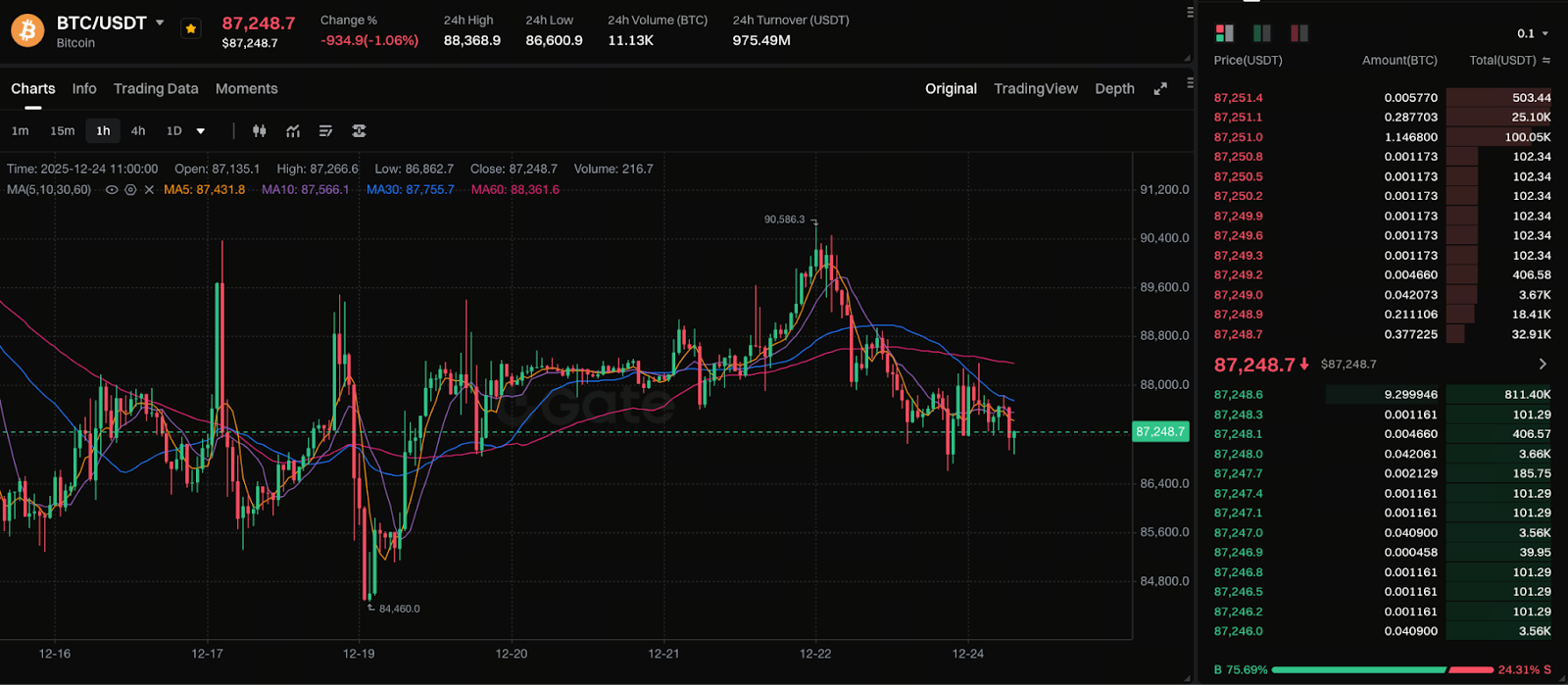
Image: https://www.gate.com/trade/BTC_USDT
Based on the latest market data from 2025, Bitcoin’s price has exhibited complex volatility. By the end of December 2025, BTC had fallen sharply to around $86,500, driven by factors such as stricter mining regulations. Technical indicators show that market sentiment remains cautious in the short term. Some analysts believe that if price support fails, a deeper correction may follow.
At the same time, historical data shows that Bitcoin’s price has experienced significant swings under the influence of institutional investors and macroeconomic conditions. For instance, some institutions projected that in an optimistic scenario, Bitcoin could surpass $150,000 or higher, though recent trends have been more divided.
In summary, BTC’s short-term market performance is shaped by macroeconomic data—such as Federal Reserve policies and employment statistics—as well as developments in the mining ecosystem.
The Relationship Between the Whitepaper and Price Trends
Many investors and analysts seek to identify a link between the publication of the Bitcoin Whitepaper and BTC’s price movements. In reality, the whitepaper itself does not drive price; however, the technology and foundational beliefs it represents play a decisive role in long-term price trends:
- Long-term value support: The whitepaper’s decentralized value storage concept has led to Bitcoin being recognized as “digital gold,” establishing a logical foundation for long-term price appreciation.
- Market confidence symbol: Since its inception, the Bitcoin network has never experienced downtime, demonstrating the reliability of its design and reinforcing confidence among both institutional and retail investors.
- Integration of technology and economics: By merging monetary economics with computer networks, the whitepaper provides theoretical support for BTC’s supply constraints and value growth.
In essence, the whitepaper serves as the benchmark framework for assessing Bitcoin’s value, while price trends reflect the market’s real-time response to this framework.
How Should Investors Assess the Whitepaper’s Value?
For investors, understanding the Bitcoin Whitepaper is not just about technical details—it’s about interpreting Bitcoin through its technological underpinnings:
- Understanding decentralization and network effects: The peer-to-peer transaction network described in the whitepaper is one of BTC’s most significant competitive advantages.
- Supply and economic incentive model: Bitcoin’s scarcity and incentive structure underpin its long-term value potential.
- Risk and volatility: While short-term prices are driven by market sentiment and macro factors, long-term trends typically align with the supply-demand logic outlined in the whitepaper.
Therefore, both institutions and retail investors should base their value analysis and strategy development on the foundational principles set forth in the whitepaper.
Conclusion: The Lasting Significance of the Bitcoin Whitepaper
The Bitcoin Whitepaper is more than a technical document—it marks the beginning of economic and social innovation. From its publication in 2008 to 2025, despite price fluctuations, its influence on the crypto industry remains undiminished. It has redefined financial assets and established a global consensus around a decentralized, verifiable, and immutable value system.
Regardless of how BTC’s price moves in the future, understanding the concepts and design logic of the Bitcoin Whitepaper remains essential for anyone seeking to grasp the digital asset ecosystem.







