Is Dogecoin a Stablecoin? In-Depth Analysis of DOGE’s Attributes and Market Position

Beginner
Quick Reads
Last Updated 2026-04-03 15:33:05
Reading Time: 1m
Is Dogecoin a stablecoin? Drawing on the latest market trends and updates as of July 2025, this article provides an in-depth analysis of the distinctions between Dogecoin and stablecoins, and explains why DOGE does not qualify as a stablecoin.

What Are Stablecoins?

Stablecoins are a distinct type of cryptocurrency whose value is pegged to relatively stable assets, such as the US dollar, euro, or gold. Their main objective is to maintain price stability and reduce risks during transactions or as a store of value. Common stablecoins like USDT, USDC, and DAI achieve their stability through methods such as fiat reserves, over-collateralization with crypto assets, or algorithmic mechanisms.

For example, USDT (Tether) is issued based on a 1:1 fiat reserve ratio, with each USDT typically backed by an equivalent amount of US dollar reserves. Its price fluctuations are minimal, usually not exceeding 0.5% within a 24-hour window. This level of stability has made it widely used for cross-border transfers, on-chain hedging, and DeFi staking.

The Origins and Uses of Dogecoin

Dogecoin (DOGE) was launched in 2013 as a lighthearted cryptocurrency, originally created as a meme joke by Billy Markus and Jackson Palmer. Its iconic Shiba Inu logo quickly went viral, giving rise to a community known for humor and inclusivity.

While Dogecoin lacks significant technical innovation, it has found applications in microtransactions and social tipping. Tesla CEO Elon Musk’s repeated endorsements have propelled Dogecoin into the global spotlight, making it a recurring topic in the market.

However, Dogecoin’s design did not prioritize price stability. Its inflationary model, unlimited total supply, and susceptibility to public sentiment set it apart fundamentally from stablecoins.

Dogecoin Price Review: July 2025
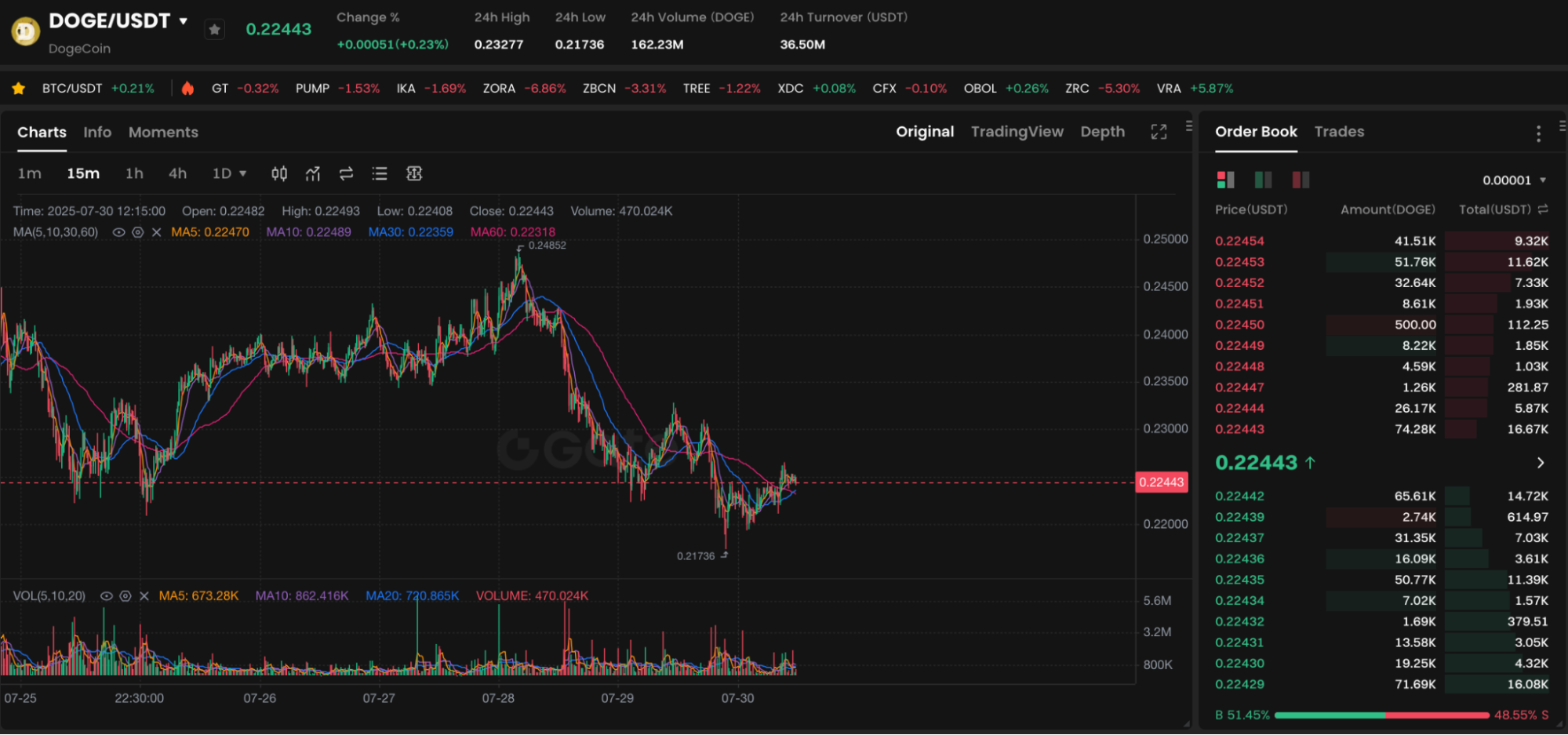

Chart: https://www.gate.com/trade/DOGE_USDT

As of July 30, 2025, Dogecoin was trading at $0.2248, down 1.2% over the past 24 hours. While this price move is relatively modest, Dogecoin’s monthly volatility can exceed 10%. For instance, in early July, Dogecoin surged more than 17% amid rumors of integration with social platform X’s payment system, only to sharply pull back as the market took profits.

Such dramatic price swings are almost unheard of with stablecoins. Over the same period, USDC’s value fluctuated less than 0.3% around its $1 peg. This starkly highlights that Dogecoin lacks the “price-pegged” stability that defines a stablecoin.

Is Dogecoin a Stablecoin?

Across multiple dimensions, the answer is no.

1. Dogecoin is not backed by fiat reserves and does not employ any algorithmic mechanism for price stability; its value is determined entirely by market supply and demand—unlike most stablecoins.

2. Dogecoin’s price is highly volatile and easily influenced by celebrity endorsements, social media buzz, and speculative sentiment. For example, a single supportive tweet from Elon Musk can send DOGE’s price soaring in minutes, while negative sentiment can trigger rapid declines.

3. Dogecoin was never intended to be “price-stable.” Instead, it serves as an internet culture icon—a product of community tipping, online humor, and hype culture. This contrasts sharply with stablecoins like USDT and DAI, which are designed for cross-border settlement and risk mitigation.

Therefore, based on its technical design, price behavior, and application, Dogecoin cannot be classified as a stablecoin.

Dogecoin’s Potential and Risks as a Payment Method

Although some businesses now accept Dogecoin for payments—including certain e-commerce platforms, restaurants, and social platform X—and some developers are working to integrate it into broader payment ecosystems, substantial challenges remain for Dogecoin’s viability as a payment method.

The primary risks include:

  • Significant price volatility, which can cause value swings between initiation and completion of payment, impacting merchants and users alike.
  • Slow network development and upgrades, limiting its ability to support large-scale payment use cases.
  • Lack of institutional backing and less robust trust mechanisms compared to stablecoins.

In contrast, stablecoins offer clear advantages for cross-border payments and on-chain settlements due to their price stability and transparent reserve frameworks.

Investment Recommendations and Conclusion

Dogecoin is a crypto asset with strong community backing, especially among fans of meme culture. However, it is not a stablecoin and does not offer price stability. For beginner investors, allocating a small portion of funds to Dogecoin for speculation or entertainment may be reasonable. But for those seeking asset preservation or reliable payments, stablecoin products such as USDT and USDC are better suited.

Dogecoin’s existence demonstrates the diversity of the crypto world, but it’s essential to understand its core features. While keeping up with trends, investors must remain rational and actively manage their risks.

Author: Max
Disclaimer
* The information is not intended to be and does not constitute financial advice or any other recommendation of any sort offered or endorsed by Gate.
* This article may not be reproduced, transmitted or copied without referencing Gate. Contravention is an infringement of Copyright Act and may be subject to legal action.

Related Articles

AI-Native Settlement Layers: How United Stables Is Building the Next Financial Rail
Beginner

AI-Native Settlement Layers: How United Stables Is Building the Next Financial Rail

Stablecoins were originally designed as dollar substitutes within exchanges, primarily used for asset pricing and trade settlement. As on-chain financial ecosystems have matured, their role has expanded beyond simple payments to include collateral assets, cross-chain liquidity mediums, and unified settlement units. In particular, as AI systems and automated agents begin to participate directly in economic activity, demand has risen sharply for programmable value units capable of instant settlement. This shift is pushing stablecoins toward the role of foundational financial infrastructure.
2026-03-25 03:16:17
The ve(3,3) Flywheel Explained: How AERO Tokenomics Powers Aerodrome’s DeFi Economy
Beginner

The ve(3,3) Flywheel Explained: How AERO Tokenomics Powers Aerodrome’s DeFi Economy

In the competition for DeFi liquidity, high-inflation mining alone is no longer enough to build lasting advantages. Aerodrome applies the ve(3,3) economic model to redesign token emissions, voting mechanisms, and revenue distribution, creating a liquidity flywheel centered on governance and cash flow. This article examines AERO tokenomics, the veAERO locking mechanism, and protocol revenue models to explain how Aerodrome builds a sustainable DeFi economic system.
2026-03-25 06:41:58
How Does PAXG Work? In-Depth Overview of the Physical Gold Tokenization Mechanism
Beginner

How Does PAXG Work? In-Depth Overview of the Physical Gold Tokenization Mechanism

PAXG (Pax Gold) is a tokenized asset backed by physical gold, issued by the fintech company Paxos and traded on the Ethereum blockchain as an ERC-20 token. The core concept is to tokenize physical gold on-chain, with each PAXG token representing ownership of a certain amount of gold. This structure enables investors to hold and trade gold in the form of a digital asset.
2026-03-24 19:12:51
Aerodrome Tokenomics: How ve(3,3) Powers Base's Most Profitable DEX
Beginner

Aerodrome Tokenomics: How ve(3,3) Powers Base's Most Profitable DEX

AERO is the native token of Aerodrome Finance, a core decentralized exchange and liquidity protocol in the Base ecosystem. It is primarily used for liquidity incentives and ecosystem operations. veAERO is a governance NFT that users receive by locking AERO, representing both voting power and the right to share protocol revenue. Through a dual track structure of AERO as a utility token and veAERO as a governance credential, Aerodrome separates liquidity usage value from long term governance power, allowing participants to act as liquidity providers, governance decision makers, and revenue sharers within the same system.
2026-03-25 06:40:31
How is the price of PAXG determined? Pegging mechanism, trading depth, and influencing factors
Beginner

How is the price of PAXG determined? Pegging mechanism, trading depth, and influencing factors

PAXG (Pax Gold) is a tokenized asset backed by physical gold reserves, launched by fintech firm Paxos and issued as an ERC-20 token on the Ethereum blockchain. The core concept is to digitally represent real-world gold assets, allowing investors to hold and trade gold via the blockchain network. Because each PAXG token corresponds to a specific quantity of physical gold, its price is theoretically expected to closely track the global gold market.
2026-03-24 19:11:40
Hybrid Collateral Stablecoins: Inside United Stables' Stability and Yield Architecture
Beginner

Hybrid Collateral Stablecoins: Inside United Stables' Stability and Yield Architecture

In the early stages of the crypto market, traditional stablecoins mainly relied on single-reserve or single-collateral models. Their primary focus was price stability and payment convenience, which allowed them to become foundational tools for on-chain trading and capital flows. As the market has entered a more mature financial phase, however, this structure has begun to reveal limitations, including high concentration risk and the difficulty of balancing liquidity with yield. These constraints have driven the evolution toward multi-layer collateral and portfolio-based designs, such as the dual-layer hybrid collateral architecture proposed by United Stables, which seeks to redefine the underlying logic of stable assets.
2026-03-25 03:17:39





